Indoor wedding arches run from copper pipe you cut yourself to chandelier rigs that need a venue electrician, and the right choice depends on whether your ceremony is afternoon or evening.
Candlelit arches need enough mass to read in a ballroom, while LED panels wash out entirely under afternoon sun through windows.
1. Hanging Floral Garden

Flowers hung from above turn the ceiling into part of the ceremony.
Weight and suspension matter most: a beam or rigging point rated for the load, sheer fabric layered in to soften the hardware, and blooms positioned to read as descending rather than dangling.
I would check with the venue first; many historic spaces lack the infrastructure, and a freestanding frame that rises to meet the hanging pieces changes the whole budget.
For couples in raw studios or industrial lofts, this is the option that uses what the room already gives you.
2. Greenery Garland Arch
Eucalyptus or ferns wired along a simple frame give you the arch without the flower bill.
The garland approach scales well: a small circle arch carries a modest run of greenery, a larger rectangular frame takes far more, and the cost moves almost linearly.
I like this for indoor spaces with strong architecture already, where the arch frames rather than competes.
A single variety reads cleaner than mixed foliage; eucalyptus holds its color longest out of water, which matters for morning setup and evening ceremony.
3. Drapery Wedding Arch
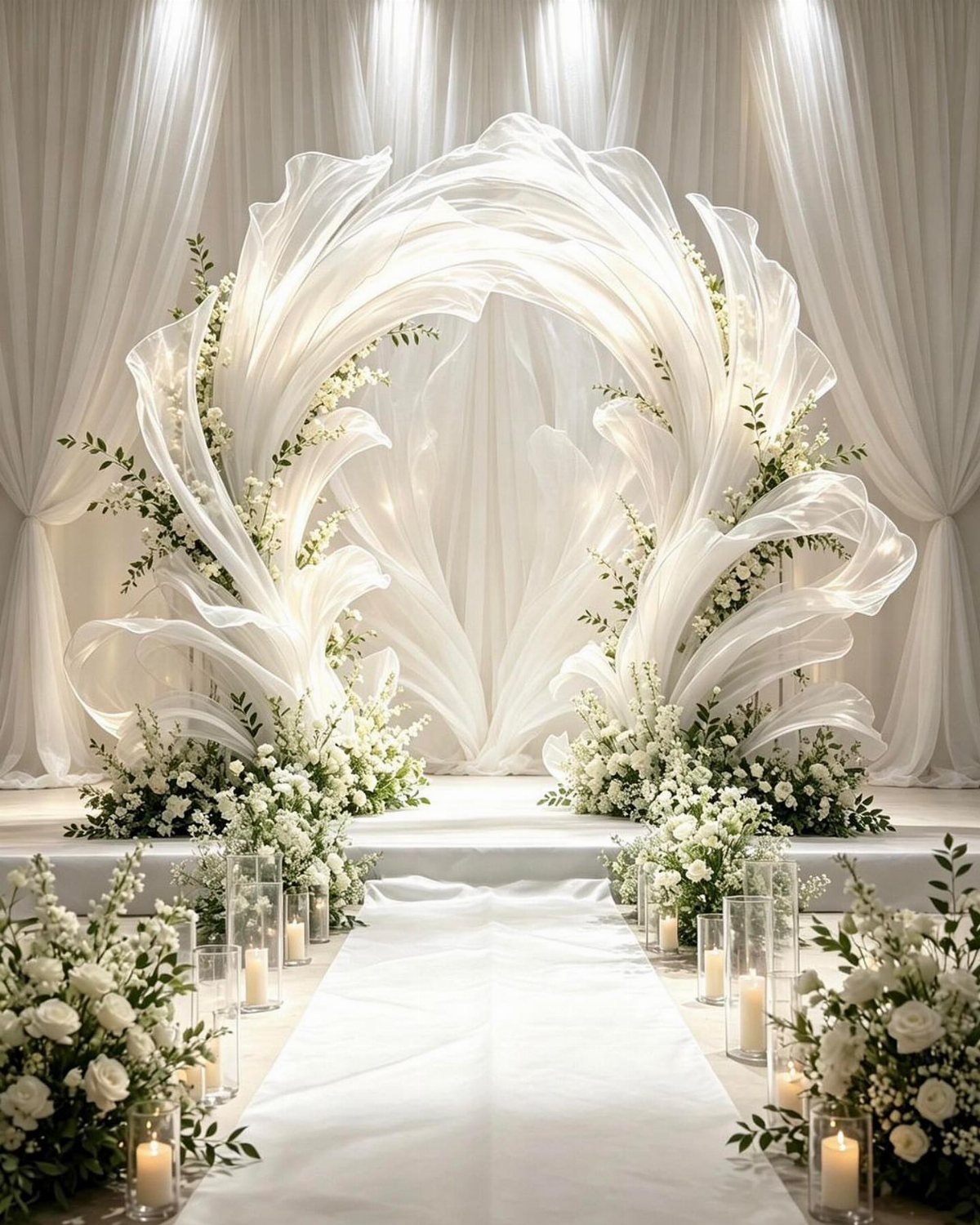
Chiffon or tulle gathered at intervals creates the swags the eye reads as movement.
The fabric does the work here, so the frame underneath can be plain pipe and drape; what you pay for is yardage and the labor to dress it.
I would ask the draper to show me a knot sample before the day: too loose and the wind from a vent sends everything swaying, too tight and the romance flattens out.
This suits ballrooms and hotel spaces where the room itself has little character to borrow.
4. Rustic Wooden Arch
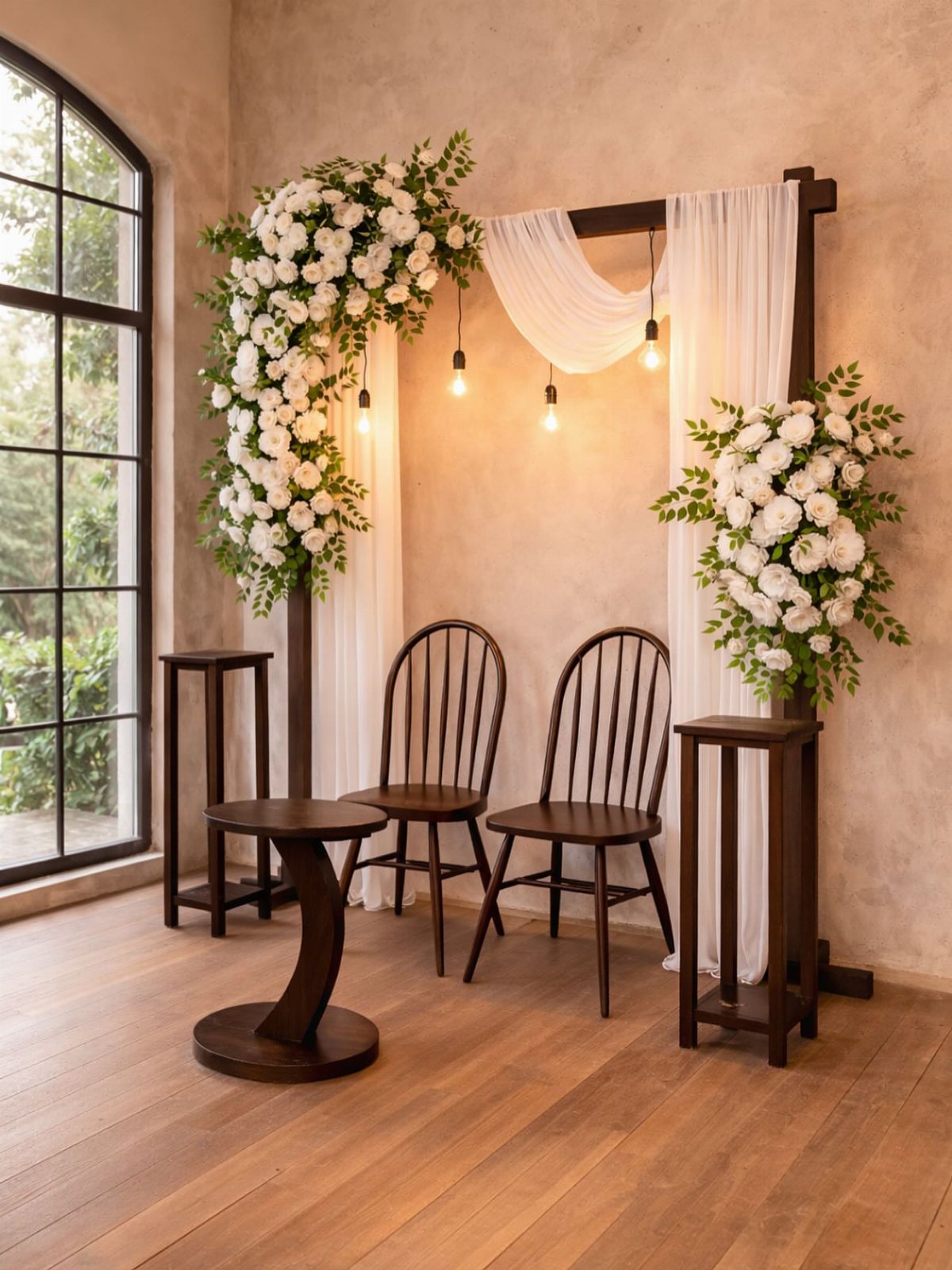
A wooden frame with Edison bulbs and soft drape sits in the space between rustic and refined.
The logs or timber pieces ground the ceremony area, and the lights matter more than you would think: they warm the white of the fabric and cast a skin tone most fluorescents kill.
I have seen this built from rental warehouse pieces and from a friend’s farm cut; the second route saves money only if you have someone who can level and secure the joints.
For barn venues or winter weddings, this is the one that feels like it belongs.
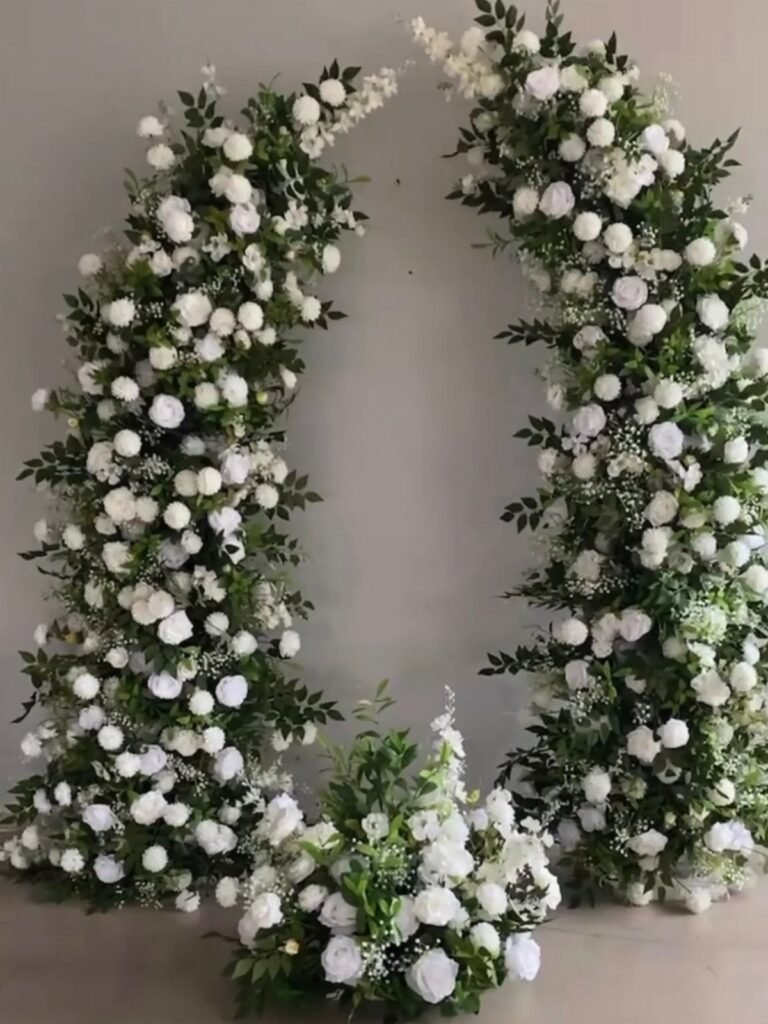
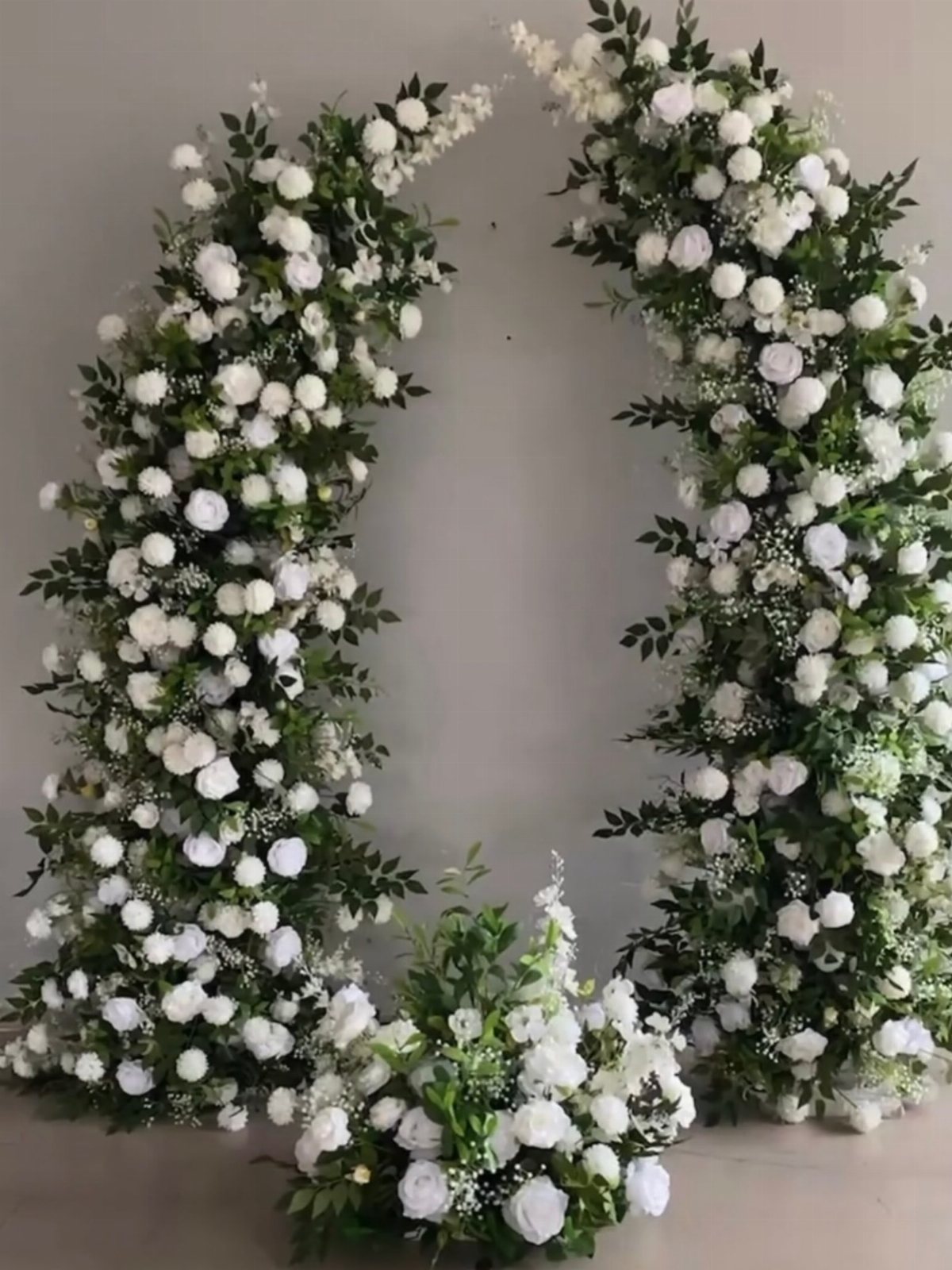
5. Circle Wedding Arch
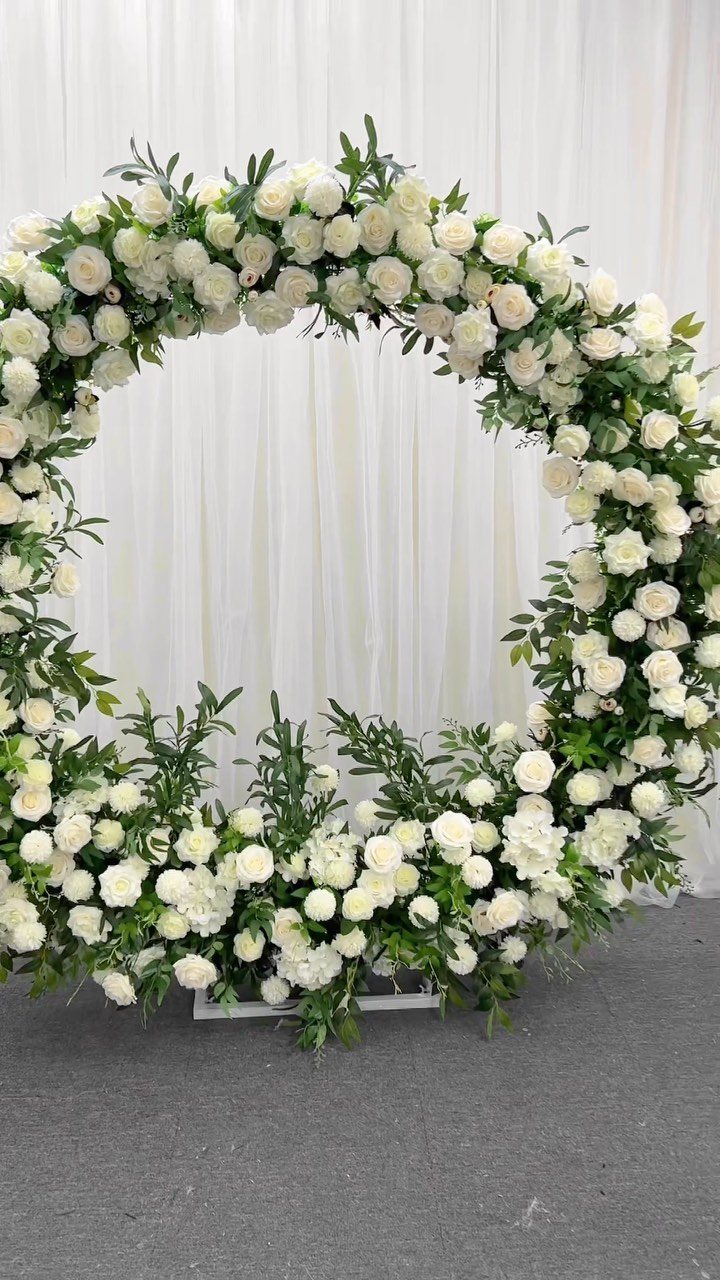
A circle reads as a wreath you stand inside, and that shape carries its own meaning without any explanation needed.
I would watch the diameter; a smaller circle feels intimate, a mid-size lets the couple and officiant breathe, and anything larger starts to dwarf the room.
This translates across styles, from desert minimal to English garden, which is why it has stayed popular.
6. Floral Fantasy Arch

Roses, peonies, or wildflowers packed tight to the frame until no black metal shows: that density is what makes the fantasy work. Seasonal blooms keep the cost from multiplying; out-of-season peonies ship from Chile and the price triples.
I would bring photos of the bouquet to the florist so the arch and what you carry match in density and palette, not necessarily in identical stems.
For couples who want the flowers to be the memory, this is where the money goes, and the trade is that the arch itself becomes the photograph.
7. Triangle Wedding Arch
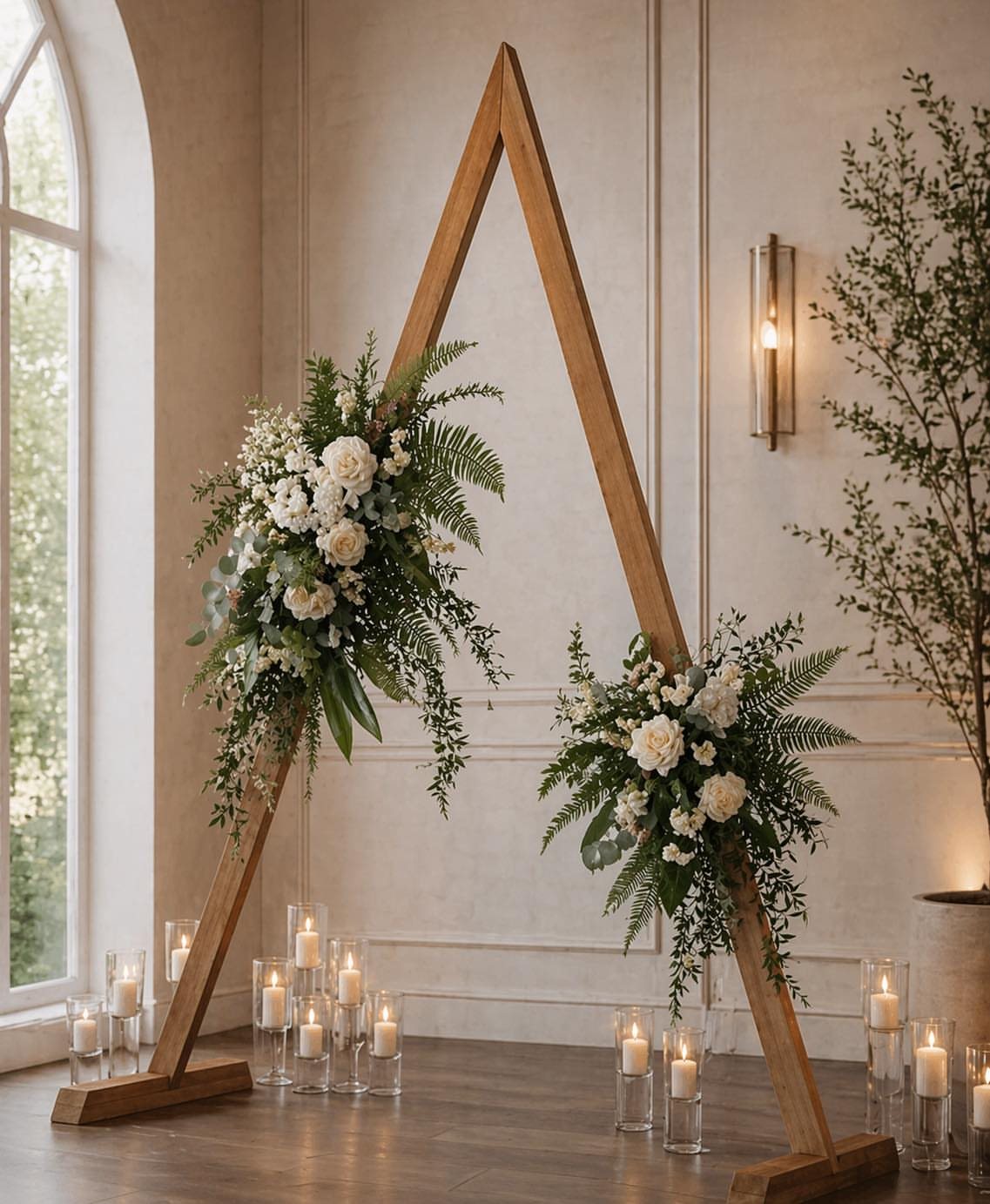
Triangle arches break the rectangle habit without going full circle. Wood frames the shape cleanly, and the three sides give florists something to climb: one side heavy with blooms, another bare, the third draped in fern.
Pampas grass lands here better than on any round frame, the plumes catching the point like a held breath.
Paint the wood if the venue reads modern; leave it raw for barn floors. The geometry asks for asymmetry, so cluster flowers at one corner and let greenery run the rest.
I’d steer a couple toward this when their venue has angles of its own: industrial windows, peaked ceilings, anything that already broke from the box.
8. Natural Wedding Arch
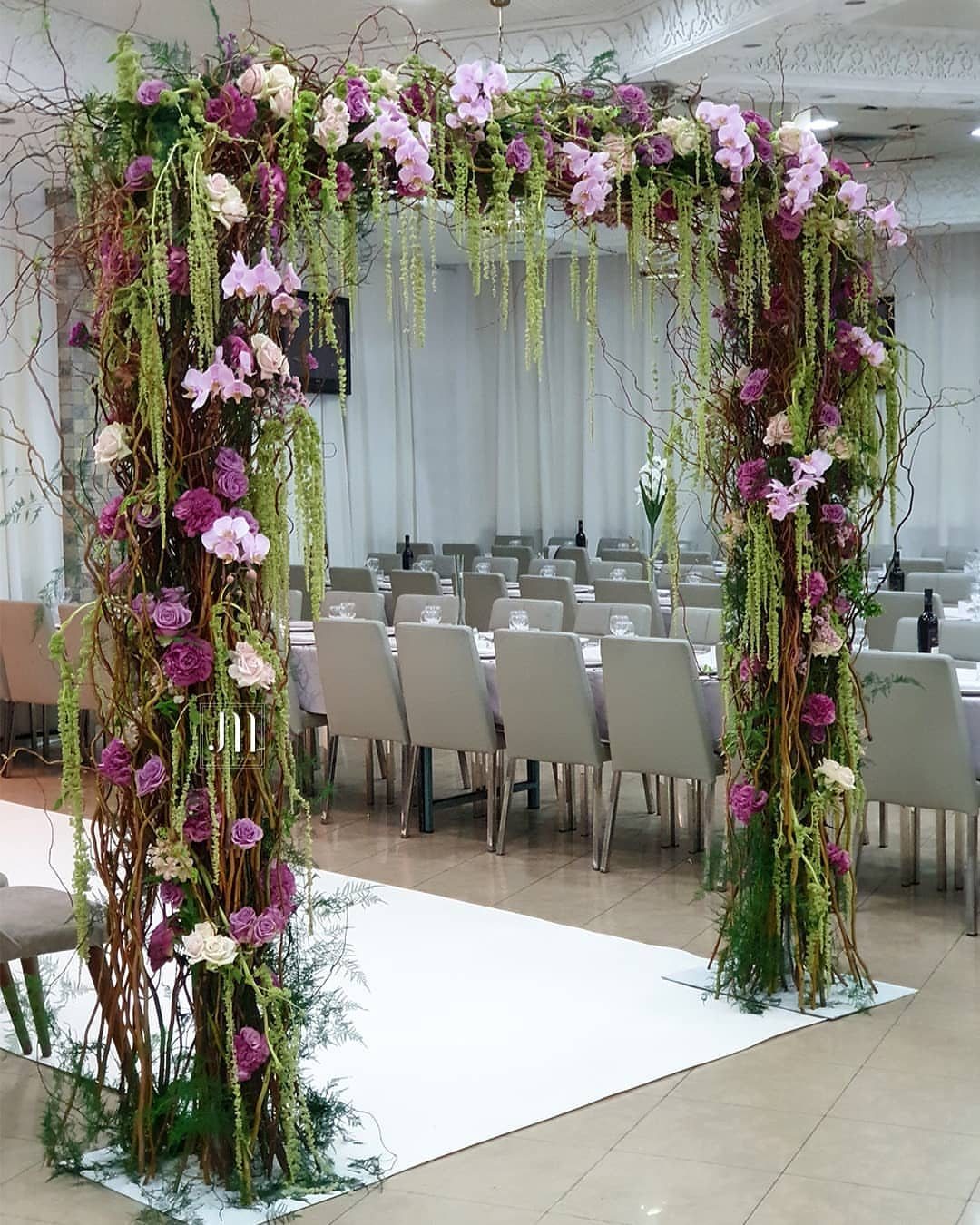
Branches you collect or reclaim shape an arch no rental company owns. The work is in the lashing: twine where limbs meet, tension that holds through the ceremony and the photos after.
Muslin or burlap drapes softens the weave without hiding it; wildflowers tied in bunches finish the thing.
Weight matters more than with built frames. Test the base on your floor surface, and check the venue’s rules about freestanding structures.
Fairy strands through the branches shift the whole look to evening without changing anything else.
This suits a couple whose date overlaps with growing season locally, when roadside blooms or a friend’s cutting garden can fill the gaps without a florist invoice.
“Behind every wedding arch is an engineering feat,” explains Amanda Luu, principal of floral design firm Studio Mondine.
— Vogue
9. Candlelit Arch
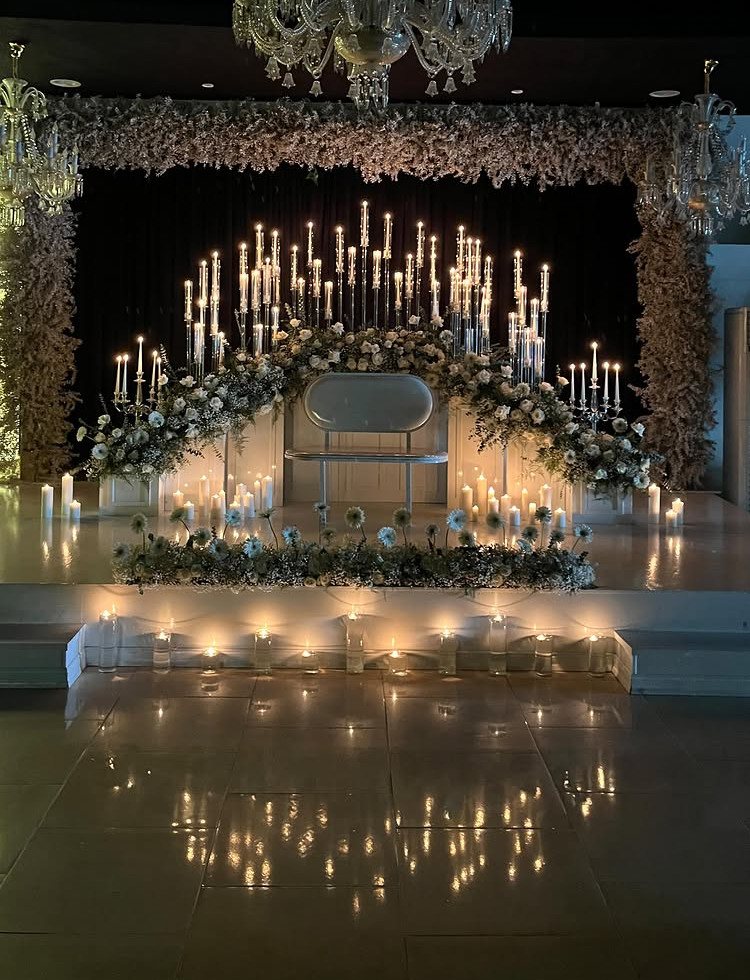
A candle arch trades color for temperature: warm amber against cool venue light, shadows that move.
Pillar heights staggered across the frame, floating bowls at the center, tea lights in glass catching the base: the mix is the trick, same flame repeated at different scales.
Glass cylinders protect the flame from passing hems and contain the wax. The florist’s work sits higher, flowers and greenery lit from below instead of spotlighted from a rig.
Count the candles, then double it. What reads intimate in a small room needs more mass in a ballroom.
I’d limit this to evening ceremonies: afternoon sun makes the flame invisible and the arrangement looks merely white.
10. Velvet Wedding Arch
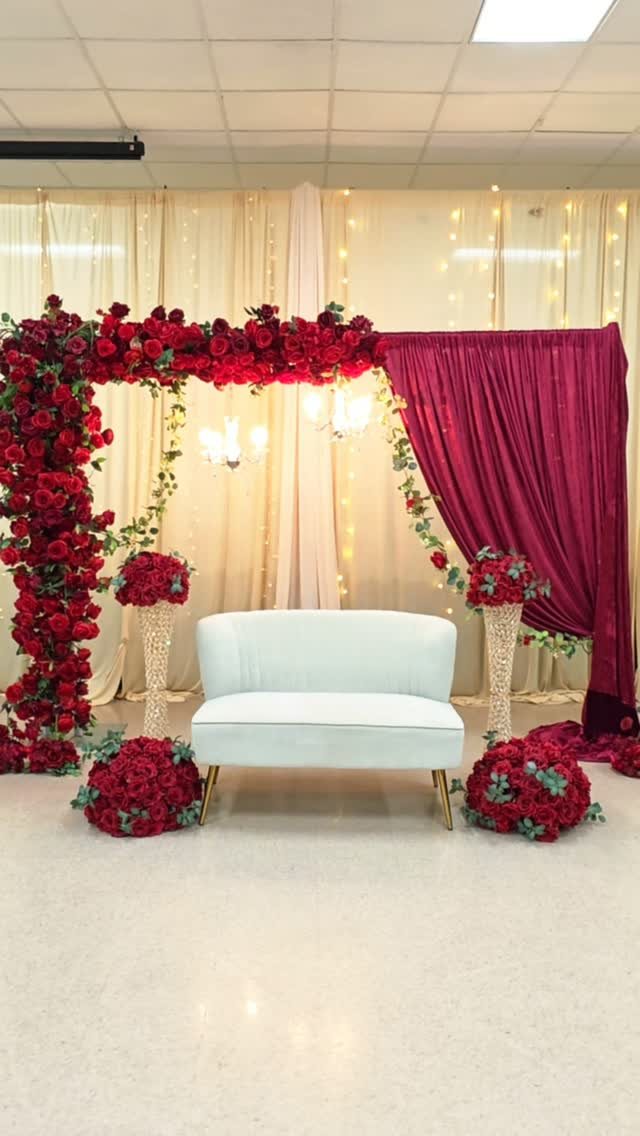
Velvet’s weight solves a problem sheer fabric creates: it hangs once and stays hung, no puffing, no drift. Burgundy against cream, as the visible setup runs, or emerald, sapphire, plum if the palette shifts.
The drape folds thick enough to read as architecture, not decoration.
Fairy strands or a small chandelier overhead pick up the nap of the fabric, light catching the weave differently than on satin or linen. Gold or silver at the tie points sharpens the glamour.
Velvet costs above muslin or chiffon by the yard, and the yardage itself runs higher: the fabric eats light and needs mass to look intentional.
I’d assign this to a winter wedding, when the warmth of the fabric answers the cold outside.
11. Copper Wedding Arch
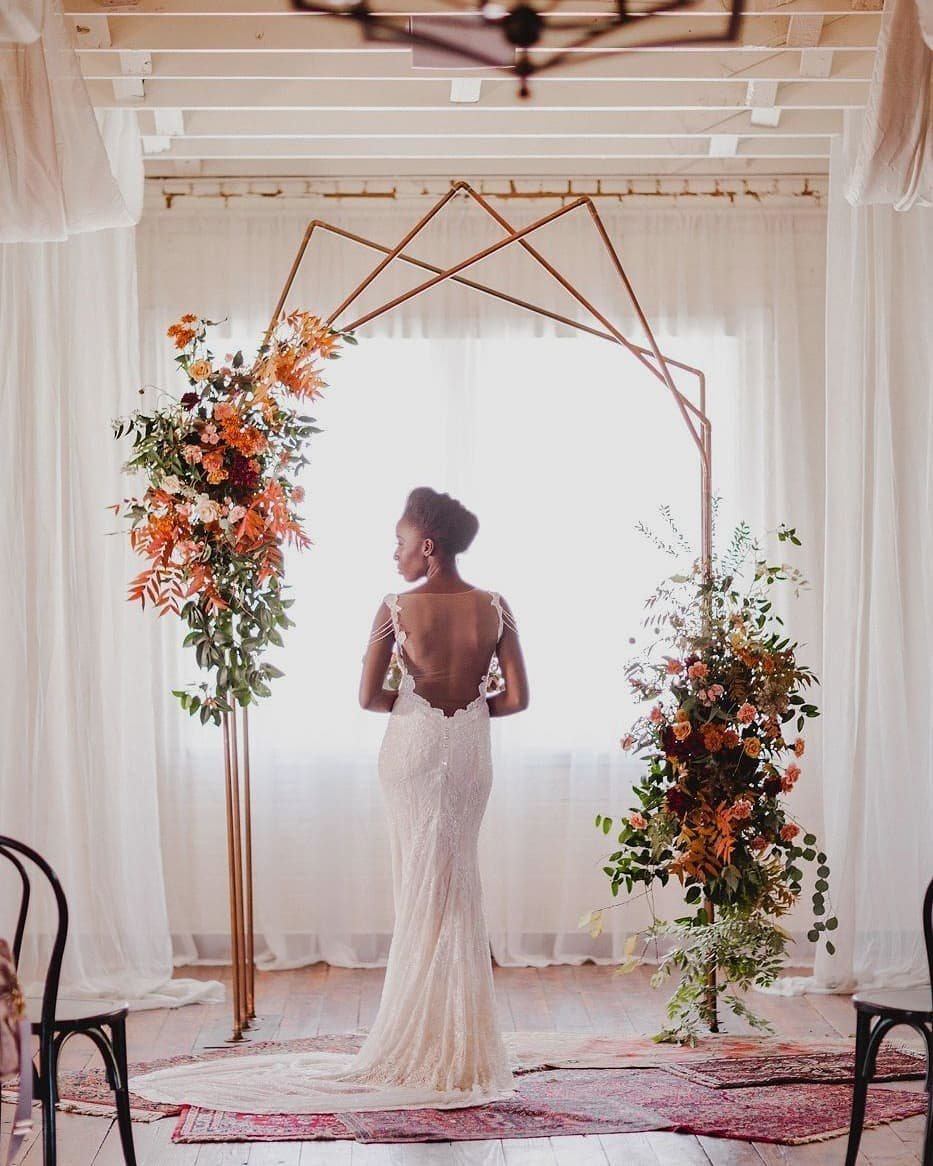
Copper pipe builds a frame that looks finished bare, no paint or stain needed. The metal warms under venue light in a way aluminum or steel does not, and the geometric angles hold their own against floral softness.
Greenery against the copper reads as deliberate contrast, the living and the manufactured.
Fittings at the joints let you adjust height or width to the room. The pipe itself ships from hardware suppliers in standard lengths; a cutter and a plan are the only tools.
Autumn tones in the florals extend the metal’s own warmth, though white and green would push cooler.
This frame travels well: breaks down to pipe lengths, reassembles with fresh flowers at the destination. I’d point destination-wedding couples here, or anyone marrying where rental inventory runs thin.
12. Balloon Arch
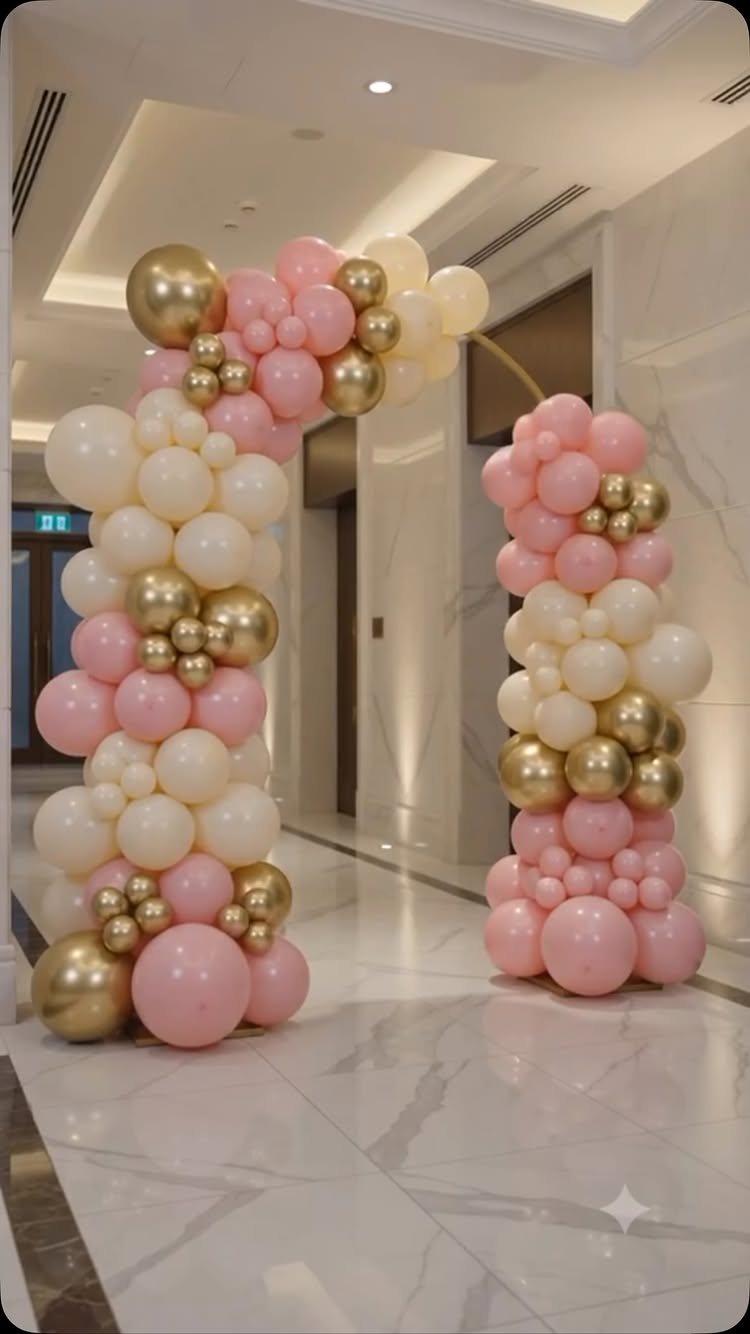
Balloon arches carry a birthday association that wedding color discipline can override. The visible setup runs pink, cream, and metallic gold in tight clusters over a metal frame: the palette signals intention, not party store.
Hoop shapes or paired pillars with a banner between them give structure the random cloud lacks.
The frame matters more than the balloons. Air-filled clusters last the day; helium drifts and fails.
Weight the base, test the doorway clearance, and order 20% extra for pops during setup.
I’d reserve this for a cocktail-hour photo moment or a dessert station marker, not the ceremony itself. The scale reads playful, and playfulness at the altar asks more of the couple than most bring.
For a reception transition or a send-off line, though, the movement and color do work that fabric cannot.
13. Hexagonal Wedding Arch
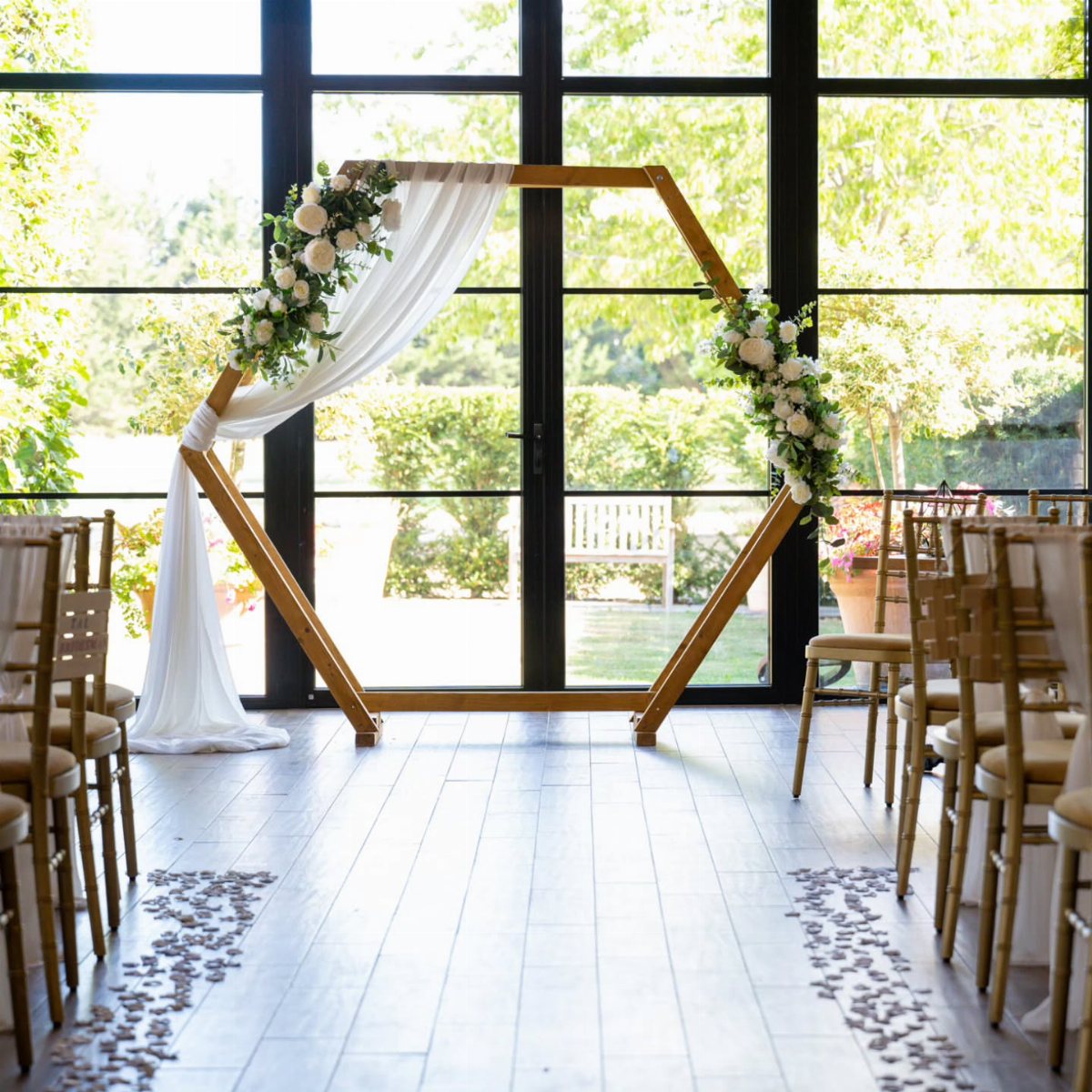
Hexagonal frames give a ceremony more points to decorate than a single opening, which matters when you are working with a plain wall or narrow room and need the arch to read from every angle.
I would build this in wood rather than rent metal if your venue allows it: the weight helps the thing feel permanent, and the grain photographs warm against white fabric.
Drape from the top point downward and let the cloth pool slightly at each corner before it ties; the slight sag is what keeps it from looking like a tent.
Florals go at two opposite corners and the top, not all six, or the geometry disappears under decoration. This one suits couples whose venue is modern enough that a circle feels too soft and a rectangle feels too expected.
14. Geometric LED Arch
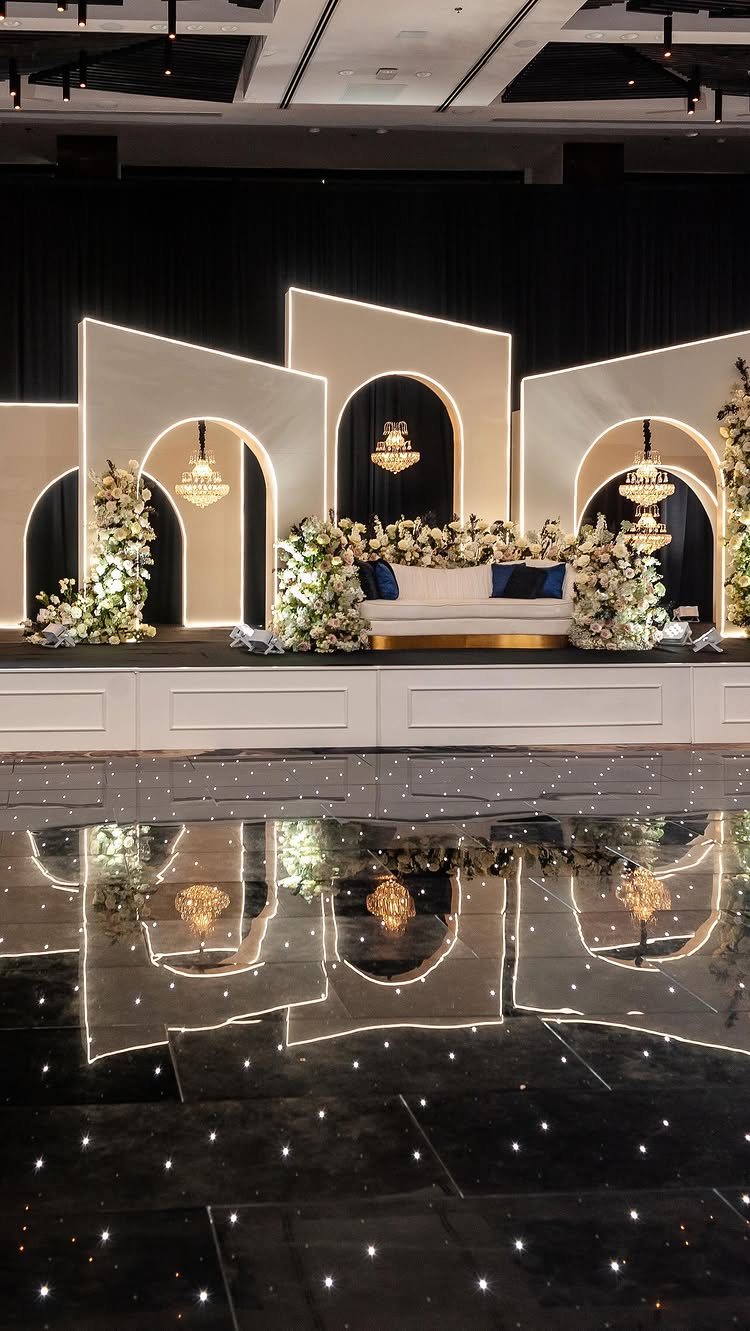
LED border lighting on layered geometric panels turns a ceremony stage into something closer to installation art, which is useful when the room itself has no character worth showing.
The panels are cream and arched, but the idea works in acrylic or painted plywood if your budget runs lower; the lights do the work.
I would keep the florals minimal and low, at the base only, because the glow competes with anything hanging.
Wiring is the part that changes the price: battery strips are simpler but dimmer, and hardwiring means coordinating with your venue’s electrician, which not every place will allow on a Saturday turnaround.
This suits evening ceremonies or rooms with controlled lighting; in afternoon sun through windows, the LEDs wash out and the panels look like bare stage sets.
15. Fabric Panel Arch Backdrop
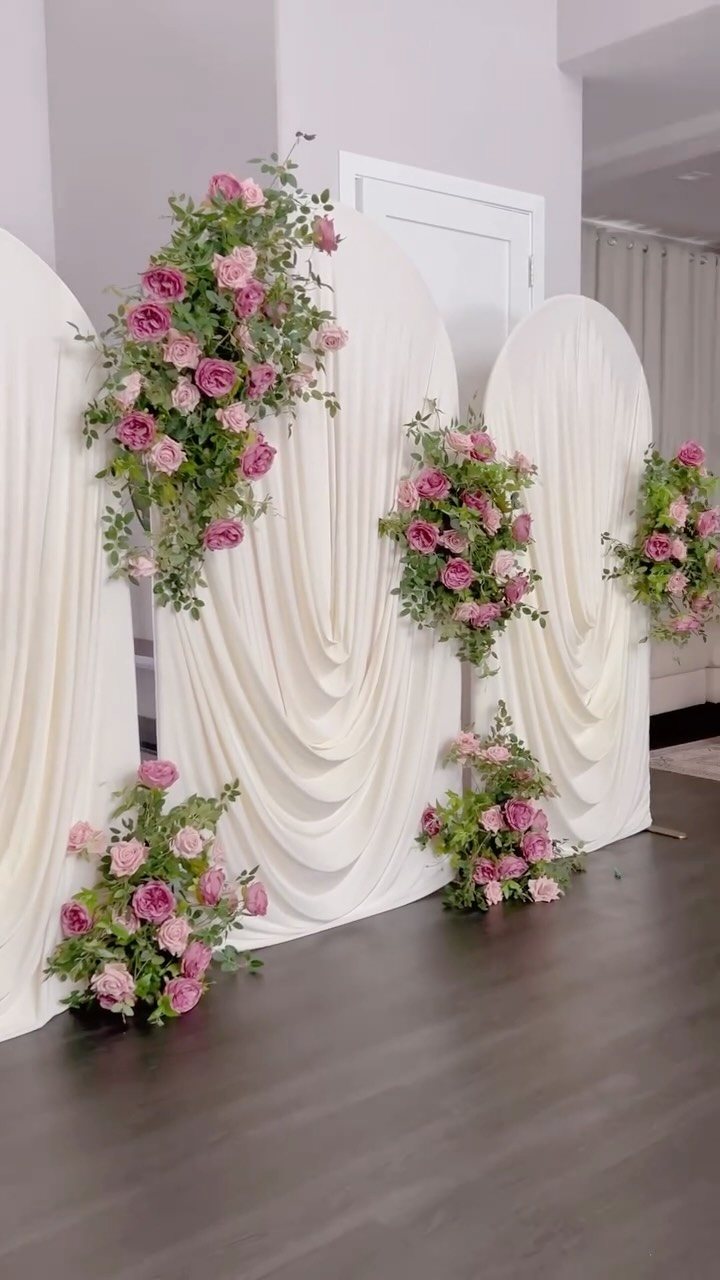
Multiple arched panels let you build a backdrop wide enough to fill a hotel ballroom or cover an ugly stage wall without renting a single oversized piece.
Clusters of pink and mauve roses at different heights keep this from looking like a department store window; symmetry would feel commercial, and the asymmetry is what keeps it personal.
I would use more than two panels; two read as accidental, and too many starts to feel like a fence.
Fabric weight matters more than color: you need something heavy enough to fall straight, because gathered chiffon on a tall panel turns to ribbon candy.
This one trades portability for presence; moving it between ceremony and reception means a crew, not two friends.
16. Hanging Bulb Arch Backdrop
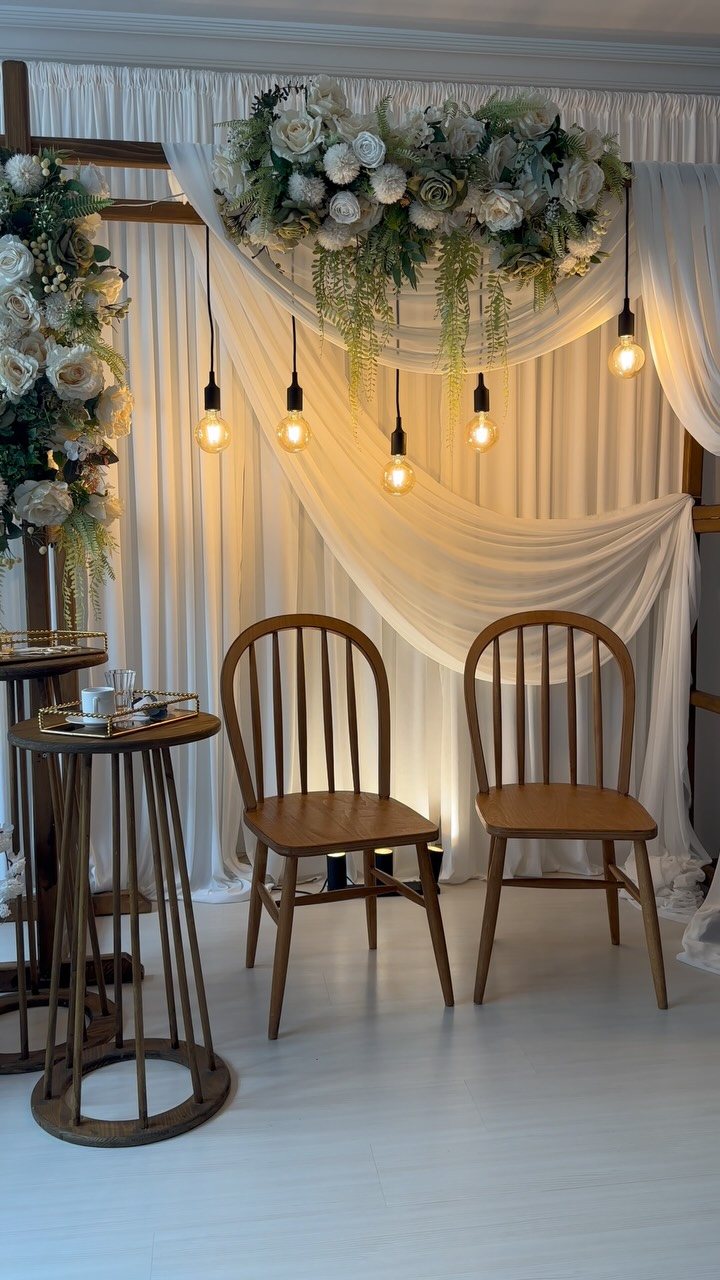
Edison bulbs hanging from a draped fabric backdrop give you the warmth of candlelight without the fire code problems, which is the practical reason this appears so often in converted warehouses and historic buildings.
The bulbs are grouped above the floral arrangement, not spread evenly; I would cluster them tighter than you think, because single bulbs read as sparse from the back row.
The fabric behind needs to be white or very pale to bounce the glow; cream turns muddy under yellow filaments.
You can rent the bulbs and cord on stands, but test the wattage against your photographer’s settings: these bulbs photograph warmer than they appear to the eye, and skin tones can shift orange.
17. Fairy Light Fabric Arch

Fairy lights inside a draped arch solve the problem of daytime ceremonies in rooms that are bright but flat, because the lights show even when they are not the main illumination.
The lights hang within the fabric, not pinned to the front; that placement means the cloth itself glows instead of the bulbs reading as separate dots.
I would use warm white, not cool, against white fabric; cool turns clinical, and colored tips you toward Christmas. The fabric is opaque enough to hide the wires, which is the detail that separates polished from homemade.
This one costs less than the Edison bulb version and sets up faster, though it gives up some of the industrial character.
18. Chandelier Wedding Arch
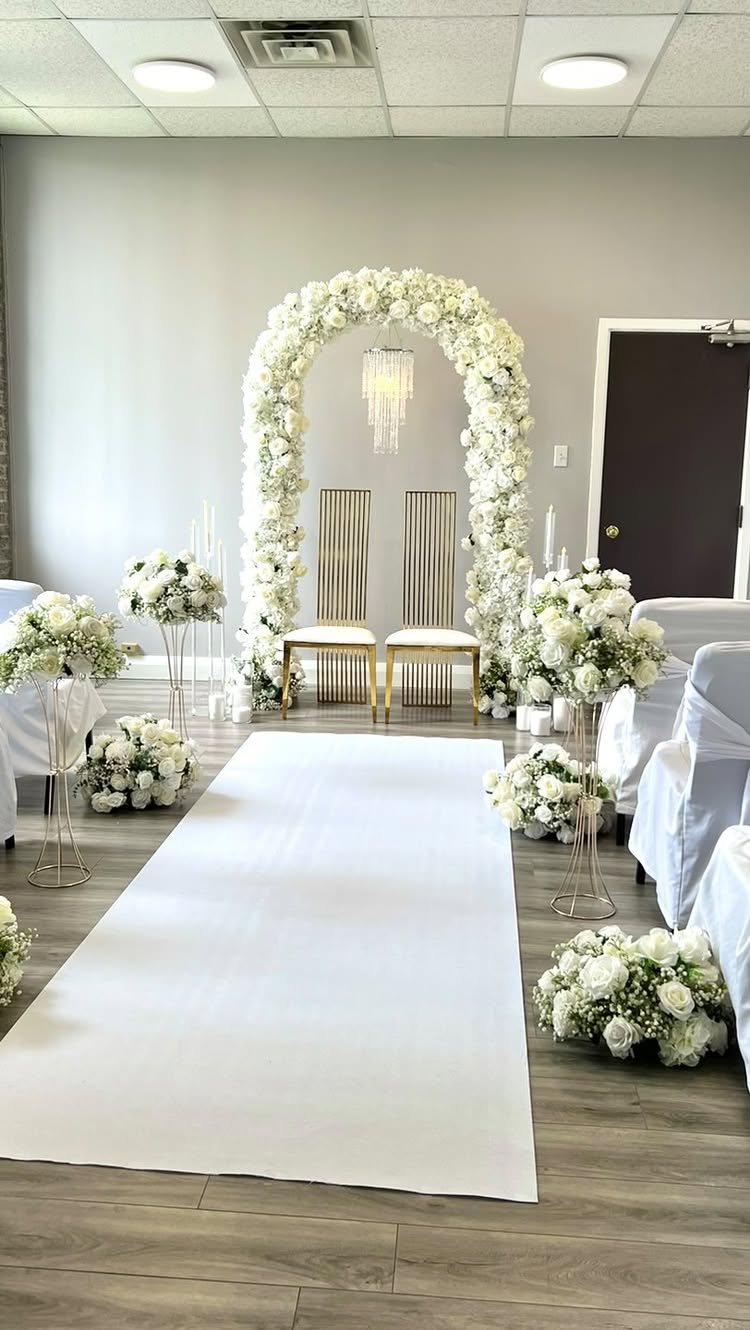
A chandelier hung inside a floral arch is the kind of gesture that only works indoors, where you have the ceiling height and the rigging; try it in a tent and you are fighting wind sway and center poles.
The crystal piece is centered and substantial, which means the arch itself must be built to carry the load or you are bolting to the ceiling separately.
I would check that your venue has a junction box or beam where you need it; otherwise you are running cable down a pipe and drape, which the photos never show.
White roses and gold chairs keep the palette quiet because the chandelier is already doing the ornament. This one trades some of the couple’s prominence for the room’s grandeur: the eye goes to the light first, then to you.
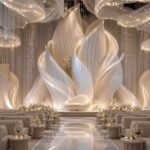
19. Sculptural Leaf Fabric Arch
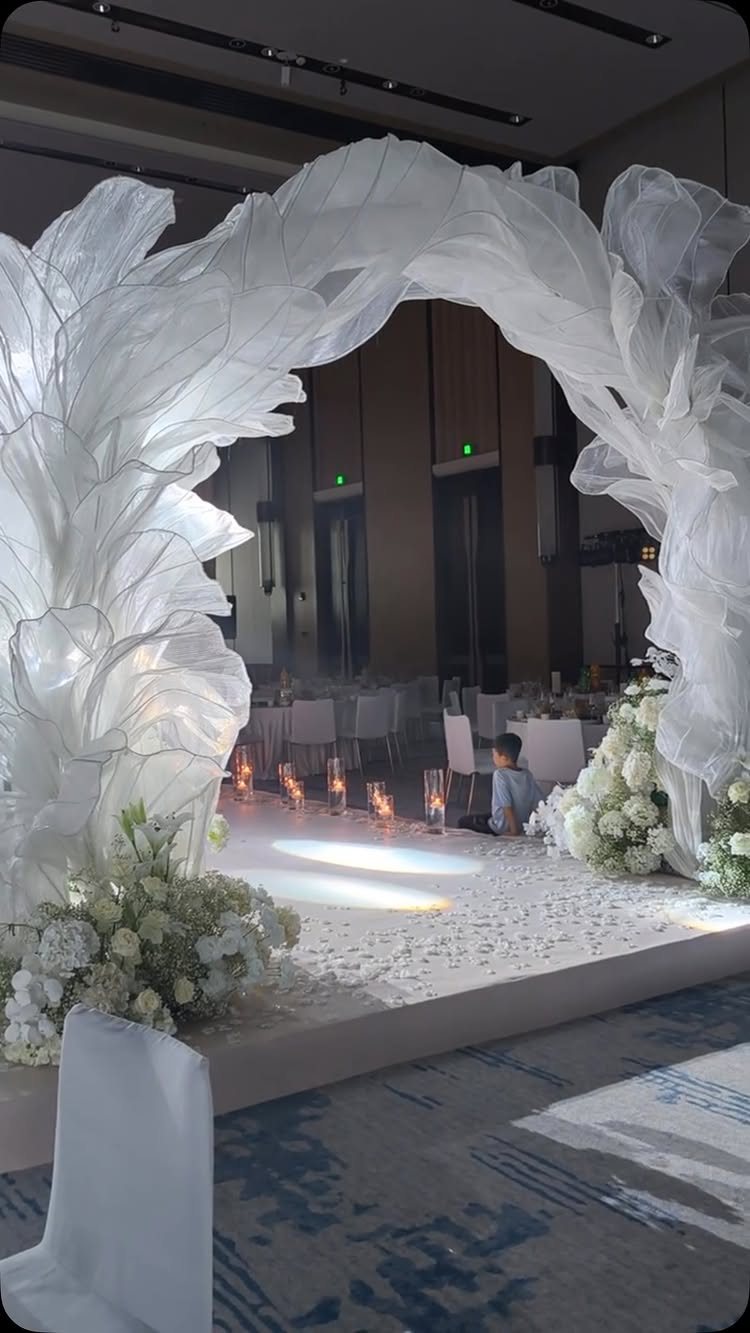
A sculptural leaf fabric arch turns the ceremony backdrop into architecture itself. Layered translucent panels catch light like frosted glass, giving depth without weight.
Organza works here for its crisp transparency; chiffon reads heavier and tulle too soft.
The panels need a welded metal frame strong enough to hold their shape against air currents from HVAC or guest movement, so venue engineering matters more than with draped fabric.
White-on-white keeps the sculpture from competing with florals at the base.
This suits couples whose venue already has stage lighting to throw shadows through the layers. Without that raking light, the dimensional effect flattens into expensive wallpaper.
The trade is scale: too short and it looks like a prop, so ceiling height sets the minimum.
20. Butterfly Floral Arch

Oversized butterflies pinned among pink and white blooms turn a standard floral arch into something closer to installation art. The wings read as movement frozen mid-flight, which matters in a static room where no wind will stir real petals.
Foam-core or acrylic butterflies hold up indoors where paper wilts; wire them to the arch frame, not the flowers, so stems stay intact through the evening.
I would keep the palette tight, two tones maximum, or the wing details get lost in chromatic noise.
This one wins for spring weddings and for couples whose guests will photograph everything. It trades some sophistication for whimsy, so black-tie ceremonies should look elsewhere.
A single butterfly scale works better than mixed sizes; the ones in the display are roughly uniform, and that discipline keeps it from reading as craft project.
21. Floral Cross Backdrop
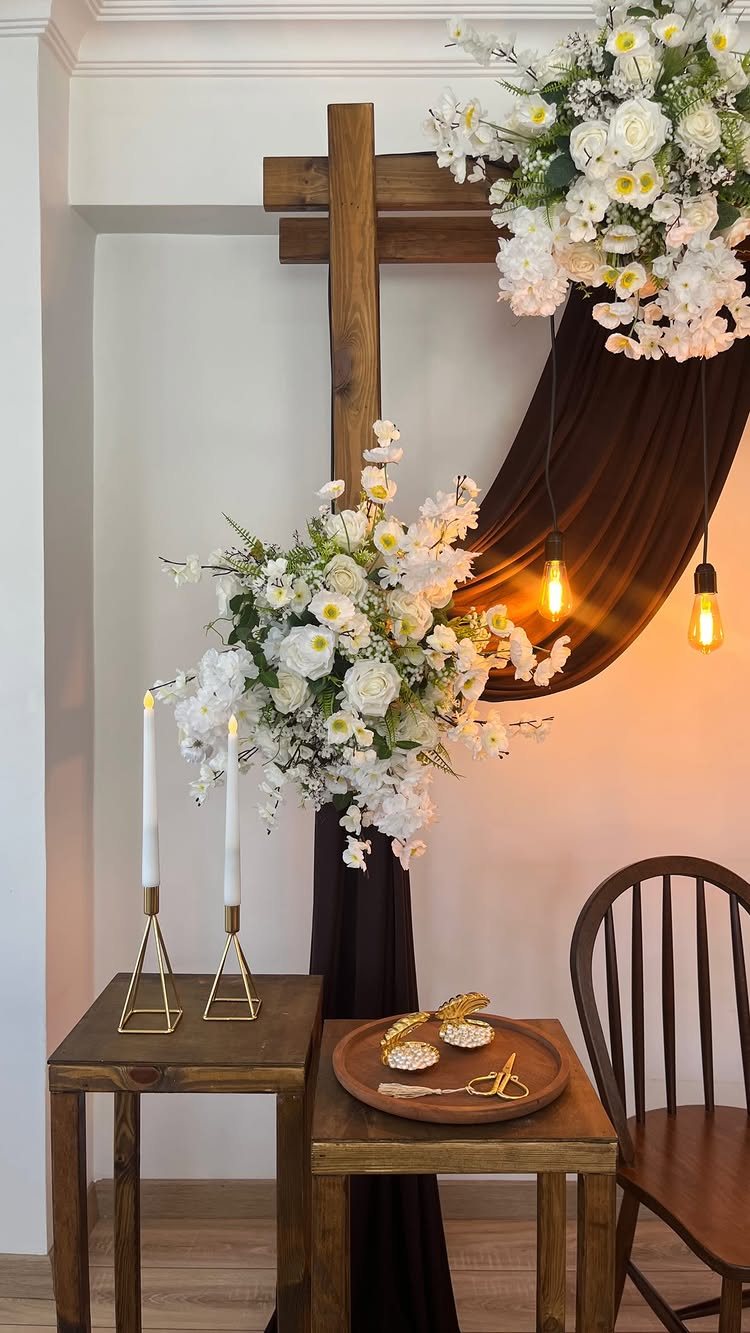
A wooden cross draped in dark fabric and white flowers reclaims a shape usually left to church sanctuaries for hotel ballrooms and loft spaces. The verticality draws eyes upward in rooms where standard arches spread wide and low.
Edison bulbs hung from the arms give warm light without rental uplighting; the filaments echo the cross grain.
Dark fabric behind the flowers makes white blooms read brighter than against bare wood or white walls, so that drape is doing functional work, not just mood.
This fits couples with religious family who still want an unconventional venue, or anyone whose aesthetic runs toward the solemn and structured.
The trade is flexibility: the cross shape reads Christian to most American guests regardless of your intent, and adapting it with secular symbols tends to look like avoidance rather than inclusivity.
Side tables with candles extend the geometry into the aisle space, which helps if your ceremony spot is wider than the cross itself.
How to Decorate a Wedding Arch
A wooden frame takes paint, stain, or bare grain depending on the room.
Metal, copper, wrought iron, or acrylic gives you a different starting point, and mixing materials, wood against metal or fabric against lattice, builds more interest than any single one.
Sheer fabric hung in layers softens hard lines; macrame adds texture if the rest of the room runs clean.
A beam built for drapery may not take a chandelier, and rigging added after the fact leaves cable in view.
If you are building the arch yourself, test the full decoration at home. Flowers read differently against a painted wall than they will in venue light, and fabric that falls one way in still air moves differently near a vent.
Seasonality of Flowers
Seasonal blooms hold color and shape longer, which matters for an arch assembled hours before the ceremony. Hardy flowers, larger varieties that keep their form out of water, reduce the risk of wilt between setup and vows.
Delicate stems work fine in a bouquet that moves with the bride; fixed in place on an arch, they have no protection from heat or dry air.
For outdoor weddings, durability against sun and wind is the deciding factor. Indoors, the same principle applies to the time gap: morning florist delivery and evening ceremony leaves hours without water for some stems.
The Knot’s monthly guide matches flower to month if you need a starting point.
I would bring the arch’s planned location, window or no window, to the florist at the first meeting. A corner with HVAC overhead fails faster than one against a stable wall.
Repurposing Wedding Arches
Mobility at the build stage multiplies the arch’s use. Casters on the base let one person move a light frame; heavier builds need a crew.
Plan the garland as detachable and it dresses the dessert table later, framing the cake without a second rental.
The sweetheart table, at a large reception, benefits from the same structure behind it, giving the couple a visual anchor among uniform rounds.
The arch as photo booth backdrop works if the width fits the group’s scale; a narrow frame reads as prop, not setting.
I would decide the reuse before construction. A frame built for one spot and one floral arrangement resists adaptation; joints planned for disassembly, garland ties planned for relocation, make the second use possible without damage.
The budget question is whether the move happens during cocktail hour, when staff are busy, or whether the arch serves the ceremony alone and a simpler backdrop covers the reception needs.