Floral backdrops for weddings run from a handful of aisle petals you can scatter yourself to a full flower wall that needs a rental team, with arches, hanging curtains and meadow runners falling somewhere between.
The right one depends on whether your venue already has character that needs softening or is a blank box that needs life.
A pre-built panel of silk roses in ombre pinks goes up in an hour; pinning fresh stems to foam board yourself eats a weekend and leaves your thumbs raw.
1. Floral Wedding Ceremony Arrangements

A ceremony arrangement draws the eye to where vows happen, not just frames it.
The style you choose depends on venue architecture. A chuppah suits open lawns where sky becomes part of the design; low meadow arrangements work in intimate gardens where guests sit close.
Check whether your florist includes setup and strike in their quote, or if venue staff handle placement. Some locations restrict structures entirely, making pedestal arrangements the only viable option.
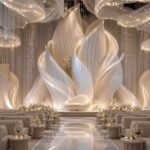
I’d pick this for a ceremony where the view behind the couple competes with the decor, since tall white pieces hold their own against greenery without blocking it.
2. Floral Arches
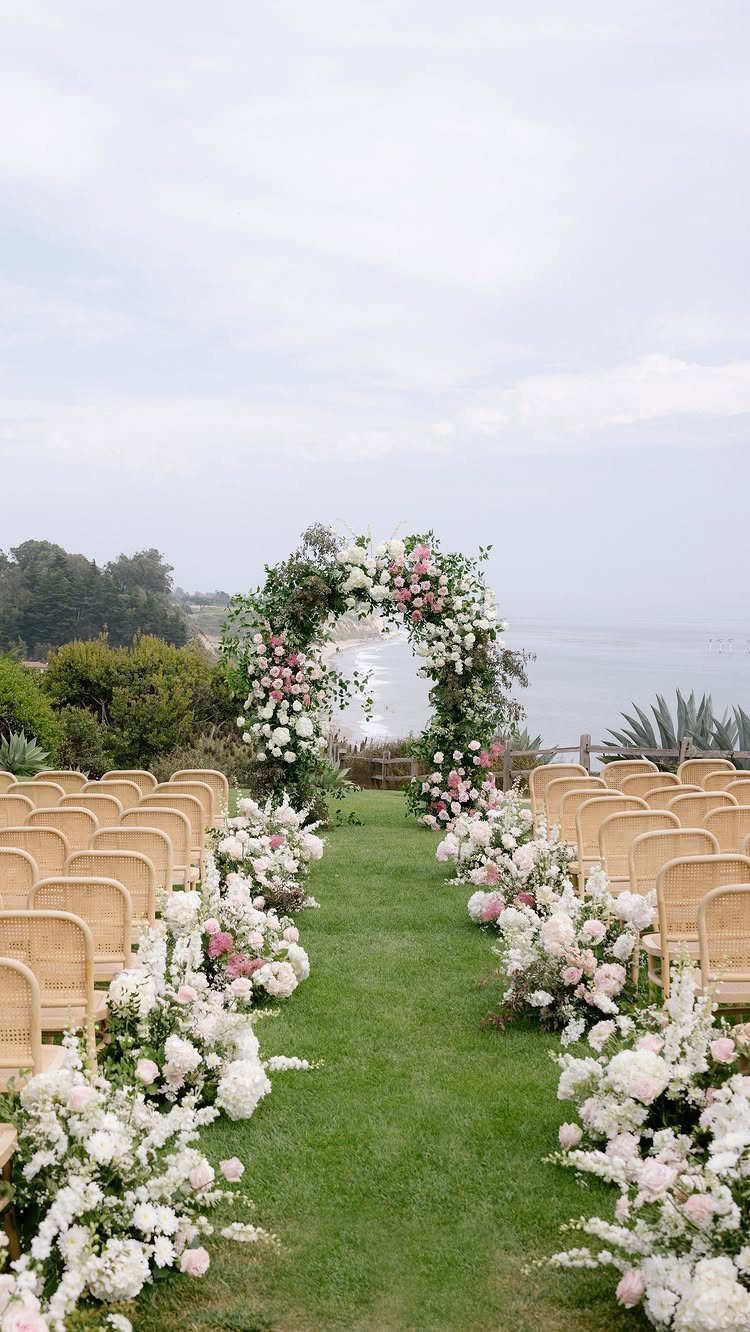
The arch endures because it solves a problem: most ceremony sites have no natural focal point. Fresh flowers and foliage across a wooden or metal frame create one instantly, though full coverage runs higher than partial.
For a tighter budget, a deconstructed arch, open at the top, uses fewer blooms and reads more modern.
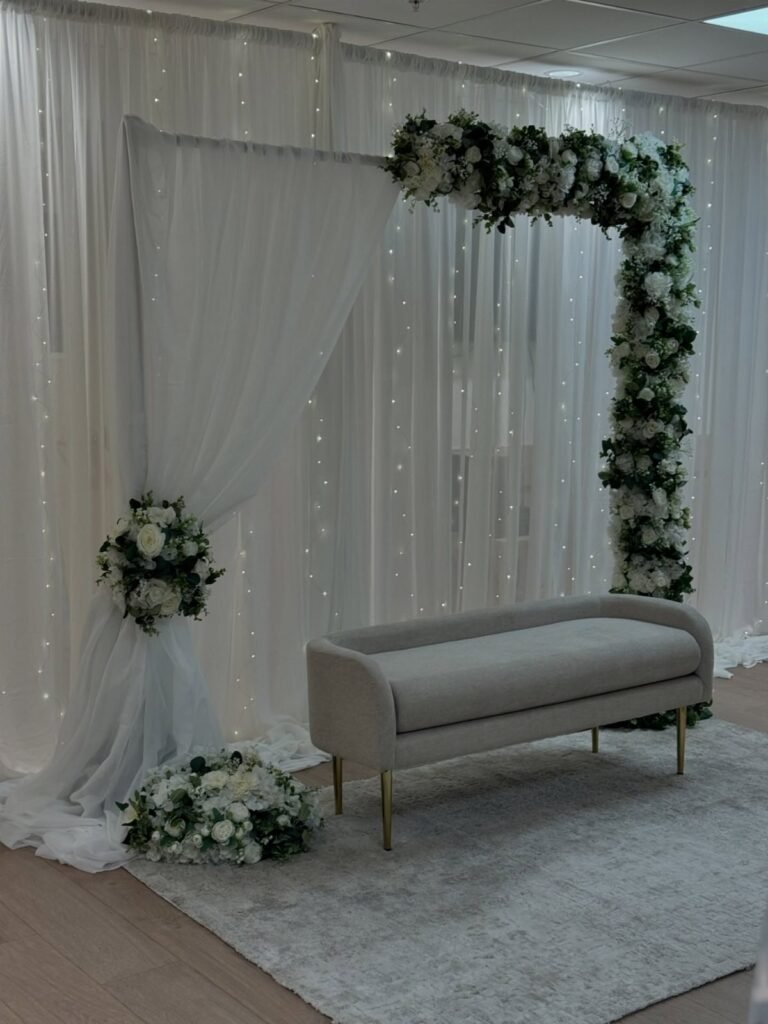
Fabric drapes layered with faux flowers and chiffon ribbon offer another angle; one maker builds theirs to look completely real and ships ready to assemble.
That matters if your venue allows setup only the morning of, or if local florists book solid during peak season.
Pale pinks and whites read softest in open daylight near water. I’d lean dramatic for late afternoon ceremonies when shadows deepen color, and minimal for harsh midday sun where simpler shapes hold their shape better.
3. Moon Gate Arches
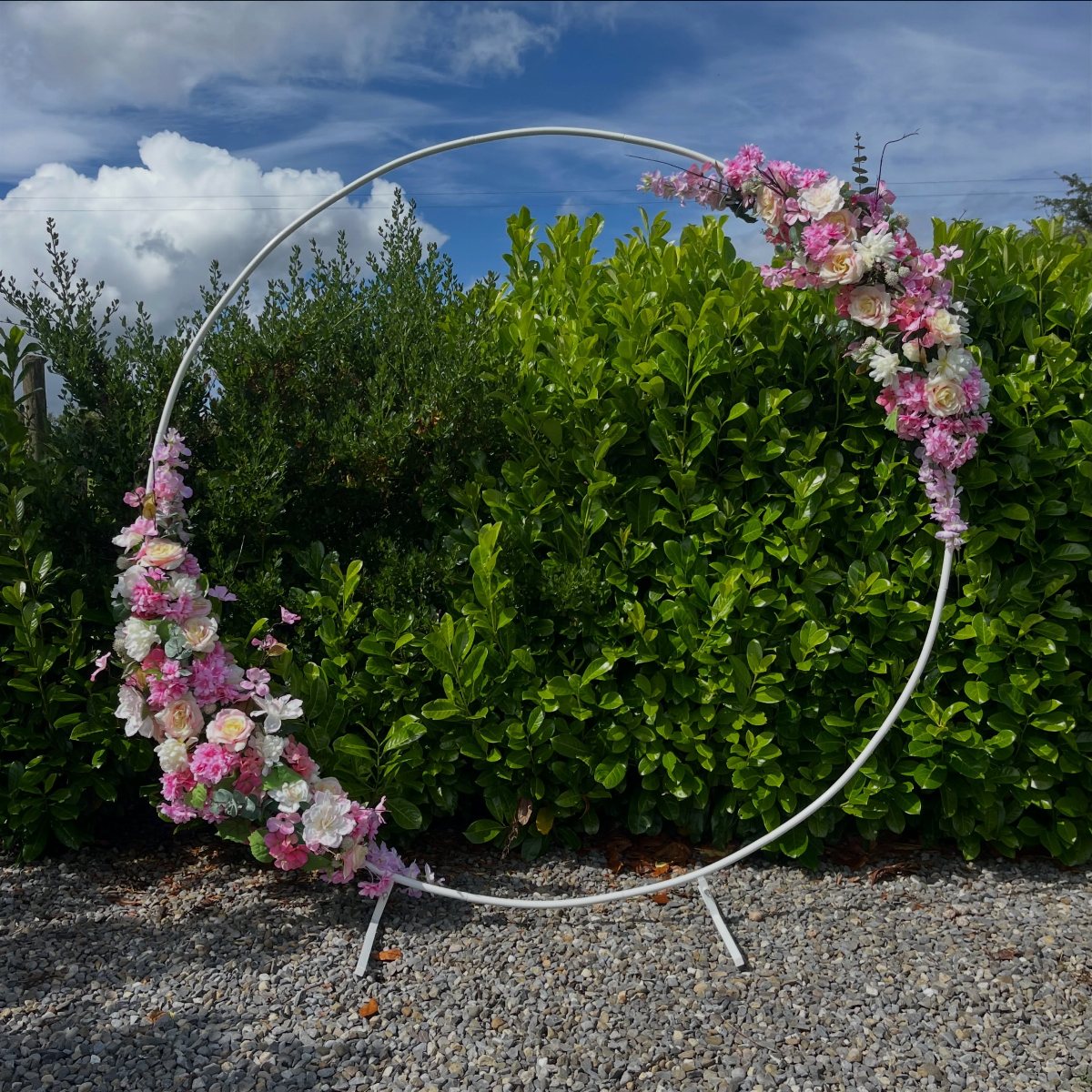
A circle reads differently than an arch; it encloses the couple rather than frames them, which suits small guest counts where the ceremony feels communal.
The shape comes from traditional Chinese garden moon gates, circular wall openings that invited passage, and that history lends weight to a modern wedding.
Metal frames in white or black stand against greenery without competing; clustered blooms at intervals read as intentional rather than sparse.
One maker notes these have stayed a hot trend across multiple seasons, so rental frames circulate widely now; ask your florist whether they stock one before buying.
I’d reserve this for couples whose aesthetic runs romantic rather than graphic, since the curve softens everything it touches.
4. Modern Minimal Wedding Backdrops

Sleek backdrops trade flower volume for material interest: fabric swags, reflective platforms, single stems in glass. A white-on-white setup uses pedestals and draped cloth to build height and texture without dense blooms, which drops the floral budget.
Lanterns, signage, or potted plants fill gaps where another design would cluster flowers. Negative space does the work; every element needs room to register.
A reflective floor or metallic frame does work that flowers would otherwise carry.
This suits couples who prefer contemporary lines or who face strict flower limits at their venue. Check whether your florist offers plant rental, or if you will source greenery yourself.
I’d steer toward this for urban venues where minimal reads intentional rather than underdone, and away from it if your dream is abundant, layered color.
5. Meadow-like Floral Aisle Runners

Aisle runners turn the walk itself into design territory. Dense meadow-style borders of white and orange blooms, as above, require more stems but create a destination feeling; scattered rose petals cost less and still mark the path.
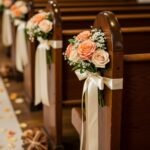
Chair decorations extend the logic, peach sashes on white folding chairs connecting floral color to guest seating. The full treatment works when the aisle is short; at length, even modest borders add up fast.
Grass sites need flat ground for runner stability, and morning dew can weigh down loose petals. I’d choose the dense style for afternoon ceremonies on dry days, and petal sprinkling for morning or unpredictable weather.
Ask your florist whether they build runners in sections for easier transport and placement, or as one continuous piece.
6. Secret Garden Wedding Backdrops

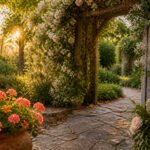
Wild, overgrown backdrops ask a florist to mimic nature rather than arrange it, trailing ivy and garden roses in warm tones that look rooted rather than placed.
A backdrop built around vintage seating and stacked books suits a lounge area as easily as a ceremony.
The effect depends on density; gaps read as failure here where they would pass in minimal designs. A good florist layers textures, roses at varying heights, ivy breaking the edge, so nothing looks clipped into shape.
This demands more labor than structured styles, which translates to cost. I’d reserve it for couples whose venue already carries aged or organic character, where the backdrop extends a story rather than introduces one.
For modern spaces, the same flowers in a cleaner arrangement usually harmonize better.
7. Floral Design with Foliage

Greenery carries the weight here, with flowers playing backup. Asymmetrical shapes built on their own stems and a hidden frame keep the structure light and the cost lower than a wall of blooms.
I would anchor each piece in floral foam on a weighted base, then build outward with trailing ivy, ferns, and seeded eucalyptus before tucking in roses or spray roses where they read as punctuation rather than paragraph.
This suits couples who want the life of fresh flowers without the price of full coverage, or who love the mood of a garden more than its color.
The clean white ground and wall behind it are doing half the work; if your venue has busy wallpaper or competing colors, this idea needs a different home.
A moss base at ground level bridges the gap between structure and floor without requiring extra blooms. Check whether your venue allows water on the floor, since soaked floral foam can leave marks on wood or stone.
8. Flower Wall Backdrop
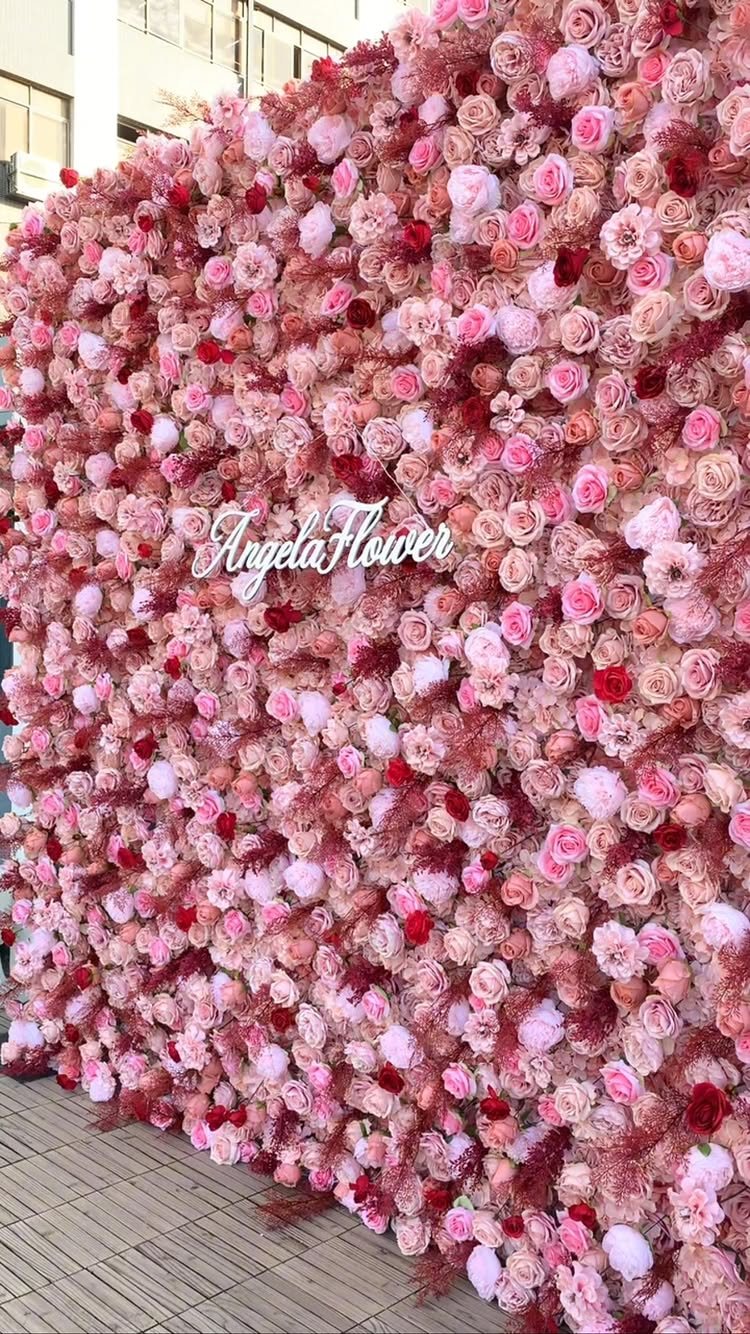
A flower wall built from artificial roses in graduating pinks reads as one saturated plane from a distance and rewards guests who step closer to take portraits against it.
The density matters more than the material; silk or latex blooms packed tight erase their own seams, while sparse placement advertises the construction.
Rental walls and purchase prices for comparable DIY panels land in the same range once you count the bloom count.
The trade is time against money: a pre-built panel ships flat and assembles in an hour, while hand-pinning individual roses to foam board takes a weekend and sore fingers.
Lettering a couple’s names or wedding date in acrylic or painted wood at center photographs cleanly against uniform petals.
This works best for indoor receptions or tented celebrations where wind cannot test the structure.
Outdoor walls need weighted skirting and a frame that does not flex, or the first guest leaning in for a photo will tilt the whole plane.
9. Hanging Stem Curtain Backdrop

Sheer curtains pinned with individual stems turn a rental pipe-and-drape into something the couple made. Fresh stems hung above guest height need water tubes or frequent replacement; a dropped bloom becomes a hazard and a fresh stem wilts in hours.
The uplights at floor level are the detail I would not skip. Without them, the curtain reads as flat fabric; with them, the petals cast shadows and the whole surface gains depth.
Battery-operated puck lights work where outlets are scarce, and RGB models let you shift from warm white during ceremony to amber during dinner without moving a cord.
This scales to almost any width, which makes it useful for filling an awkward barn wall or framing a city view you cannot change.
The stems need not match your bouquet exactly; pick up one color from the palette and repeat it at varied heights so the eye travels.
10. Sculptural Fabric Flower Backdrop

Fabric flowers at this scale become architecture rather than decoration.
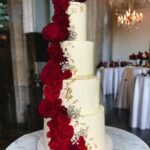
The red and pink pair sit between ribbed white panels that give them a gallery context, and the floor arrangements plus candles at their base complete the scene without competing for height.
These are made, not bought off a shelf, which means either a seamstress in your budget or your own weekends with wire, muslin, and fabric stiffener.
If you sew, plan for a materials investment per large bloom, or reach out to a prop stylist or theater costume shop for rental options.
The ribbed panels behind them are simple luan or MDF run through a table saw with a narrow blade; paint them matte white and they disappear into the background.
This suits a couple with one strong color commitment and a modern venue where traditional flowers would feel tentative. The candles are not optional; without warm light at the base, the sculptural quality turns cold and stage-set.
Budget Considerations for Backdrops
A full floral arch can swallow most of a flower budget before a single table centerpiece gets planned.
I would ask a florist to price foliage-heavy alternatives first: willow arches, urn arrangements, or leaf-dominant designs that read lush at half the stem count.
Minimal backdrops cut cost without looking spare. Pedestal arrangements, a single draped fabric line, or potted plants with one focal bloom carry a ceremony visually for far less than wall-to-wall coverage.
The savings often free budget for photography or a better menu, which guests remember longer than the arch.
Choosing the Right Style
The backdrop should feel like it grew from the venue, not landed on it. A moon gate’s curve softens warehouse angles; sculptural fabric flowers suit concrete and glass where traditional arrangements would whisper.
I would match drama to drama, quiet to quiet: a secret garden wall in a barn reads romantic, the same installation in a modern loft reads costume.
Non-floral elements stretch style without stretching budget. The question is coherence, not quantity; 3 elements that speak to each other outperform 10 that compete.
Incorporating Personal Touches
A backdrop becomes yours when one detail carries private meaning.
A painted wooden date, a fabric color drawn from your first apartment, a single bloom variety from a proposal bouquet: these register as yours without requiring guests to know the story.
Scale surprises. An oversized bow in satin, wildflowers tucked at its edge, turns a plain corner into a photograph guests will actually take.
I would place personal elements at eye level or below; above that line, they register as decoration rather than message.
The restraint matters more than the content; one line beats a paragraph every time.
Working with Florists
Florists solve problems you have not met yet. A moon gate frame they already stock saves a rental hunt; water tubes for hanging stems are a detail they have handled before.
I would bring venue photos, not just Pinterest boards, so they see load-in doors, floor surfaces, and where the light falls at ceremony time.
Ask directly about artificial options for elements guests approach only for photos.
Silk blooms in a wall panel, mixed with fresh in arrangements guests pass close, cut cost without cutting effect if the florist builds the transition so both read as the same palette.
Strike timing affects price. Same-night removal costs more than next-morning; some venues require it, others allow overnight.
That answer changes what a florist can build and how they build it.
Frequently Asked Questions
What are popular floral backdrop designs?
Floral arches, moon gates, and meadow-like aisle runners are the most common choices.
Arches solve the problem of blank ceremony sites by creating an instant focal point, while moon gates enclose the couple in a circle that suits intimate guest counts.
For something lighter, minimal backdrops use fabric swags, reflective platforms, and single stems in glass to build texture without dense blooms.
What are some good backdrops for a wedding?
The right backdrop depends on your venue and budget. Full floral arches and flower walls make strong statements but run high; foliage-heavy designs, deconstructed open arches, and fabric-drape panels with faux flowers cost less while still reading intentional.
Pedestals and draped cloth can ground a modern ceremony in a loft or gallery, while a few sheer panels pinned with single stems will cover a barn wall or block out an ugly city view without looking like you tried to hide something.
Are flower backdrops expensive?
Full coverage with fresh flowers runs highest, especially for large arches or dense walls.
You can lower the cost by choosing partial coverage, open or deconstructed shapes that use fewer blooms, or designs where greenery carries the weight and flowers play backup.
Fabric flowers, rental panels, and faux options land in the same range as DIY once you count materials and time, and they ship ready to assemble when local florists are booked solid.