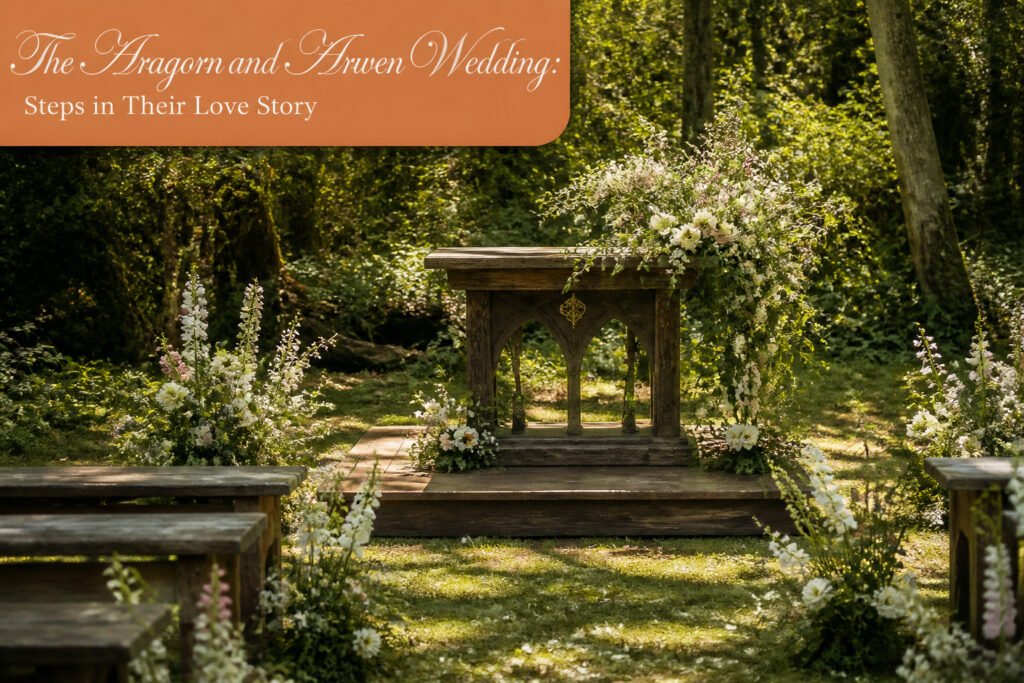
The wedding of Aragorn and Arwen is a conditional union that only becomes possible after decades of war, exile, and a father’s absolute demand that Aragorn first become King of both Gondor and Arnor.
Elrond forbids any betrothal until this standard is met, and Arwen risks true mortality itself, trading the Undying Lands for a single shared lifetime.
Their troth-plighting on Cerin Amroth binds them to nothing immediate; thirty years still separate that pledge from the midsummer ceremony in Minas Tirith, where the White Tree blooms again for a marriage spanning 120 years.
1. Their Initial Meeting

The first time Aragorn sees Arwen, he is twenty years old and fresh from learning his true name and heritage.
She appears in the woods near Rivendell in a mantle of silver and blue, and he mistakes her for Lúthien, the immortal Elf-maiden of the First Age who chose mortality for love.
He calls out "Tinúviel!" as Beren once did, and from that moment he loves only her.
This single encounter reroutes his entire life. Gilraen warns him against loving so far above his mortal station.
Elrond sees what has happened without being told and lays down the terms: no troth, no wife, until Aragorn rises higher than any forebear since Elendil or falls into darkness with the rest of his kin.
Aragorn responds with the foresight of his bloodline, predicting that Elrond’s time in Middle-earth is ending and Arwen will soon face her own choice between mortal life and the Undying Lands.
Rather than linger, Aragorn leaves Rivendell and spends thirty years abroad as a Ranger, becoming a determined enemy of Sauron.
The glimpse of Arwen does not settle into patient waiting; it propels him into the hard work of becoming someone who might one day deserve her.
2. Elrond’s Warning

Elrond does not make this easy.
When Aragorn falls in love with Arwen in Rivendell, her father sees it immediately and sets a condition that will shape every choice Aragorn makes afterward: he shall neither take a wife nor bind any woman to him in troth until he proves worthy of his destiny.
That worthiness means becoming King of both Gondor and Arnor, the ancient southern and northern kingdoms of Middle-earth.
The condition is absolute. Aragorn cannot simply pledge himself to Arwen and wait; he must earn the throne through action, not patience.
What struck me reading this again was how Elrond frames it as protection as much as prohibition. He warns of a "great doom" awaiting Aragorn, either to become the greatest of his line since Elendil or to fall into darkness.
Without that standard, the marriage would bind Arwen to failure as surely as to the man himself.
Aragorn responds with prophecy of his own, foretelling that Elrond’s time in Middle-earth will end and forcing Arwen toward her own impossible choice between father and mortal love. Neither man yields.
The argument sets the stakes for thirty years of separation, with Aragorn wandering in service to others and Arwen waiting, neither permitted even the small comfort of formal betrothal until the war is won.
3. The Troth-Plighting

Aragorn and Arwen’s pledge on Cerin Amroth in Lothlórien carries weight precisely because it binds them to nothing immediate.
Thirty years still stretch between this moment and their reunion, and Aragorn has yet to prove himself worthy of the throne that would make him her equal.
The betrothal is conditional in every practical sense, yet they treat it as fixed.
The conditions matter deeply. Elrond has made clear that Arwen may not marry a mortal man who has not claimed his kingship, and Sauron’s threat still darkens all of Middle-earth.
Aragorn could die in battle, fail in his lineage, or simply never summon the fortune required. Arwen, for her part, commits to mortality itself, a loss measured not in years but in the unending westward road denied to her forever.
What strikes me about their troth-plighting is the asymmetry of what each risks. Aragorn hazards his life, which all men do anyway.
Arwen hazards an unbounded future, trading the light of the Undying Lands for a single shared lifetime that grief will shorten at its end.
She makes this choice on Cerin Amroth knowing full well the cost, not in the flush of first love but after decades of separation have already tested the bond.
4. The War of the Ring

Aragorn spent nearly four decades as a Ranger, a captain of Rohan, and a wanderer in the South before he ever claimed a throne.
The victories that mattered were not the skirmishes but the ones that proved he could unite the fractured kingdoms of Men against Sauron.
At the Battle of the Pelennor Fields, he unfurled the standard Arwen had sewn, and the people of Gondor hailed him as King. The One Ring was destroyed, and with it the power of the three Elven-rings, including Elrond’s, faded.
Aragorn became King of both Gondor and Arnor.
Aragorn becomes King of Gondor and Arnor, and at midsummer, he and Arwen are married in Minas Tirith.
That coronation fulfilled the condition Elrond had set years before: Arwen would marry no less than the King of both realms. The military victory bought the political legitimacy, and the political legitimacy bought the wedding.
Without both, the ceremony in Minas Tirith would not have happened.
5. The Wedding Ceremony

The wedding takes place in Minas Tirith, the City of the Kings, on Midsummer’s Day, after Aragorn has been crowned King of both Gondor and Arnor.
That timing matters: midsummer in Middle-earth carries the weight of fulfillment, the longest day of light after years of war and waiting.
The White Tree blooms for the occasion, a living sign that the royal line of Gondor has been restored.
Tolkien places this marriage at the precise hinge where the Third Age ends and the new age begins, with Elrond departing Middle-earth the same year and the couple "sundered by the Sea and by a doom beyond the end of the world."
The ceremony itself is described with restraint, almost as if the joy of it speaks for itself after six-score years of foreshadowing.
What strikes me is how unlike a modern wedding this is in its construction: no guest list counts, no processional details, just the union of two people whose separate labors have finally converged at the right throne, in the right season, under a tree that had been dead for centuries and now flowers again.
6. Their Life Together

The marriage of Aragorn and Arwen spans six-score years, 120 in plain count, and that length matters.
In Tolkien’s telling, their reign is measured deliberately against the age of Middle-earth itself: the Third Age closes as Elrond departs, and what follows is the Fourth Age, the Age of Men, built on their joint rule.
I keep coming back to how those years are described. "Great glory and bliss" sounds almost too tidy for a reign that has to justify Arwen’s sacrifice, but the text insists on it.
They rule Gondor and Arnor together, not as consort and king but as partners in the rebuilding. The kingdoms themselves are renewed: Arnor, long broken, restored under the same crown.
The span also sets up the final grief. Aragorn dies at 210, choosing his moment rather than waiting for decay.
Arwen, who gave up immortality for this, is "not yet weary of her days."
She outlives him, and the bitterness of that mortality she chose becomes literal: she dies of old age, the only Elf since Lúthien to do so, under fading mallorn trees in a Lorien emptied of its people.
Their marriage is the visible proof that the renewal of Middle-earth is personal as well as political. The kingdoms are healed because someone in them chose to stay, and suffered for it.
Mortal Against Immortal Love

Arwen’s choice to become mortal is the sacrifice that defines this union, but Aragorn pays a price too.
The Elf-maiden gives up the endless life of the Eldar, the slow fading of her people into the West, and the company of her father forever.
She makes this choice on the hill of Cerin Amroth, with the Shadow visible in the East and the Twilight in the West, binding herself to a man who may yet fall into darkness.
Aragorn’s cost is quieter but no less real. Elrond sets a condition: no marriage until Aragorn is King of both Gondor and Arnor.
The path to that throne runs through war, exile, and decades of waiting. An easier life was possible; Aragorn could have turned aside, claimed some lesser honor, lived out his years without the burden of his lineage.
Instead he accepts the doom his foresight shows him, the shortening of his days by toil and crown, and the certainty that he will leave Arwen widowed.
Their union joins mortal and immortal in a way that echoes the older tale of Beren and Lúthien.
Tolkien placed this story in the Appendices, not the main text, because it extends beyond the hobbits’ view; the love-interest shifts to the margins, and the action takes center stage.
What remains is the hard fact that each partner chose loss. Arwen chose death; Aragorn chose the harder road to his destiny.
What the Ring of Barahir Means

The Ring of Barahir stands in for any modern wedding band Aragorn might have worn.
Tolkien never has Aragorn slip a gold circlet onto Arwen’s finger in the books or films, and the emerald-set ring he does carry serves an older purpose: it marks who he is, not just who he loves.
The ring’s history runs back to Valinor, where the Noldor crafted it before it passed to Finrod Felagund in Middle-earth. Finrod gave it to Barahir after Barahir saved his life, a gift of friendship rather than romance.
From there it traveled father to son through the bloodline that would produce Isildur, and eventually Elrond held it before handing it to Aragorn.
That lineage matters more than any magical property; the ring holds no power of its own, only the weight of survival and loyalty across generations.
When Aragorn used it in his proposal to Arwen, he was offering not just his heart but his inheritance. The ring joined their two lineages, mortal and immortal, through an object that had already outlasted centuries.
Hope for Middle-earth

The marriage of Aragorn and Arwen carries weight that reaches far past the two people standing at the altar.
She is the Evenstar of the Elves, daughter of Elrond, descended from Lúthien Tinúviel; he is the heir of Isildur, Elendil, Eärendil and Beren.
Their union rekindles life for all peoples at the very moment the Eldar’s long sojourn in Middle-earth begins to close.
Aragorn does not simply gain a queen. The standard Arwen sewed for him unfurls at the Battle of the Pelennor Fields, and the people of Gondor hail him as King.
The symbol and the man become inseparable. When the One Ring is destroyed, the power of the three Elven-rings ends with it, yet their marriage opens a springtime of possibility that outlasts that loss.
Every marriage unites private happiness with public hope.
This one does so on a scale that makes it consummation and prophecy together: the hope for Humankind and the light of the Elves joined, when both races needed to believe the division between earth and heaven could still be healed.
Arwen’s Choice and What It Costs

Arwen’s choice to become mortal for Aragorn is the kind of decision that costs more than a single lifetime.
She gives up both immortality and the light of the Undying Lands, trading them for a human span of years with a man who must die.
The parallel to Lúthien is deliberate and exact. Where Lúthien sang before Mandos for Beren, Arwen makes her stand in the living world, against her father’s wishes and the whole weight of Elvish history.
That green elfstone Aragorn receives in Lothlórien, set in silver from Arwen’s own hand, marks a promise already made in full knowledge of its price.
Their 120 years together as King and Queen of Gondor and Arnor represent the full reward of that bargain. Aragorn lives to see his great-great-grandchildren, then chooses the time of his death as the Númenórean kings once did.
Arwen, bound now to mortal fate, follows him to the grave shortly after, aged and grieving. The choice she made for love does not spare her from loss; it only changes which loss she must bear.
Frequently Asked Questions
What challenges did Aragorn and Arwen face before their marriage?
Elrond forbade any betrothal until Aragorn became King of both Gondor and Arnor, a condition that forced thirty years of separation while Aragorn fought as a Ranger and proved his worth.
Arwen risked her immortality itself, committing to mortality without any guarantee he would survive the War of the Ring. The Shadow in the East and Sauron’s growing power threatened every step toward the throne Elrond demanded.
What is the significance of Aragorn and Arwen’s marriage?
Their union joins the highest mortal and immortal bloodlines in Middle-earth, marking the moment the Third Age ends and the Age of Men begins.
The White Tree of Gondor blooms again for their midsummer wedding, showing the kingdom’s renewal through their combined lineage. Together they rule for 120 years, turning private sacrifice into public hope for all peoples.
How does Arwen’s choice affect her character?
She becomes the only Elf since Lúthien to die of old age, trading unending light for a single human lifespan that grief shortens at its end.
Her decision on Cerin Amroth was made with full knowledge of the cost, not in first love’s flush but after decades tested the bond. The bitterness she tastes after Aragorn’s death is the literal price of mortality she chose.
What was the age gap between Aragorn and Arwen when they married?
Aragorn was 87 at their wedding, while Arwen had lived over 2,700 years as an Elf. He was twenty when they first met in Rivendell, and nearly seventy years passed between that glimpse and their troth-plighting in Lothlórien.
Do Arwen and Aragorn get married?
Yes, they marry in Minas Tirith on Midsummer’s Day after Aragorn is crowned King of both Gondor and Arnor. The wedding fulfills Elrond’s condition that Arwen marry no less than the King of both realms.
Tolkien places the ceremony at the hinge where the Third Age closes and the Fourth Age begins.
How long did Aragorn wait to marry Arwen?
Nearly ninety years passed between their first meeting and their wedding, with roughly thirty years between their troth-plighting in Lothlórien and the ceremony in Minas Tirith.
Aragorn spent those decades as a Ranger, captain of Rohan, and wanderer in the South before claiming his throne. The wait ended only when the One Ring was destroyed and his kingship secured.
Did Aragorn truly love Arwen?
From their first meeting in Rivendell, when he mistook her for Lúthien and called out "Tinúviel!," he loved only her for the remainder of his life.
He spent thirty years abroad as a Ranger, driven by the need to become someone who might deserve her rather than settling into patient waiting.
When he finally laid down his life at 210, their 120 years of marriage had already outlasted most mortal unions.