A wedding ceremony altar can run from a simple wooden arbor to a sculptural modern backdrop engineered for a lakeside sunset, and the difference is almost never the budget alone.
What separates one idea from another is where your ceremony actually happens: an oak already on the property that becomes a tree-centered altar, a slope that needs leveling for a floral semi-circle platform, a July afternoon that wilts anything unwatered under a draped fabric altar, a ballroom ceiling too low for a floral canopy.
The 14 ideas below move from rough cedar posts that forgive uneven ground to floral rigs heavy enough to need their own metal frame, with the numbers that matter, ten guests or a hundred, built in.
1. Wooden Arbor

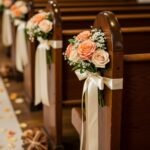
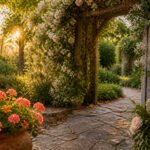
A wooden arbor gives you the most forgiving frame to work with if your venue is already outdoors in grass or trees.
A wooden arbor dresses up thick with peach and orange blooms against dark wood, or reads completely different stripped to greenery and muslin for a woodland ceremony.
I have seen these built from rough cedar posts or finished lumber, and the unfinished version wins anywhere the ground is uneven.
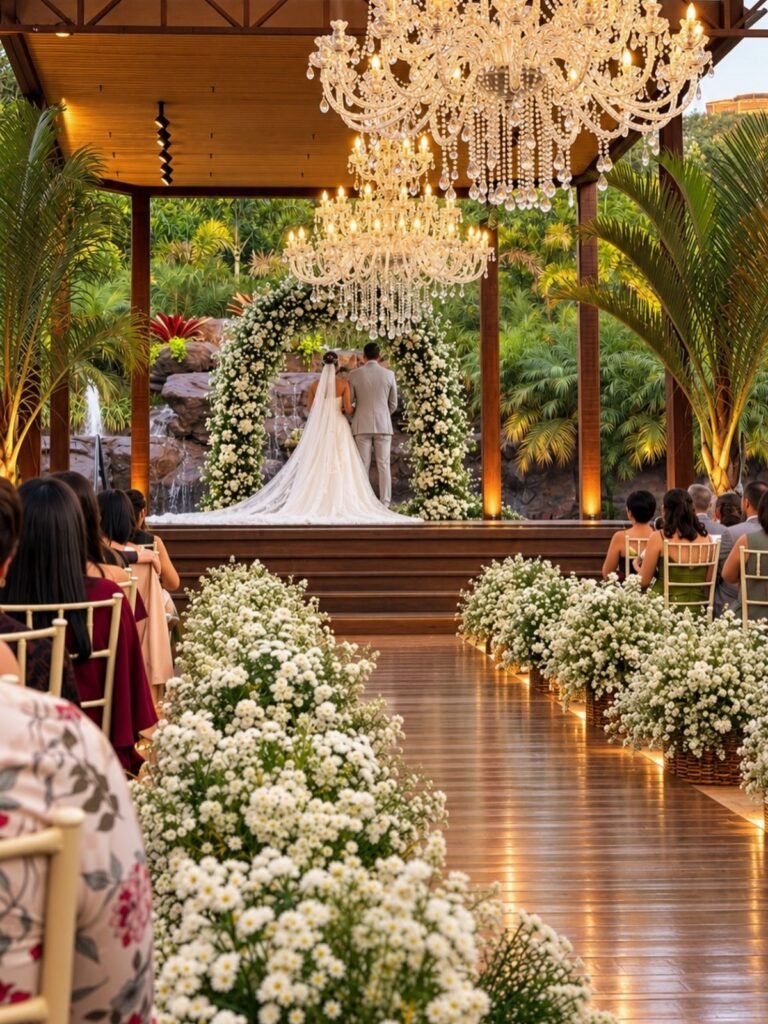
Hang a chandelier if your ceremony runs into evening; otherwise the gap overhead stays open and the light falls naturally on your faces.
Fabric weight matters more than color: chiffon lifts, canvas drops, and a wet linen drape will pull a light frame sideways in a surprise shower.
For a ten-guest backyard or a hundred-guest farm, this is the altar that apologizes for nothing and asks little of your rental budget.
2. Circular Arch
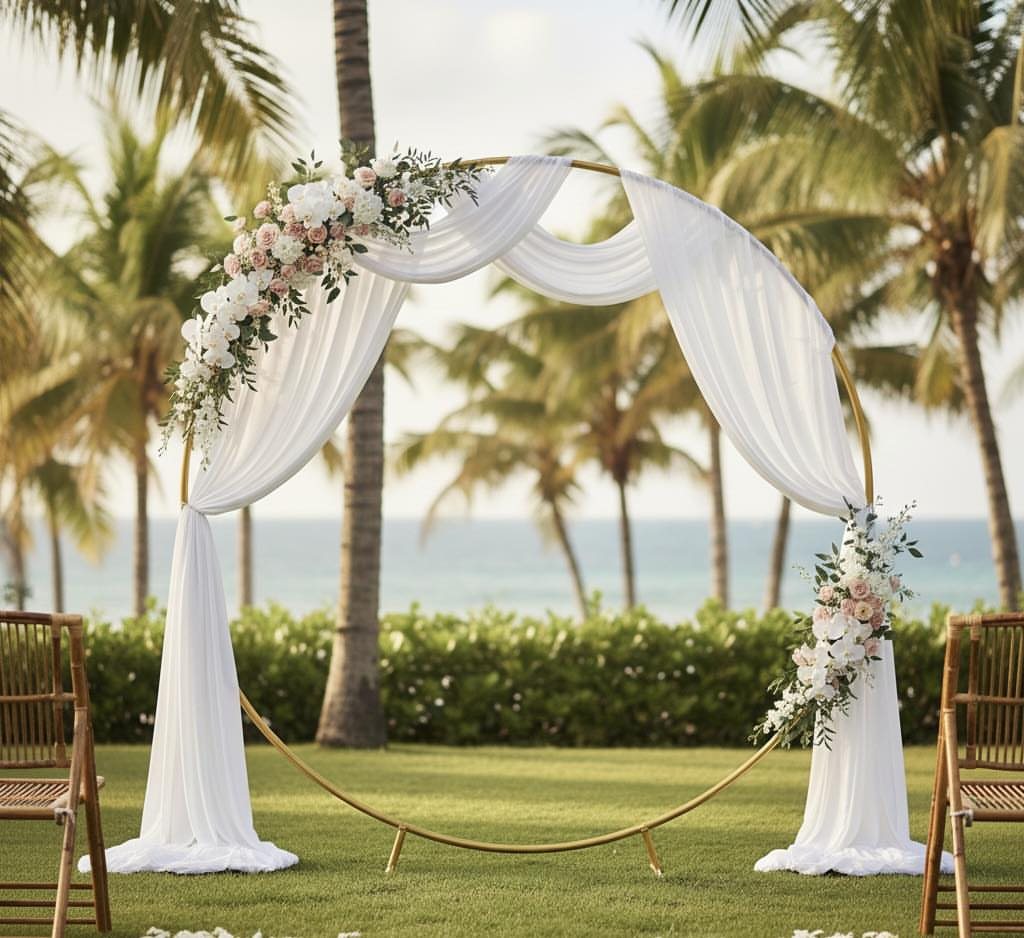
The circle reads as modern because the shape itself carries meaning; guests understand it without explanation. What changes the effect is how much of the ring you fill.
A gold frame carries white fabric and soft pink blooms across most of its curve, leaving the top open to sky and palm fronds.
A full floral wrap turns ceremonial, almost cocoon-like; a bare metal ring with a single asymmetrical spray reads gallery-clean. Pampas grass ages fast in humidity, so check your month and your coast before committing to that texture.
Indoor ballrooms need a wider diameter or the circle photographs as a tight halo around your heads. This shape asks for space behind it: a wall or hedge flattens the depth that makes the circle worth building.
3. Draped Fabric Altar
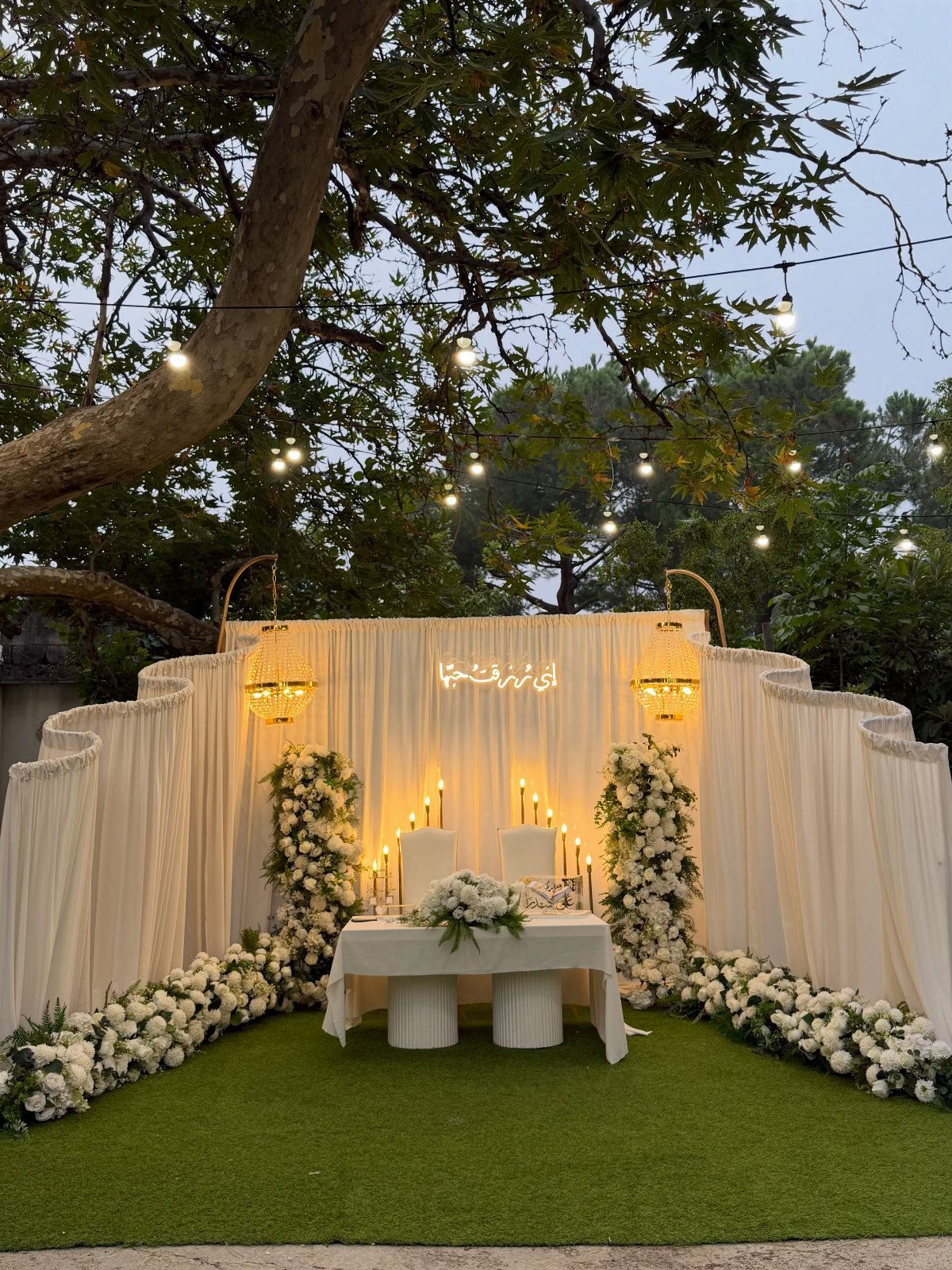
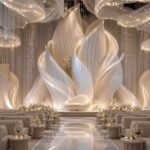
Fabric alone can carry a ceremony if you commit to the volume. White panels curved like sails, hung from a tree’s limbs with chandeliers dropped between them, let the fabric serve as architecture rather than decoration on top of one.
Chiffon and silk move differently in breeze than tulle, which can read costume-y if the yardage is thin. For a bold turn, swap the white for saturated color: cobalt, poppy, a deep marigold.
The frame underneath determines whether this reads tent or altar; four posts give you a canopy, a single branch gives you something looser and less expected.
Cost rises with the height you need to rig, since every extra foot of drop is another foot of fabric to buy and weight to secure.
4. Tree-Centered Altar
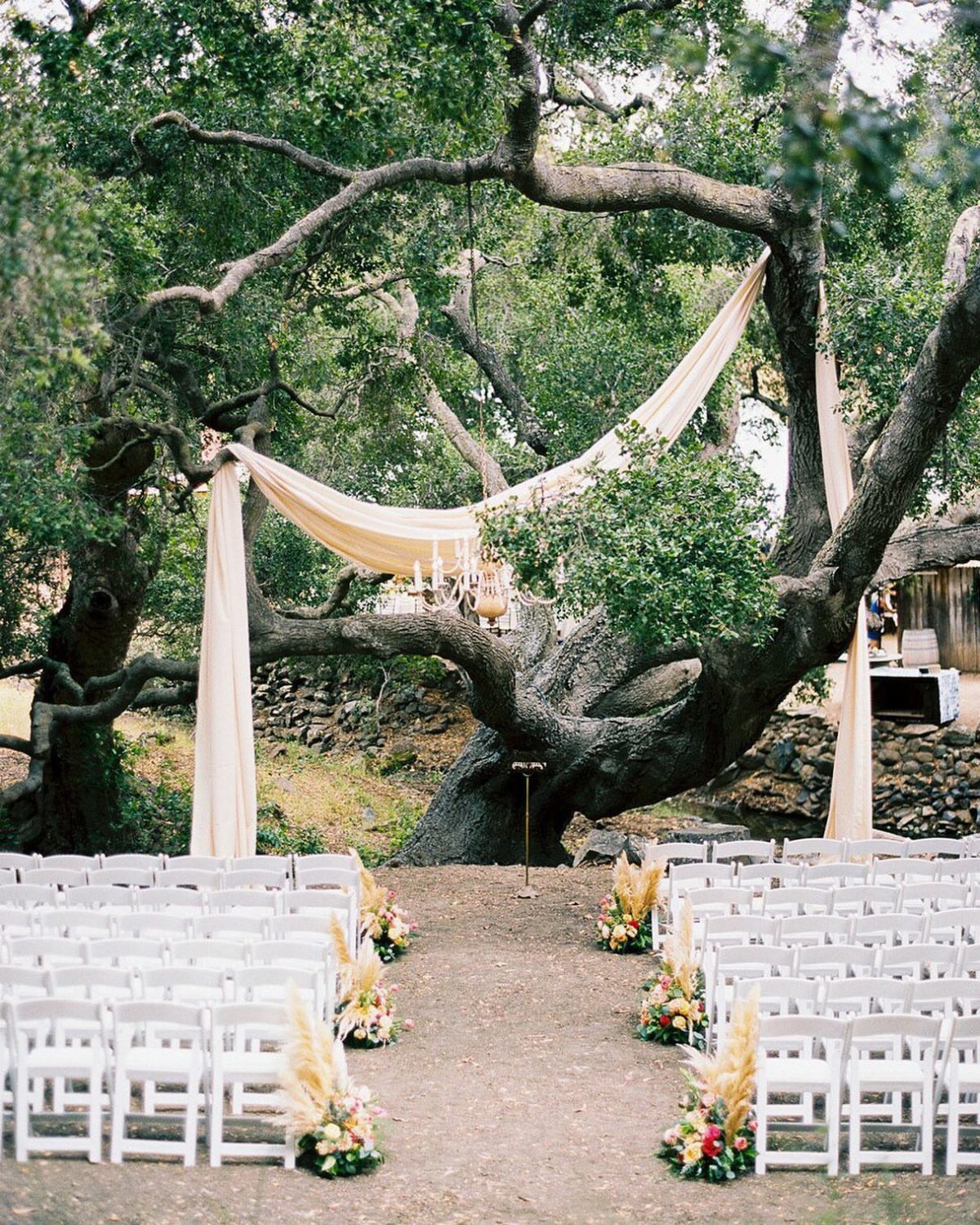
A tree that is already there costs nothing and cannot be replicated. An oak draped with cream fabric and a single hanging light keeps the gesture modest against the scale of trunk and branches.
Your tree needs a spread wide enough to frame both of you standing, not just to mark a spot; walk the distance yourself before setting chair rows.
Fairy lights strung through upper branches turn practical at dusk, and a floral garland at eye level gives guests a focal point without competing with the bark.
The minimalist version, a few chairs and a cleared aisle, works only if the tree is genuinely grand; otherwise the eye wanders to what is missing.
Check the root zone for level ground, or budget for a platform: a twisted ankle in a long skirt is not the memory you want.
5. Floral Arch
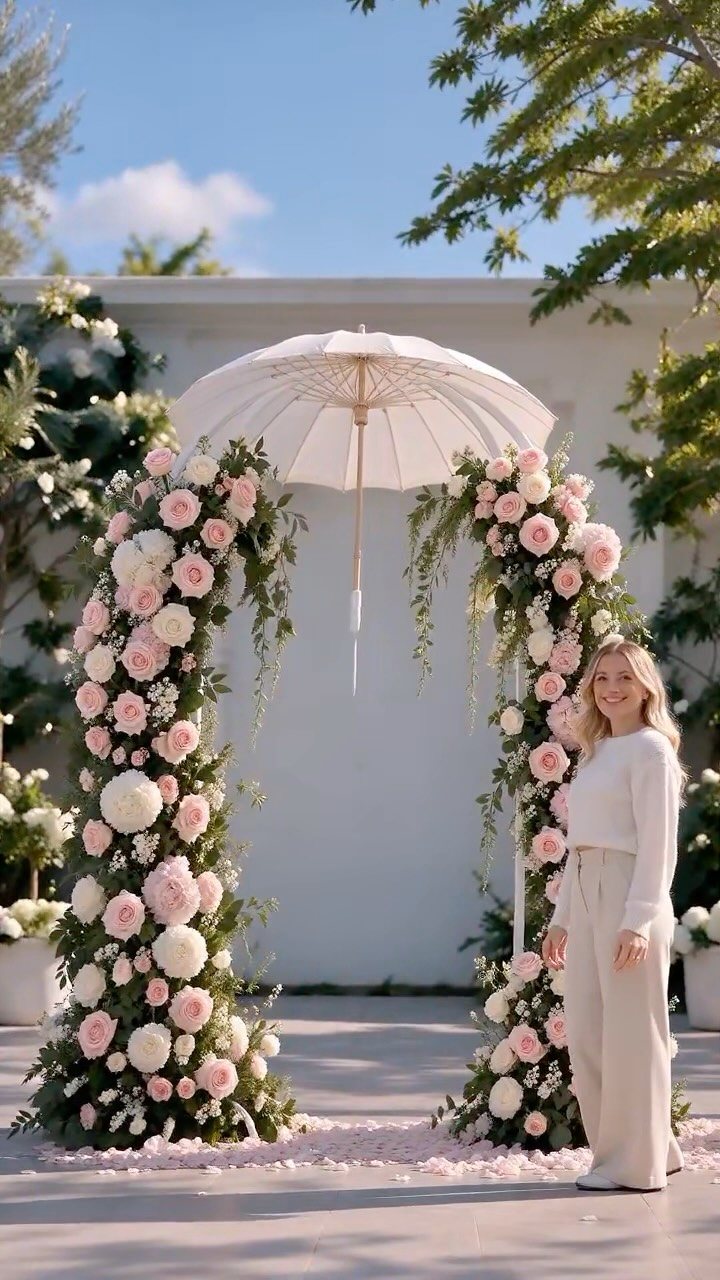
The floral arch is the choice you make when you want the flowers to do the talking and the structure to disappear.
Seasonal and local blooms keep the color from drifting toward funeral-home pink in July or hothouse stiff in October; ask your florist what is at peak the week of your date, not the month.
A cascading asymmetry, heavy on one side, photographs better than a balanced wreath but needs checking from the guest side, not just the aisle. This suits any venue that already has some formality: a garden, a lawn, a terrace.
The cost is in the flower count, not the frame, and a full-bloom design runs higher than greenery-based alternatives by a visible margin.
6. Floral Canopy
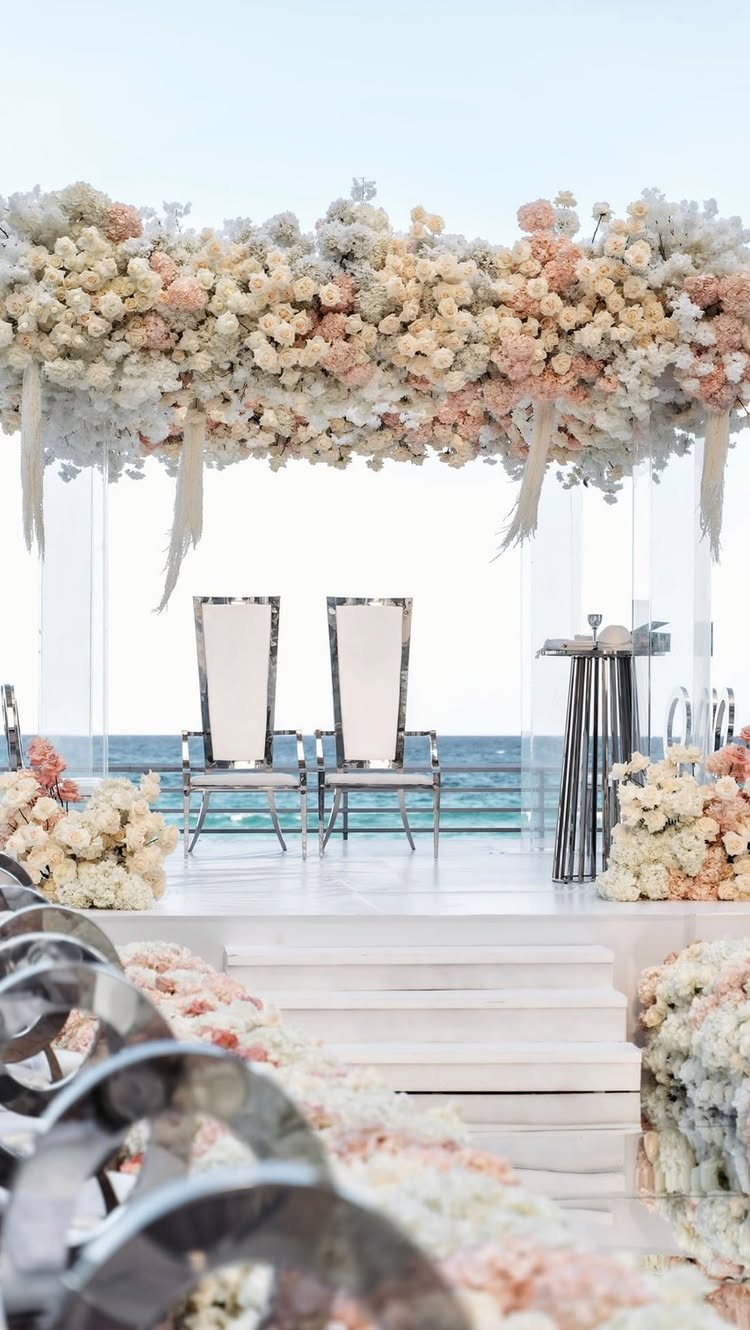
A floral canopy inverts the usual arrangement: instead of flowers behind you, they hang overhead, and the ceremony happens underneath.
Clear pillars hold a dense roof of white, peach, and cream blooms over a white stage facing the ocean, so the view stays open while the ceiling closes in.
That density of hanging material needs engineered support; a wooden frame or metal rig is not optional, and the labor to install it is a separate line item from the florals.
The effect is closest to a garden room, and it suits outdoor sites where the horizon is the point: beach, cliff, wide lawn.
Indoors, the scale compresses and the canopy can feel low; I would use this only where the sky or water is part of the backdrop.
Greenery-only versions bring the cost down and the light up, if your venue timing is midday.
7. Vintage Door Altar

Old doors carry the weight of other stories into yours. I like how the paint cracks and the hinges show; that history does half the work of making a ceremony feel grounded rather than staged.
Two matching doors set into a simple wooden frame give you the bones, and a garland of roses and greenery across the top finishes the frame without hiding it.
String lights after dusk turn the gaps between boards into points of light.
The doors are the one part that takes hunting: architectural salvage yards, estate sales, or family barns. Lace is an option, though the flowers and lights already do plenty.
Best for outdoor ceremonies where the surrounding trees and grass already feel a little wild. The vintage quality reads as romance, not costume, when the setting is informal.
8. Stacked Vintage Books Altar

A book arch frames the couple, but the same stack works at human scale as a small altar or as the surround for a sweetheart table.
The spine colors become your palette: group by tone or let them stay mismatched, whichever fits the rest of the day.
A floral arrangement on top softens the line where the stack ends, and a quote from a shared favorite tucked among the pages gives guests something to discover.
Sourcing takes time. Library sales, thrift stores, and estate auctions move by the box; aim for hardcovers with some height variation and avoid anything too valuable to the world.
The weight adds up fast, so the base needs to be solid wood or a low platform, not a skirted table that shifts.
This one wins for intimate weddings where guests know your story. The detail gets lost at scale, and the joke wears thin if neither of you actually reads.
9. Sculptural Modern Backdrop
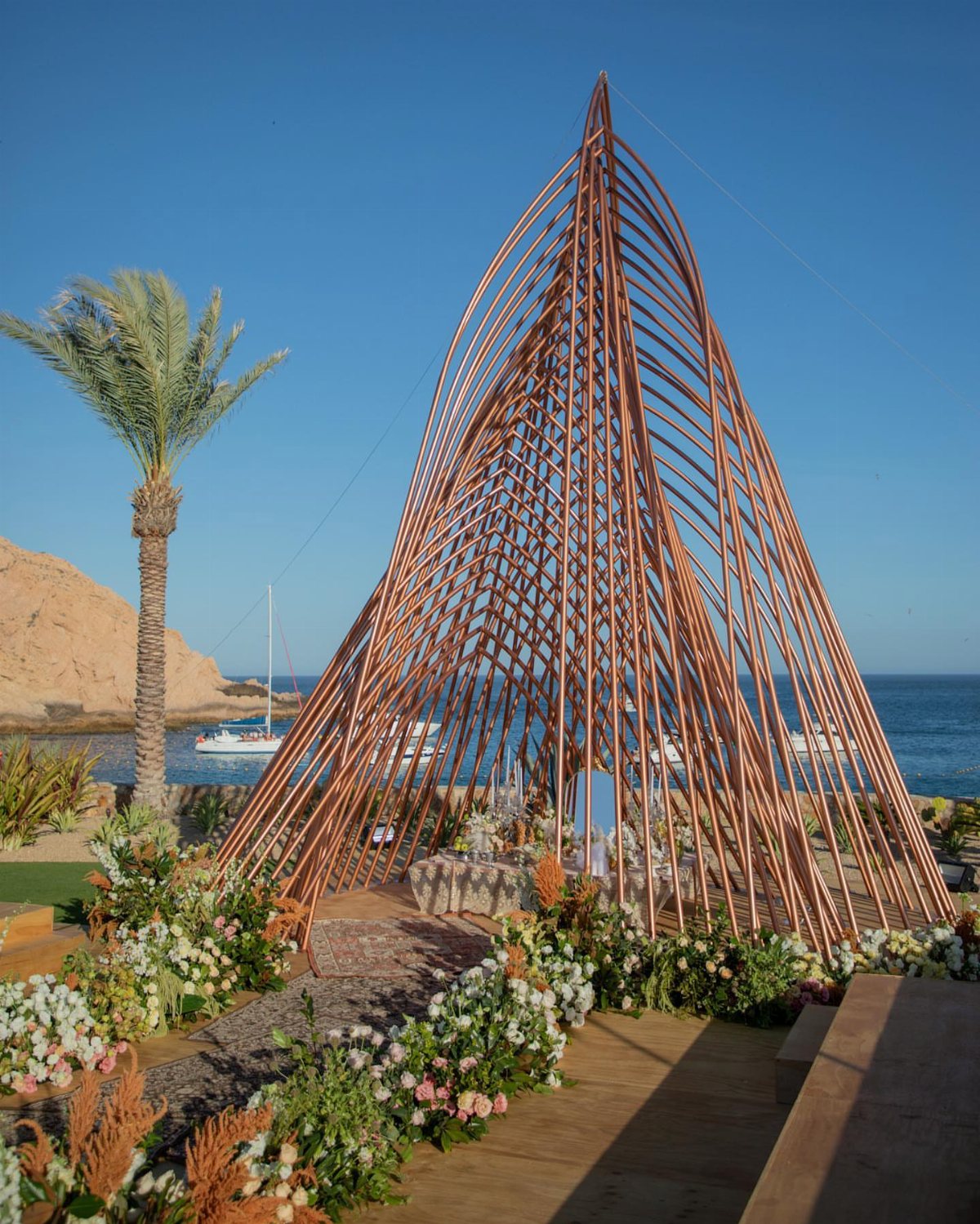
Copper pipe bends into a shape that belongs more to sculpture than to wedding tradition, and that is the point. The tall curve catches light and casts shadow, making the backdrop active rather than static.
Set beside open water, the metal picks up sunset tones; in a garden it would read cooler and more industrial.
The structure needs a specialist build or a rental company with this piece in inventory. Transport and leveling on anything but a flat deck add cost fast, so check the venue surface before committing.
Floral arrangements at the base ground it, but the pipe itself carries the visual weight.
I would use this for a modern, small guest list where the ceremony is the main event and the budget allows one striking element.
It trades warmth for impact; add a Persian rug and candle altar, as the photo does, or the space below stays cold.
10. Floral Semi-Circle Platform
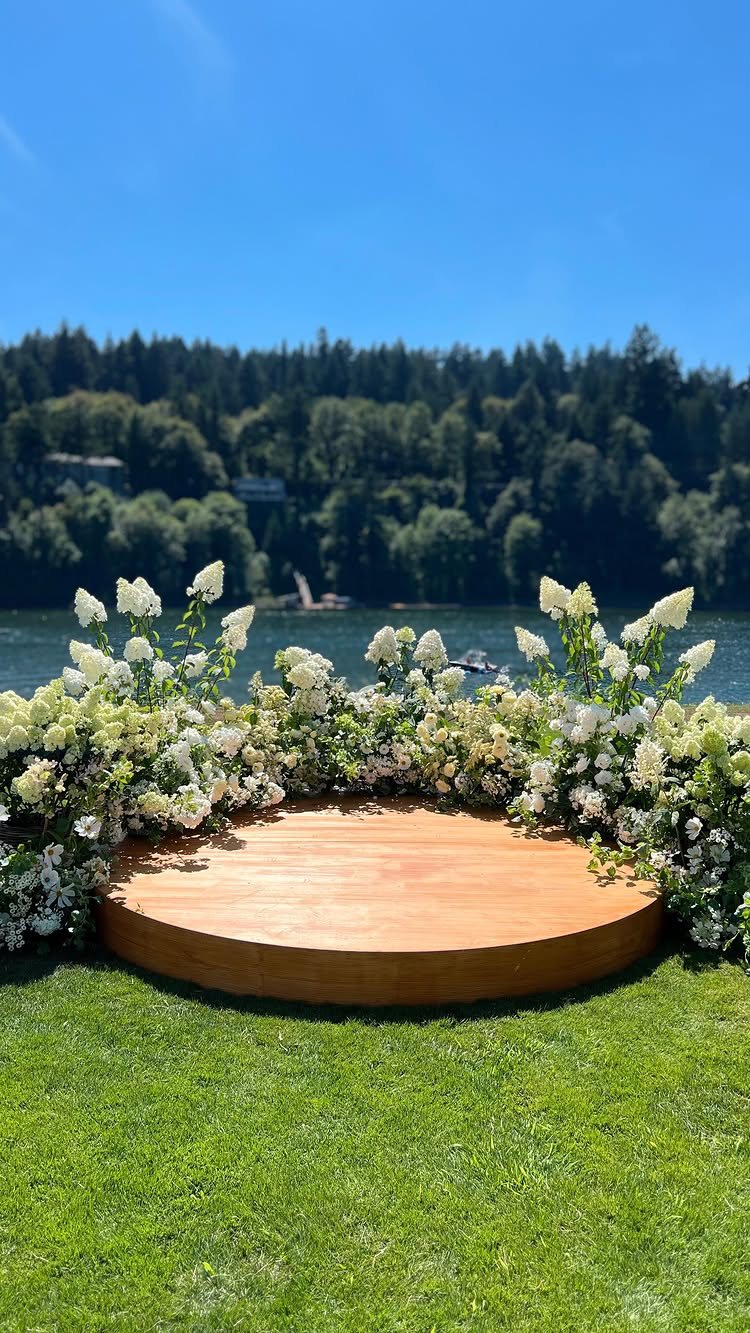
A low platform lets the landscape stay visible while still giving the couple a defined place to stand.
The semi-circle of flowers behind creates a natural focal point without blocking the lake and hills beyond, which is the balance that open-air ceremonies need.
Wood decking on grass requires a level base; even a gentle slope reads as a trip hazard in heels. The flower border wants irrigation or excellent timing, since a July afternoon wilts an unwatered installation.
White and cream blooms against green keep the palette quiet, letting the water do the color work.
This suits the couple whose venue is the reason guests traveled. Spend on the platform and keep the flower variety simple; the view is doing the heavy lifting.
11. Geometric Backdrop Structure
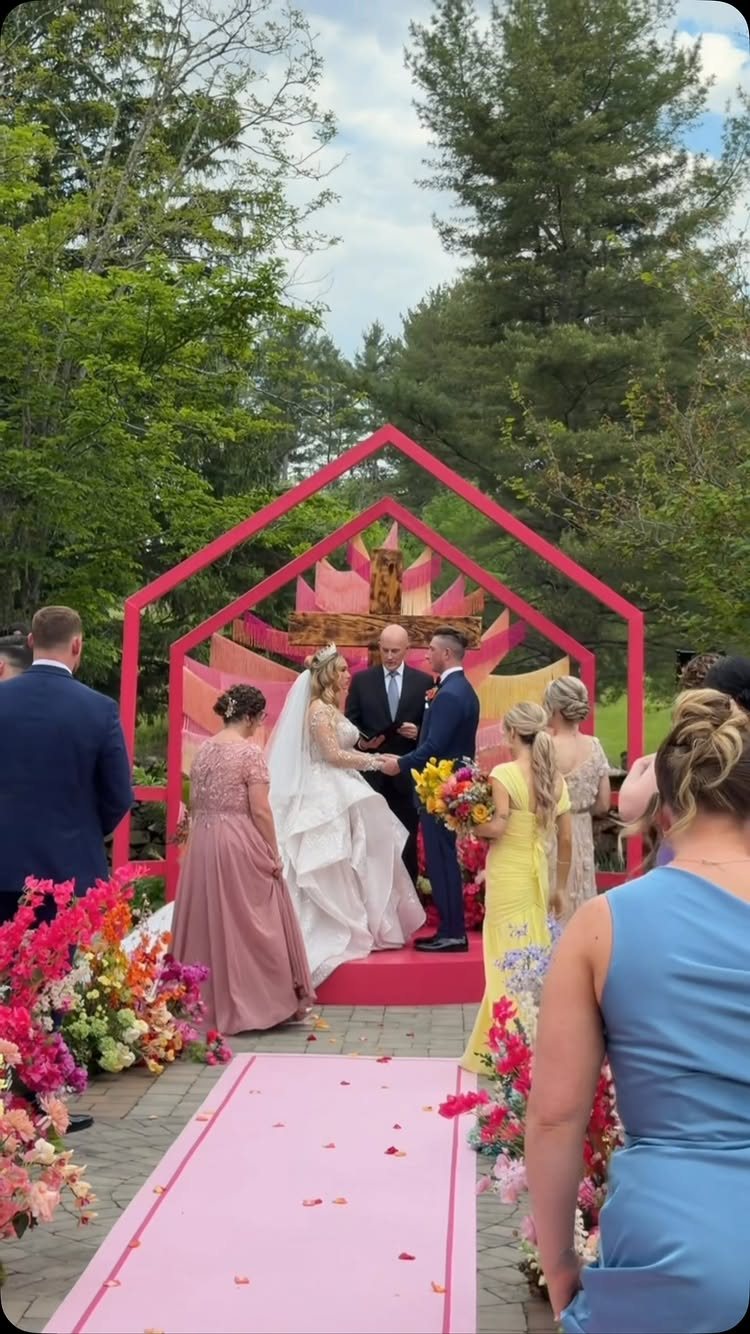
A geometric frame in bright pink makes a deliberate contrast with natural surroundings, and that boldness is not for every couple.
The house-shaped arch layers dimensional planes rather than hanging flat, which means it photographs from angles and reads as architecture rather than decoration. Floral arrangements at the joints soften the geometry without disguising it.
The color choice is the decision that makes or breaks this idea. Pink against lawn and sky works; muted tones against the same background would disappear.
Dried florals or single-bloom clusters keep the modern edge that the structure claims, while full traditional arrangements fight against it.
Rentals with this exact shape are limited, so a local fabricator or set builder may be the path. Budget for delivery and assembly time; these frames do not travel in pieces small enough for a standard van.
12. Fluted Columns with Floral Toppers
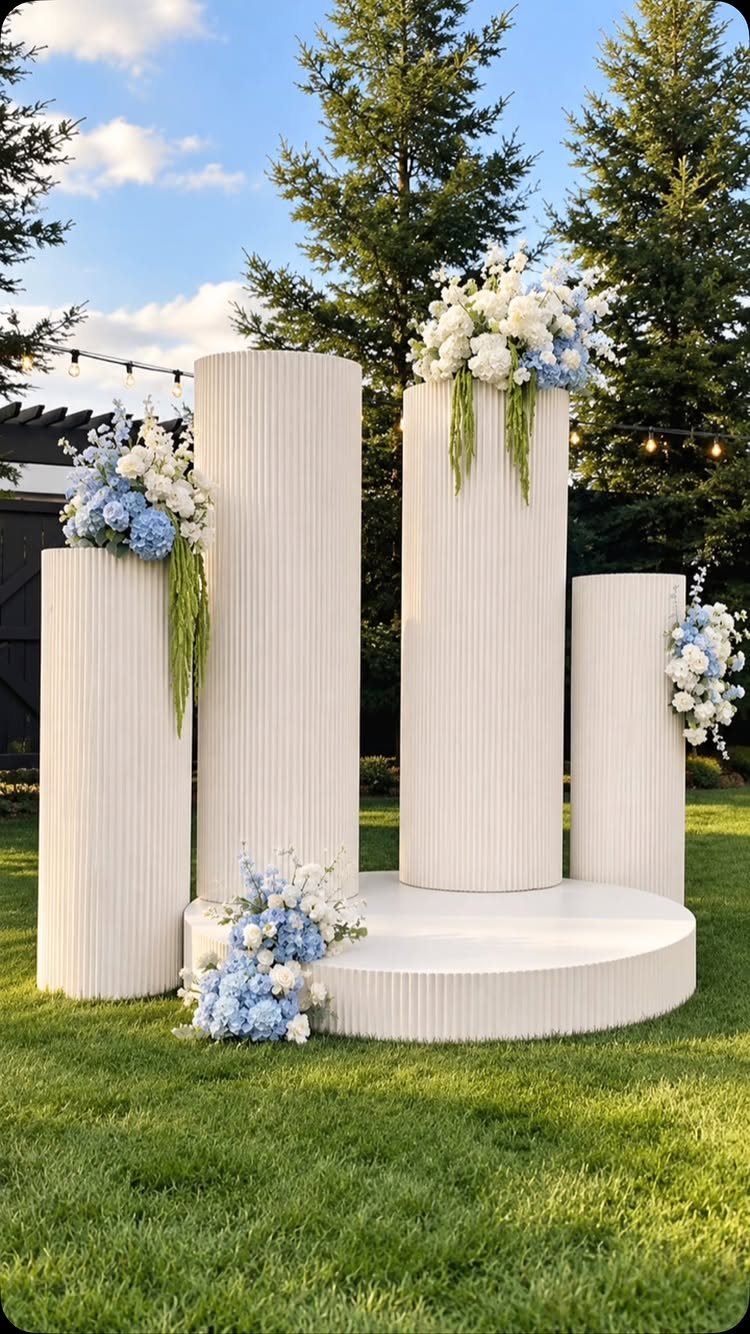
Varying heights turn identical columns into a composition rather than a fence. The fluting catches light vertically, which lengthens the silhouette, and the circular stage contains the setup so it reads as one piece rather than scattered furniture.
Blue and white flowers on top repeat at the base, which is the detail that keeps it from looking like afterthoughts set down on posts.
The columns are the easy part: plaster or lightweight composite versions rent from most event suppliers. The circular platform is the custom element, and its diameter needs to fit the wedding party without crowding.
Check that the tallest column still clears any tent ceiling or tree branch overhead.
This idea travels well from garden to ballroom, though the outdoor version gains from the sky behind it.
I would use it for a ceremony with some formality in the dress code; the classical reference reads as intentional rather than pretentious when guests have dressed for the occasion.
13. Antler Accent Wooden Arch

Antler accents belong to weddings that already lean rustic, western, or mountain lodge.
The skull and rack sit where another arch might carry a wreath or fabric drape, so the statement is immediate: this couple’s version of rustic includes hunting tradition or ranch heritage, not just barn wood and mason jars.
The dark stain on the arch matters as much as the antlers. I would check local game laws before buying antlers online.
Some states require proof of natural shed or lawful harvest, and a venue on public land may have its own rules about displaying animal parts.
Floral sprays on both posts soften the silhouette without hiding the antlers. Too little greenery and the arch looks taxidermy-heavy, too much and the antlers might as well be driftwood.
14. Floral Urns on Pedestals

A pair of urns on pedestals frames the ceremony without building anything overhead. For outdoor sites with wind, ocean views, or tall trees already doing the vertical work, that lower profile keeps the focus on what surrounds you.
The urn itself carries the formality. A fluted classical shape in cream or white reads traditional; a matte concrete or aged terracotta version shifts the same idea toward modern or Mediterranean.
Pedestal height is the practical detail.
Fresh flowers in open air last the ceremony hour fine, but direct sun wilts white lilies faster than roses or greenery-heavy mixes.
I would ask the florist to hydrate the arrangement on site rather than deliver it staged, or sub in quality silk for a July afternoon.
Two urns suit symmetric ceremonies; one placed off-center, with the aisle curving toward it, works for smaller guest counts where a full processional feels like overkill.
Choosing the Right Altar
Your altar should look like it belongs to the rest of your day, not like a set piece wheeled in from another wedding. The vintage door altar works because its wear matches informal outdoor settings where nothing else is polished.
If your reception is black-tie in a hotel ballroom, those same doors read as a theme park prop.
The practical check is color temperature. Copper pipe catches sunset tones outdoors; indoors under LED it can read orange and sickly.
Walk your venue at the hour you will marry, not at noon when you tour it. The altar that looks romantic at 2:00 PM can look haunted at 6:00.
Incorporating Natural Elements
A tree already growing on the property gives you height and presence no florist can rent you, and the price is built into the site fee.
The centuries-old oak needs only fairy lights and a single garland at eye level; anything more competes with the trunk.
I pace the aisle myself once the chairs are down, since the walk looks shorter on paper than it feels in heels.
Fire accents suit mountain, desert, or evening weddings where the temperature drops. A fire pit or torches adds warmth, but check local burn restrictions and your venue’s insurance before committing.
Boulders, ponds, and dry creek beds that belong to the land itself become the architecture of the ceremony, no delivery truck required. The rule is enhancement, not overpowering: work with what is there rather than building in front of it.
Personalization Options
Family heirlooms on the altar carry weight if they are visible.
A small object on a pedestal reads as clutter; something large enough to frame you both, a quilt stretched as a backdrop or a door from a grandparent’s house, becomes the architecture.
Warm metallics like brass and copper soften angular frames; matte black or crisp white keeps the same shapes feeling sharper and more current.
The shape itself can carry meaning, but only if you choose it for that reason rather than for the photograph.
Seasonal Considerations
Fruit clusters, figs, pomegranates, grapes, or citrus, add richness and symbolism styled into ceremony setups. They suit late summer and fall when the fruit is actually ripe; out of season they read as grocery-store props.
Frequently Asked Questions
What is traditionally on a wedding altar?
Flowers, candles, and personal items are the usual pieces. A floral arch or urn arrangement anchors the space, while candles add light for evening ceremonies.
Personal touches might be a family heirloom, a book with meaning, or a fabric choice that ties to the rest of the day.
What are some creative ideas for a wedding altar?
A circular arch in gold or bare metal reads modern, while a tree-centered setup uses what is already on the site.
Vintage doors from salvage yards, stacked books with spine colors as your palette, or a copper pipe sculpture each carry a specific mood.
Geometric frames in bold color, floral canopies hung overhead, and antler-accented wooden arches for mountain settings all move beyond the standard floral arch.
What are some good things to include in an altar?
Flowers that are seasonal and local to your week, not just your month, keep color alive and fresh. A chandelier or fairy lights turn practical at dusk.
Personal items like a quote tucked among book spines or a family piece give guests something to discover. For outdoor sites, always check root zones for level ground and plan for wind if you hang anything overhead.