These thirteen cakes run from showstopping sugar pearl installations to monogram details a couple can add themselves, with uneven tiers, cascading florals, and vintage Lambeth piping in between.
The deciding factor is how close your guests will stand to the cake table, since textured buttercream reads as craft only from a few feet away and tall tiers covered in sugar pearls hold up from across the room.
Sugar roses, wafer paper folds, and hand-placed pearls all appear more than once, which means most bakers who work in white already stock the materials.
1. Uneven Height Tiers with Sugar Flowers

Uneven height tiers turn a standard round cake into something that reads modern the moment guests walk into the room. The tallest layer draws eyes upward without needing extra width, which matters when your reception table space is already tight.
A flowy stenciled design follows the vertical line of uneven tiers, finished with sugar roses rather than fresh ones so the arrangement keeps its shape through a long evening.
I’d suggest this for a couple who wants height without the fuss of a cake topper or hanging installation.
A clear glass stand keeps the look light; a dark stand would ground it differently and shift the mood toward formal.
2. Wedding Cake with Lights
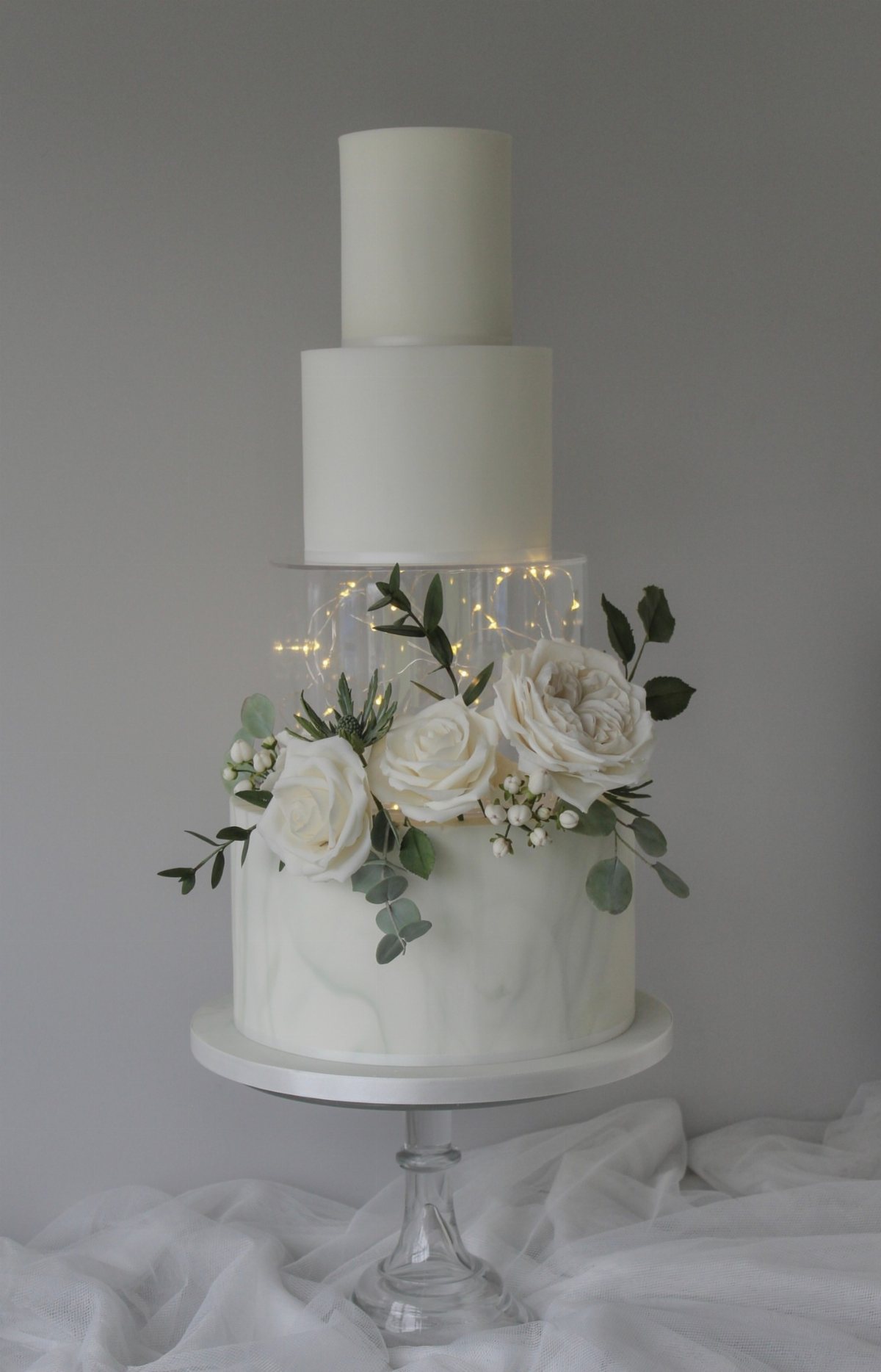
Fairy lights inside a cake tier solve a lighting problem most couples don’t think about until the reception: the cake table often sits where venue spotlights don’t reach.
The acrylic separator holding the lights is doing double duty as structure and lantern.
For a winter wedding, when darkness arrives during cocktail hour, this becomes practical as much as decorative. Silver initials on the middle tier add a personal mark without competing with the glow.
I’d check whether your venue allows open flames or electrical elements inside food displays; the rules vary, and battery-operated strands may be required.
3. Elegant All-White Design
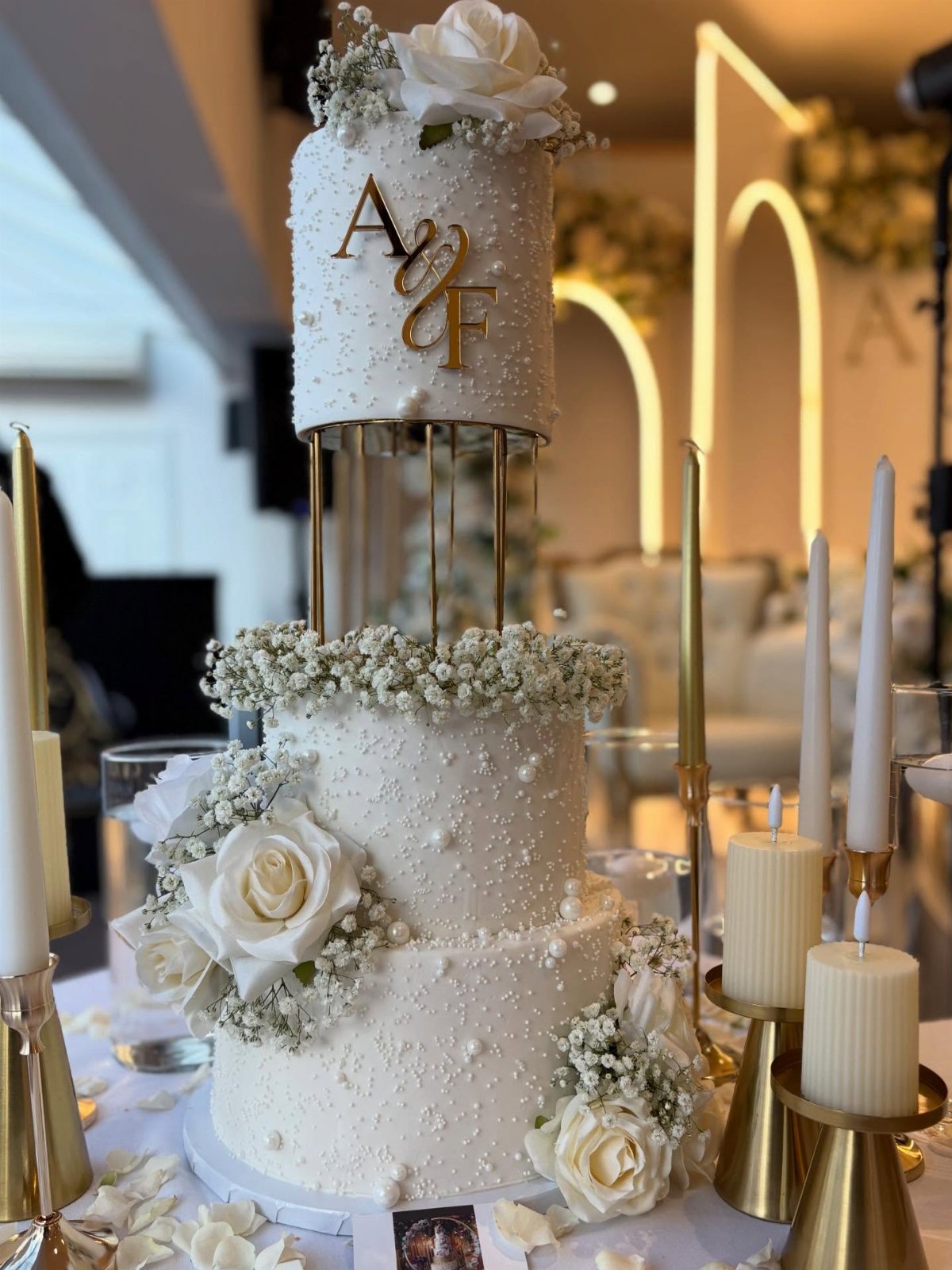
An all-white cake survives any trend cycle because white carries texture so well. Ruffles, quilting, lace impressions, or wafer paper folds all read as different designs without introducing a second color that might clash with your flowers or linens.
Sparkle from the pearls reads as texture, not as decoration.
This suits couples who want luxury without committing to a palette beyond white and cream. The gold accents are thin enough to swap for silver or rose gold if your metals change.
4. Cascading Florals
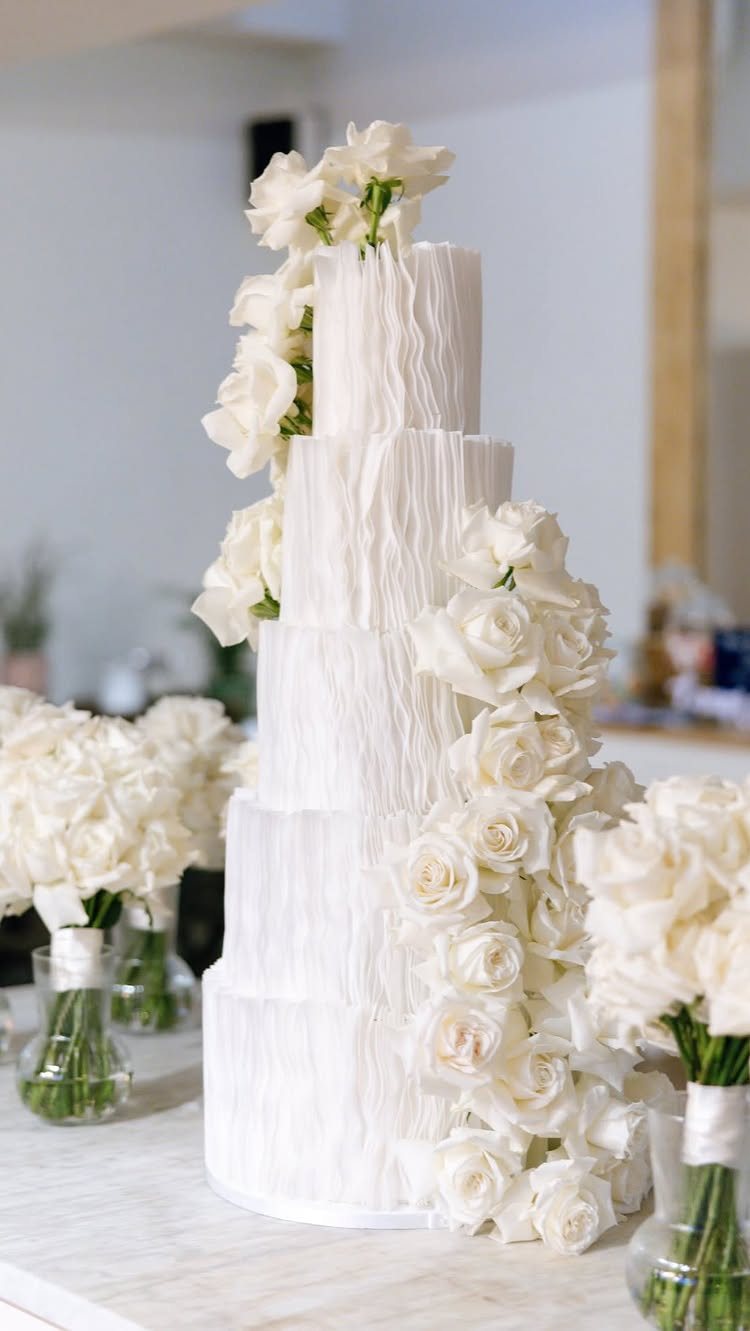
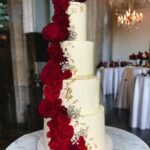
Cascading florals down a cake side make most sense when your florist is already handling abundant table arrangements and you want the cake to participate in that same language rather than sit apart as dessert.
Hundreds of hand-cut wafer paper pieces build a soft, flowing texture across five tiers before any flowers arrive.
That base texture means fresh roses have something to hold onto visually; without it, a cascade can look like flowers were stuck to a smooth surface as an afterthought.
Fresh white roses finished this piece. I’d ask your baker whether the cascade structure is built into the cake or added at the venue; timing affects how long those roses stay crisp.
5. Textured White Cake
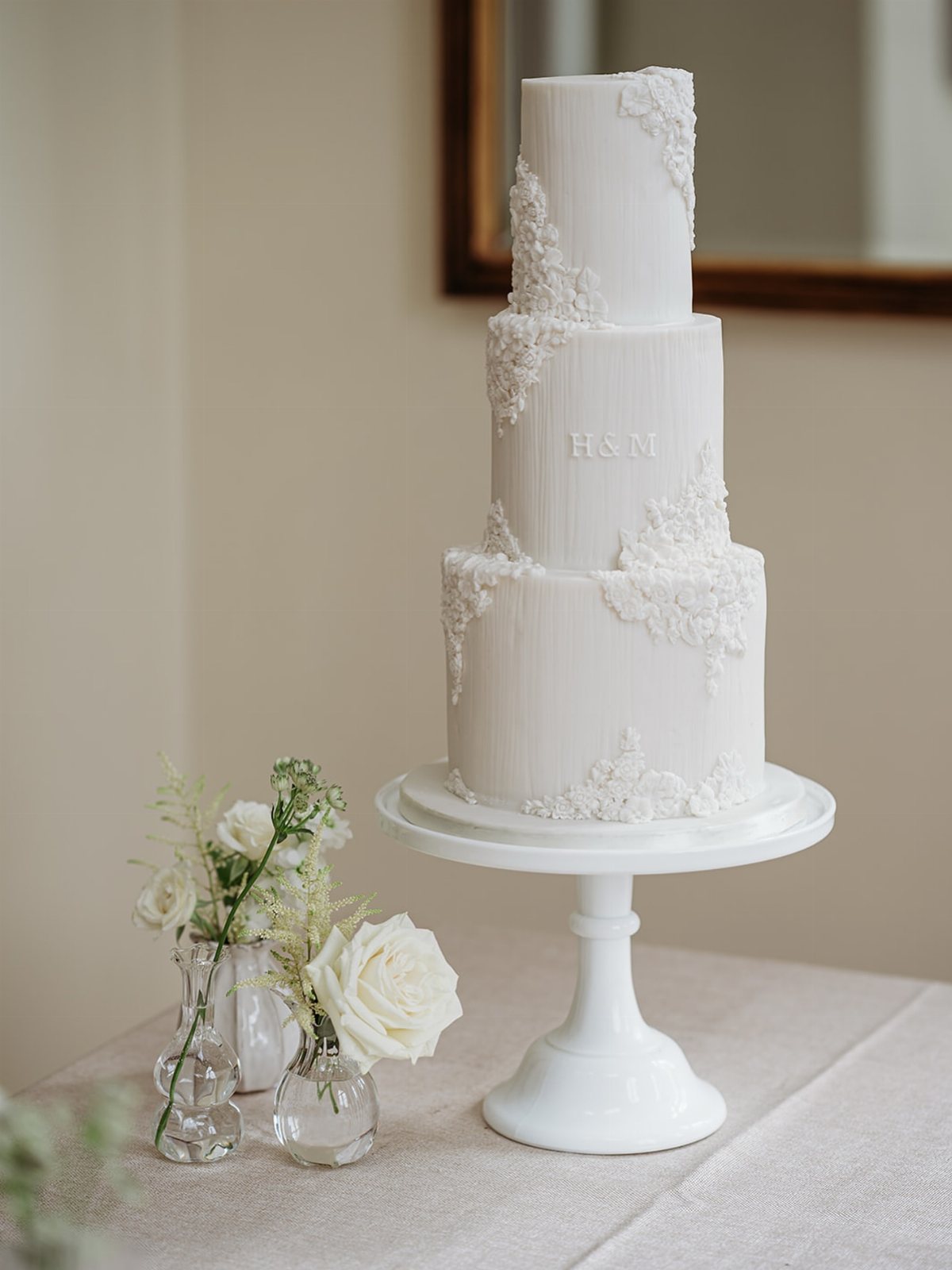
Vertical texture on buttercream reads as modern in a way that smooth fondant rarely does, and it forgives the small imperfections that outdoor summer weddings guarantee.
Lace-like sugar florals and embossed stripes in the same tone let the eye read pattern rather than decoration.
Piped buttercream patterns need a baker comfortable with freehand repetition; stenciled designs are more uniform but require a different skill set. Ask to see a sample board if you’re deciding between the two.
Sugar flowers add cost but travel better than fresh, and they keep if you want to save a tier.
I’d use this for a garden or barn setting where rustic texture already dominates the room and a glossy cake would feel out of place.
6. Vintage Lambeth Piping

Lambeth piping, the frilled butterwork that covered mid-century wedding cakes, returns now as a deliberate vintage reference rather than a default decoration.
Flowers are optional with this technique, which keeps costs down and suits couples who dislike the look of fresh blooms near food. A round or square base works as well; the heart shape reads celebratory but not required.
The piping itself takes time, so this is not a last-minute order.
I’d choose this for a small reception where guests will actually walk past the cake table and notice handwork, or for anyone whose parents married in an era when this style was everywhere and will recognize the reference immediately.
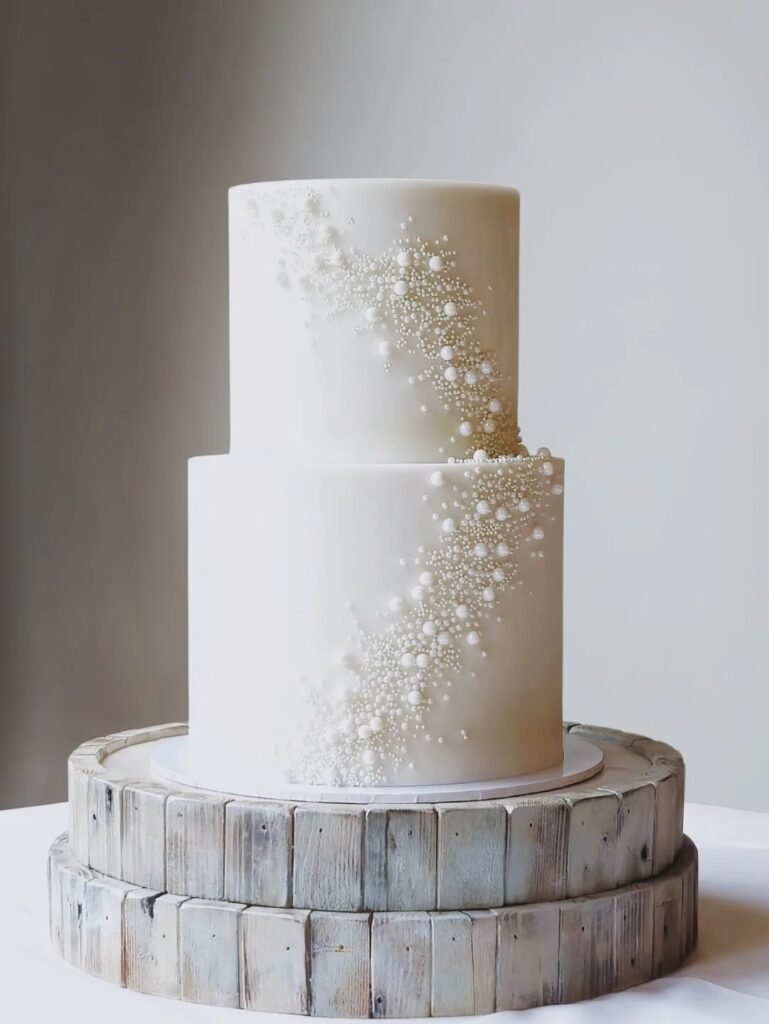
7. Tall Tiers Covered in Sugar Pearls

Tall tiers covered in sugar pearls catch light differently than frosting alone, turning the whole cake into something closer to jewelry than dessert.
The pearls need real height to read as pattern rather than accident, so this idea works best when you are already planning 3 tiers or more.
A baker who builds these regularly starts the pearls at the base of each tier and lets them thin toward the top, which keeps the eye moving upward.
The cost lands in the hours, not expensive materials; sugar pearls are standard supply, but placing them takes time.
I’d reserve this for a reception where guests will pass close enough to see the detail. From across the room it reads as texture.
Up close it reads as craft.
8. White Roses and Pearls
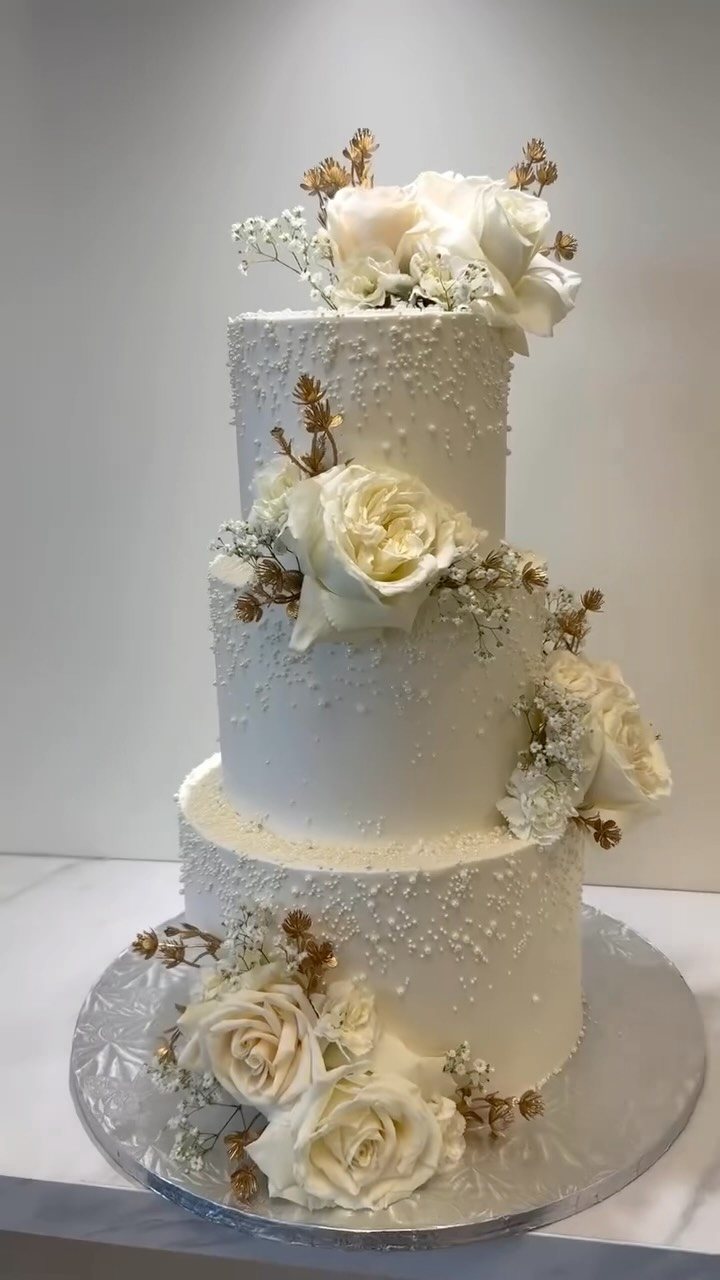
Fresh white roses plus edible pearls give you two different whites at once: the soft, uneven white of petals against the hard, consistent white of sugar. That contrast is what keeps an all-white cake from going flat.
The roses go in last, within an hour of display if you want them fully open, or the night before if you prefer them tighter. Either way, they need water picks or a barrier; rose stems will stain buttercream.
The pearls can be piped days ahead, which splits the workload nicely.
This combination borrows from formal tradition without requiring a traditional budget. The roses are the splurge, the pearls are the labor.
A bride doing partial DIY could handle the pearls herself and hand the flowers to a florist.
9. Monogram Initial Details
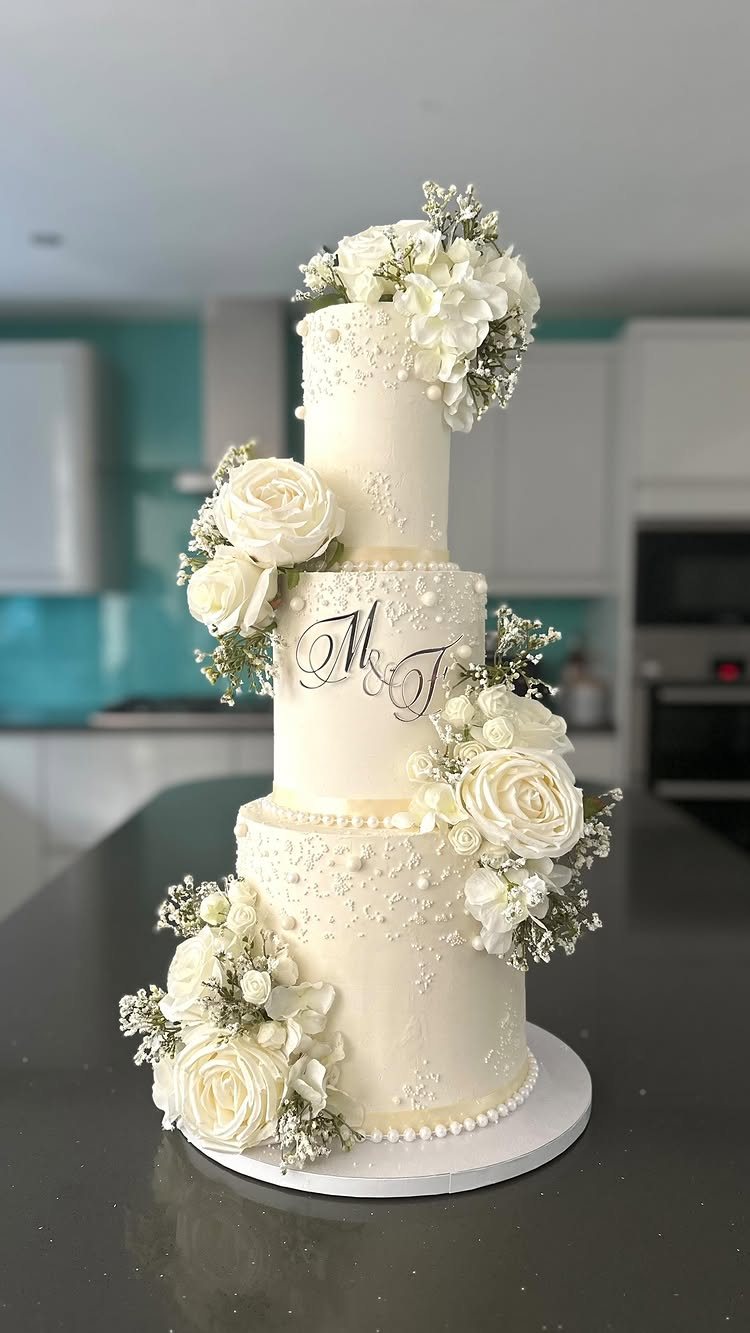
A monogram on the middle tier turns a standard cake into property of the couple, not just dessert for the crowd.
The placement matters more than the lettering style: dead center on the middle tier draws the eye straight to the names, while off-center reads as casual, even accidental.
Script initials in thin metal or painted gum paste both work; metal reflects light and reads from farther back, gum paint blends softer and photographs without glare.
Either way, the initials need scale, tall enough to hold their own on the cake’s base tier or they disappear.
One baker who uses this design often pairs it with small pearl dots framing the letters, which gives the monogram a finished edge without adding another color. The whole detail takes little time to place but reads as custom work.
Frosting Techniques
Smooth buttercream starts with butter that has actually reached room temperature, soft enough to leave a dent when pressed but not melted at the edges. Cold butter will not incorporate air properly no matter how long you beat it.
Beat the butter alone for 5 to 8 minutes before adding anything else; this step is what creates the silky base.
Clear vanilla extract keeps the frosting white rather than ivory, worth the extra trip if you are after a pure white finish.
Add powdered sugar at low speed, 1 cup at a time, then thin with heavy cream to the consistency you need. A final 3 minutes on the lowest speed removes air bubbles that would telegraph through fondant or show in bare buttercream.
DIY Wedding Cake Tips
A three-layer, 9-inch cake feeds 14 people. That is not a wedding.
It is, however, a display cake that sits at the head table while cupcakes from the same recipe feed the room.
Most couples who need to stretch a tight budget bake one small tiered cake for the photos and the first cut, then set out sheet cake or cupcakes in the back for the rest of the guests.
Same batter, same frosting, no one goes hungry.
Cake flour and egg whites together give the structure you need for a cake that will sit out through a long reception without turning tough or yellowing.
The egg whites keep the crumb white; the lower protein in cake flour keeps it tender under buttercream weight.
If you are nervous about tiered construction, a single display cake with sheet cakes in the kitchen is the old professional solution, and it works for home bakers too.
Cake Size Considerations
One 9-inch, three-layer recipe yields 14 servings. Plan from that number rather than guessing.
For a wedding of 100, you need 7 times the batter at minimum, and that assumes everyone takes one modest piece. Round up.
The common mistake is baking exactly to the head count and watching the last tables go without.
A 14-inch round from the same recipe scales differently; it looks substantial but still does not stretch far. Cupcakes solve the math neatly, and they let you display a small, perfect cake while hiding the volume in the kitchen.
If you want a true tiered cake for 100 or more, you are into structural engineering: internal supports, dowels, boards between tiers. That is not a Friday night project.
Order the display cake from a baker and make the sheet cakes or cupcakes yourself if the budget demands it.
Seasonal Cake Ideas
All-white cakes carry winter better than most palettes. Sparkle reads as frost, sugar pearls as snow, and the whole thing gains atmosphere against early darkness rather than fighting it.
That same cake in summer needs different handling. Sugar flowers travel and hold where fresh wilt.
The versatility is in the white itself. A winter reception can take silver and crystal; a summer garden, the same cake with softer shadows and no metallic.
The cake does not change. Everything around it does.
Frequently Asked Questions
What does a white cake symbolize at a wedding?
White has long stood for purity in Western wedding tradition, which is why it became the default choice for cakes as well as dresses.
The color also carries a practical advantage: it reflects light well in dim reception spaces and pairs with any flower or linen palette without clashing.
That flexibility helps explain why white remains the reference point couples picture when they imagine a wedding cake, even as other colors have become common.
What are the trendy wedding cake trends for 2026?
White cakes are returning as a deliberate choice rather than a default, with bakers treating the single color as a constraint that drives creativity.
The current direction favors texture over added color: ruffled fondant, vertical buttercream ridges, sugar pearls, wafer paper folds, and Lambeth piping all add interest without introducing a second hue.
These approaches let the cake read as modern or vintage depending on technique, while still coordinating cleanly with whatever flowers and linens the couple chooses.
What flavor is traditional white wedding cake?
Traditional white wedding cake is typically vanilla, though the "white" refers to the color of the crumb rather than the flavoring. Bakers often add almond extract for depth, since egg whites and clear vanilla alone can taste flat.
A traditional white wedding cake keeps the interior pale, usually vanilla or almond, so the crumb stays neutral against white buttercream or fondant and the outside design gets the attention.