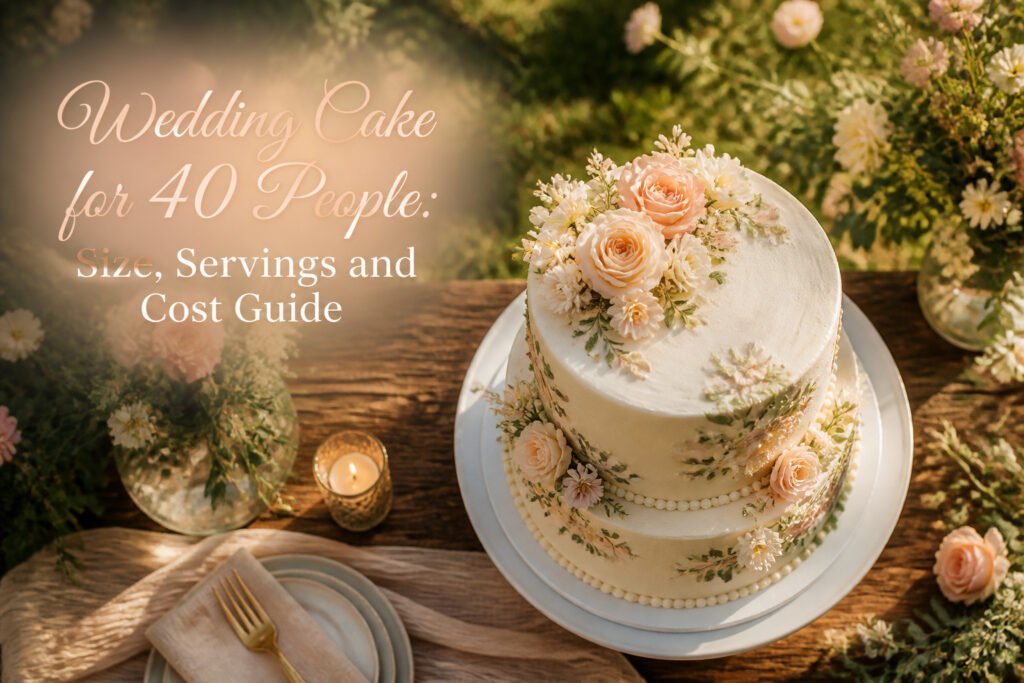
A wedding cake for 40 people tastes best when you do not order for 40 people. Most bakeries expect you to multiply your headcount by 0.8, which lands you at 32 servings, or drop to 0.7 if a dessert table shares the load.
The two-tier 6-inch plus 8-inch round sits right at that edge at 30 to 40 servings, which means the safer play is often a single 10-inch tier or a backup kitchen cake cut in the back at half the decorated price per slice.
What You Need

Sizing a cake for 40 people means gathering a few numbers before you call the bakery. Here is what to have ready:
- Your guest count, then multiply by 0.8. Not everyone eats cake, so the 80% rule is the standard starting point. For 40 guests, that means roughly 32 servings to order toward.
- A serving chart to check against. Round tiers break down as follows: a 6-inch serves about 14, an 8-inch about 26, a 10-inch about 38. For 40 guests, a two-tier 6-inch plus 8-inch combination lands near 40 servings, which gives you a small buffer above the 80% estimate.
- Optional kitchen cakes. A smaller display cake with sheet cakes cut in the back keeps the visual impact without paying tiered prices for every slice. Some bakeries build these with the same layers and finish so the plate looks identical.
- Contact information for your bakery. Serving counts shift by how they cut, and every cake is quoted individually by size and design. Call with your numbers and let them confirm the tier combination that matches your count.
Size the Cake

- Start with the number you expect in the room, not the number you invited. RSVPs drift, and a headcount padded by maybes leaves you paying for slices no one claims.
- Multiply that realistic count by 0.8. Drop to 0.7 if you are also putting out a dessert bar or late-night donuts; hold at 1.0 for plated service or if you want leftovers. For 40 guests, that lands you at 32 servings, or 28 with extra desserts.
- Match that number to the tier chart. A single 10-inch round yields 38 servings, which overshoots slightly but works if you want cake to spare. A two-tier 6-inch plus 8-inch combo lands at 30 to 40 servings, closer to the bone but enough if your multiplier came in at 0.8. Between sizes, take the smaller display cake and add kitchen cakes.
- Kitchen cakes are sheet cakes cut in the back and served from the kitchen, priced at about half the decorated rate per serving. They let you keep the visual impact of a modest tiered centerpiece without the cost of scaling the whole display.
- Send that final serving count to the bakery for your quote. The number you land on here sets the budget conversation, and it moves the price as much as the design does. Lock the size before you book the tasting; dates disappear fast in peak months, and bakeries need a hard count to hold yours.
Serving Sizes

A standard wedding serving runs smaller than most guests expect: a 1 x 2 inch slice from a 4-inch-tall tier. The Wilton serving guide, which most bakeries follow, bases all counts on that cut.
Ask whether your baker counts by the wedding slice or the wider 1.5 x 2 inch party cut; the same tier drops from 38 servings to about 28 when the slice widens.
Shape matters too. Square tiers squeeze extra portions from their corners, yielding roughly 30 to 35% more servings than round tiers at identical diameters.
A three-tier square stack of 6, 8, and 10 inches serves about 100 wedding-cut portions where the same sizes in round land at 74.
| Tier Setup | Round Servings | Square Servings | Best Fit |
|---|---|---|---|
| 6-inch single | 12–14 | n/a | Tiny cutting cake |
| 8-inch single | 20–28 | n/a | Under 30 guests |
| 10-inch single | 38–45 | n/a | 40 guests, minimal |
| Two-tier 6 + 8 | 30–40 | n/a | 40 guests, some risk |
| Three-tier 6 + 8 + 10 | 74–85 | ~100 | 40 guests plus leftovers |
| Four-tier 6 + 8 + 10 + 12 | ~130 | ~172 | 100+ guests |
For a party of 40, the two-tier 6 + 8 inch round sits right at the edge at 30–40 servings. The safer play is a 10-inch single tier at 38–45, or the three-tier stack if you want height and a buffer.
The 80% Rule

Most couples order too much cake, not too little. The bakers I have talked to all say the same thing: plan for about 80% of your confirmed guest count, and you will still see slices disappear to the last crumb.
When your reception includes a dessert bar with cookies, pie, or candy, that share drops closer to 70%. The Knot’s planning team lands at 70% for those situations, while Zola floats a slightly wider band of 75 to 85%.
The range itself tells you this is judgment, not engineering.
How the cake reaches the guest matters as much as the head count. Plated service at each seat?
Almost everyone eats it, so nudge back up toward full count. A self-serve table where guests graze?
70% holds. The cutting method counts too: a caterer working a proper two-inch grid from the edge inward yields clean one-inch slices.
A well-meaning volunteer with a dull knife turns that same cake into roughly 10% less usable dessert, which is one quiet reason venues charge those cutting fees.
Kitchen Cakes

Kitchen cakes solve the exact problem a forty-guest list creates: the gap between a cake that looks right in photos and one that actually feeds everyone.
An undecorated sheet cake, cut in the kitchen and plated alongside slices from the display tier, runs about half the per-serving price of decorated cake.
The guest gets identical cake, same flavor, same filling; the only missing piece is the piping labor nobody eats anyway.
The real savings show up when the head count drifts past what your display cake comfortably covers.
A three-tier display meant for seventy-four guests plus a kitchen sheet for the overflow costs noticeably less than bumping that display to four tiers, because decoration drives the price, not flour and butter.
Dummy foam tiers, the other common workaround, still need to be iced and finished, so they save almost nothing by comparison.
One limit worth naming: the bakery has to bake the kitchen cake with your order from the start. It is not a rescue for a too-small cake ordered elsewhere.
Plan it when you plan the main cake, and the budget loosens without the display shrinking.
Cutting Technique

A 10-inch round tier holds 38 wedding servings only if the knife stays disciplined.
The Wilton standard counts a 1 x 2 inch slice cut from a 4-inch-tall tier, which means straight vertical cuts following the circumference, then clean horizontal divisions across the height.
Let the blade wander even slightly off perpendicular and portions balloon into 1.5 inches or more at the base. That freehand angle costs you eight servings from the same cake, roughly a 20% loss that turns a 40-guest plan into a shortfall.
I watched this happen at a cousin’s reception where the venue staff sliced from the center outward like a pie.
The wedges looked generous, but guests were holding slices closer to 2 x 3 inches, and the bottom tier of a 6-8-10 stack disappeared before half the tables were served.
The couple had paid for 74 servings on paper and fed perhaps fifty in practice.
The fix is simple but not intuitive: remove the top tier entirely, then cut a ring around the outer edge of the exposed tier, working inward in concentric circles. Divide each ring horizontally into 1-inch bands.
For square tiers, the corners hold extra cake, so a 6-8-10 square stack yields about 100 servings instead of 74 from the same footprint. Same per-serving price at most bakeries, more insurance against a heavy hand with the knife.
Design and Cost

A buttercream finish runs lower than fondant work with hand-modeled details, though the base serving count for 40 guests stays the same either way. The difference is labor hours and materials beyond that base price.
For a smaller guest list, the simpler finish is often where the budget wins without anyone noticing at the cake table.
I have watched couples fall for a fondant quote that doubled the cake budget before the flowers were priced.
The 80% rule means you are already ordering slightly under your headcount; the design finish is where you claw some of that back.
A two-tier round in textured buttercream, maybe with a single real flower from the florist, photographs clean and costs far less than the same tiers wrapped in sugar paste with piped lace.
Sheet cake from a grocery store serves more guests per dollar, a quarter sheet at 9×13 inches feeding 24 for $22 to $45. A quality bakery’s round cake of similar yield costs $120 to $200.
The gap reflects structural complexity, decoration, and ingredient quality. For a 40-person wedding, the question becomes whether the cake is your centerpiece or your dessert.
If it is both, the custom round justifies itself. If cake is one of several sweets, the simpler finish or the sheet option keeps the math from overtaking the day.
Dummy Tiers

A cake built for forty guests sits on a table without much vertical presence. Most couples notice this during the tasting, when the baker wheels out a three-tier dummy and the real thing suddenly looks like a birthday dessert.
Decorated foam tiers add height and drama without adding a single serving.
The cost picture is where this gets uneven. One bakery might quote you close to the price of real cake because the fondant work and hand-piping take the same hours either way.
Another sees dummy tiers as a way to win your order and prices them closer to material cost.
The only way to know is to ask two bakers the same question: what does the display cake cost if the bottom tier is foam?
Photographers tend to love the extra height.
A four-tier silhouette fills a frame in a way two tiers of sponge simply do not, and when your guest count tops out at forty, that visual weight has to come from somewhere that is not cake.
Dietary Restrictions

Dietary restrictions need their own track when you are sizing wedding cakes for 40 people. Gluten-free and dairy-free batters do not behave the same way in standard pans, so the yield per tier changes.
A baker will often use different dimensions entirely for these recipes, which means serving counts from the main cake do not transfer over.
The safer move is to pull those guests out of the total headcount and order their portions separately, whether that means a small satellite cake, a batch of cupcakes, or another alternative that the same bakery can produce.
Many makers do offer these options, and handling them as a standalone order keeps the math clean on both sides. One detail that gets missed at the last minute: the service table.
Alternative cakes have to be labeled clearly when they go out, because a guest with a serious restriction will not be able to tell the difference by sight alone, and a server working quickly in a crowded room will not know which slice is which unless someone marked it beforehand.
Cultural Considerations

Background shapes whether the 80% rule applies at full strength or needs loosening. Some families treat cake as the sole dessert, period; others spread the sweetness across a table of smaller sweets.
The difference matters for a forty-person wedding, where dropping from eighty to sixty or seventy percent of your headcount changes the tier count and the final bill.
Plated service at each seat means order for 90 to 100 percent of guests; nearly every slice disappears. A self-serve cake table drops that to about 70 percent, since guests graze lighter than servers plate.
Add a competing dessert bar with cookies, pie, or late-night donuts and you are looking at 60 to 70 percent, with cake still going first if it is good.
The cutting style seals it: a caterer cutting a proper grid of one-inch slices hits the count, but an amateur with a butter knife loses roughly 10 percent to uneven portions. That is one quiet reason venues charge cutting fees.
Frequently Asked Questions
How much cake is good for 40 people?
A two-tier 6-inch plus 8-inch round lands at 30 to 40 servings, which covers 40 guests if you use the standard 80% rule. For a safer buffer, a single 10-inch round yields 38 to 45 servings.
A three-tier stack of 6, 8, and 10 inches gives you 74 to 85 servings if you want height and leftovers.
What is the 80% rule for wedding cake?
Order cake for roughly 80% of your confirmed guest count, since not everyone eats cake. Drop to 70% if you are also serving a dessert bar with cookies, pie, or late-night snacks.
Nudge back up to 100% for plated service at each seat or if you want leftovers to take home.
How many servings does a 10-inch cake provide?
A 10-inch round tier cut into standard 1 x 2 inch wedding slices yields about 38 servings. If your baker uses the wider 1.5 x 2 inch party cut, that same tier drops to about 28 servings.
Square tiers squeeze roughly 30 to 35% more portions from the same diameter.
What size wedding cake will feed 100 guests?
A four-tier cake with 6, 8, 10, and 12 inch rounds serves about 130, which covers 100 guests even before applying the 80% rule. The budget route is a three-tier display plus kitchen sheet cakes cut and plated from the back.
Should you save the top tier or serve it?
Serve it. Most bakers recommend against saving the top tier for later, since freezing and thawing rarely delivers the texture you remember.
The cake is baked fresh for your wedding day, and that is when it tastes best.
What are the wedding cake trends for 2026?
For a 40-person wedding, the practical focus is on sizing, cost control through buttercream finishes, and using kitchen cakes or dummy tiers to balance visual impact against guest count.
What are some good birthday cakes for 40 people?
For 40 people at any event, the same math applies: a two-tier 6 plus 8 inch round at 30 to 40 servings, or a single 10-inch round at 38 to 45 servings, sized to whether you want the cake as centerpiece or one dessert among several.