Irish wedding dress traditions run from a single tartan ribbon to a full plaid gown that commands the room, with most brides landing somewhere between depending on how much heritage they want woven into the day.
The deciding factor is your venue: stone arches and coastal mist absorb drama that would overwhelm a hotel ballroom.
A Carrickmacross lace panel alone can shift a simple ivory gown into heirloom territory, though finding genuine provenance takes more legwork than ordering reproduction.
1. Braided Hairstyles

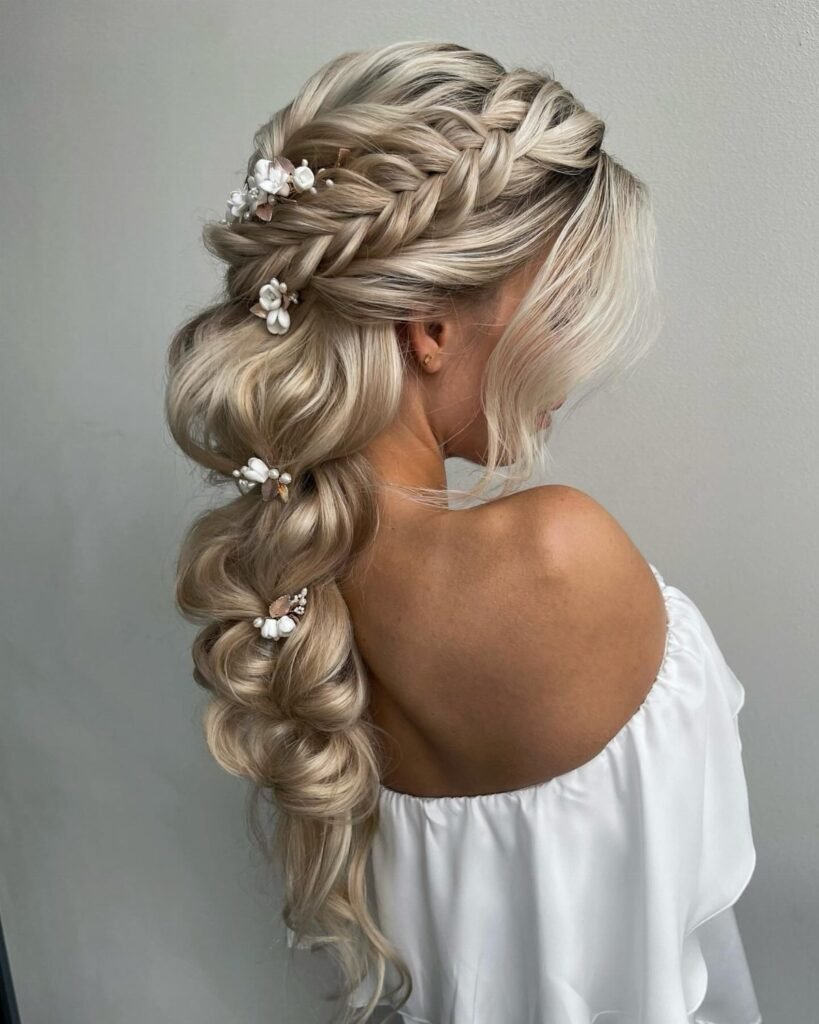
Braided hair carried meaning long before it became a style choice. Irish brides once had their hair woven with ribbons and lace as a symbol of feminine power and luck, a tradition that translates easily into modern wedding planning.
The texture works with or against your gown’s detail. A smooth, simple dress lets an elaborate braid stand as the statement piece.
Heavy lace or beading on the bodice calls for a simpler plait, or one tucked beneath a veil so the overall silhouette stays clean.
Small flowers pinned into braids bridge the gap between historical reference and current taste. I’d suggest this route for outdoor ceremonies where wind is a real factor; the structure holds through weather that would unravel a looser style.
2. Irish Lace Wedding Gowns

Irish lace has a specific character: raised floral patterns, dense netting, and a weight that sits differently on the body than machine-made alternatives. Antique cream crochet with scalloped edges now lives in collections or requires a specialist maker.
Finding genuine Irish lace for a veil or gown panel means checking provenance. Carrickmacross and Youghal lace each carry distinct techniques; a seller should name the region and ideally the workshop.
Reproduction Irish lace exists at lower cost, though the handwork difference shows in close photographs and in how the fabric drapes under movement.
The tradition suits a bride who wants one heirloom element rather than a full costume.
A lace-edged cape, mentioned as an alternative to a standard veil, works for church ceremonies where the full drama of a cathedral-length piece fits the aisle.
3. Wildflower Bouquets

Wildflower bouquets trade the uniform perfection of greenhouse blooms for seasonal variation and local meaning. Ranunculus, delphinium, daisies and sweet peas with trailing ribbon shift entirely if sourced in Ireland versus the American Midwest.
Heather, foxglove and fern appear in Irish heritage references, though your own region’s native flowers carry the same symbolic weight with less shipping cost and longer vase life.
Lavender, tied to love and devotion in the tradition, bridges both contexts; it dries well for keepsakes too.
The loose shape suits informal venues and gowns without heavy structure. I’d steer a bride in architectural satin toward something more contained.
These bouquets also demand a florist comfortable with asymmetry; ask to see examples of their unstructured work before committing.
4. Celtic Medieval Style Wedding Gown

White medieval-inspired gowns with bell sleeves and lace-up bodices pull from a period when Irish brides actually wore deep blue, red or gold depending on family wealth.
The white version reverses the original, the silhouette borrowing from piety’s color while abandoning it.
The lace-up front adjusts across months of planning, useful if your timeline runs long or short. Bell sleeves catch wind outdoors and can tangle in candlelit processional aisles; the photo’s stone arch setting suits the drama without those hazards.
This style reads costume more easily than others. I’d reserve it for brides already comfortable with statement dressing, or for ceremonies with historical venue architecture that absorbs the theatrical element.
A tiara adds another layer of period reference; simpler hair keeps the gown from becoming full reenactment.
5. Tartan Sash Accent Dress

A tartan sash pinned over an ivory gown marks clan connection without committing to full Scottish or Irish regional dress. Wearing your family’s pattern across one shoulder, matching your groom’s kilt, photographs cleanly and satisfies relatives expecting the nod.
The sash width and pin placement change the effect. A narrow ribbon reads as accessory; the broader swatch here approaches ceremonial.
The shoulder drape also shortens the torso visually, something to test in a mirror with your gown’s specific neckline.
This option wins for brides with one family side to honor while keeping the dress itself neutral enough for other settings.
The trade is that it photographs as "themed" in a way a simple colored ribbon would not; I’d suggest it for weddings where tartan already appears in the groom’s party or venue decor, so the choice reads as continuity rather than lone statement.
6. Full Plaid Bridal Gown

A strapless plaid gown with tulle underskirt commits fully to tartan as the main event.
The red base and white layering create high contrast, a combination that dominates visual memory of the day; this is not a dress that recedes into background for other elements.
The construction matters more than with solid fabrics. Plaid matching across seams requires extra yardage and skilled cutting, costs that scale with the pattern’s repeat size.
Tulle adds volume without matching complexity, though the two fabrics move differently on the dance floor.
I’d point this toward winter weddings, Scottish or Irish heritage celebrations, or brides who genuinely wear bold pattern in ordinary life. The alternative, a solid gown with plaid accents, leaves more flexibility for anniversary photographs and future formal events.
This version makes the statement once, fully, and lives in the album.
7. Flowing Celtic Harpist Gown

A flowing gown with enough movement to let you walk through coastal grass without lifting the skirt suits an outdoor Irish ceremony better than anything structured.
Look for lightweight silk crepe or soft chiffon in a cut that skims rather than hugs; a square neckline photographs cleanly against Atlantic wind and mist.
Long, unfitted sleeves keep you warm during a cliffside vow exchange without the bulk of a jacket.
Add a cape veil only if your venue is exposed; Irish weather shifts fast, and a detachable layer beats shivering through dinner. This look trades formal grandeur for atmosphere, which makes it ideal for elopements or guest lists under 30.
Modern Interpretations of Tradition
The blue dress tradition predates white entirely in Ireland, not merely as an accent. Contemporary brides are returning to full blue gowns rather than confining the color to a pendant or shoe.
Others work it in through embroidery or a sash, letting the bridesmaids carry the shade if the gown stays neutral.
Sustainable construction matters to this same audience. Bamboo satin and organic cotton lace keep the footprint lower without making the dress look like a statement piece.
Detachable skirts or capes let one gown serve after the wedding, a practical return on a four-figure investment. I’d weight this more heavily for city brides with limited closet space than for those in houses with spare rooms.
A modern Irish wedding dress works when it reads as your own choice, not a costume.
A blue underlay visible at the hem, a hand-stitched detail in the lining: these satisfy heritage without requiring explanation to guests who never heard the original custom.
Celtic Symbolism
The Claddagh ring’s heart, hands and crown sequence, worn point-in or point-out, still signals relationship status in Irish communities.
For a wedding, the point faces inward, the heart toward the wearer; the detail is small enough that only those who know will read it.
Handfasting, the literal tying of hands with cord or ribbon during vows, works in civil ceremonies where a couple writes their own ritual.
The binding lasts minutes, not the full year and day of historical trial marriage, but the gesture carries. I’d suggest practicing the knot beforehand with your officiant; fumbling reads as error, not symbolism.
These elements gain weight from context, not accumulation. A bride wearing blue, carrying a wildflower bouquet, with a Claddagh ring and handfasting cord risks theme park.
One or two, chosen for personal meaning rather than completeness, let the wedding stay a wedding.
Dress Shopping Experience
Private appointments run about €60 at specialist houses, the cost applied to purchase. Weekday evenings stay quieter, and two voices in the fitting room beat five.
Venue photographs matter: chiffon that photographs like water in studio light goes flat against gray Irish coast, while heavy lace that seemed right indoors drags in open wind.
Nude strapless undergarments let you see the real line. Sit in each sample, and try a few dance steps; a gown that stands still beautifully can pinch or ride where you bend.
The €60 consultation fee buys time with the designer directly at smaller houses, not a sales assistant working commission.
I’d bring photos of the aisle surface too. Cobblestone, grass, sand: each changes how a hem falls and whether you need a bustle or simply a lift.
Frequently Asked Questions
What color do Irish brides wear?
Irish brides traditionally wore blue rather than white, since blue carried the meaning of purity and fidelity long before ivory took over.
Irish folklore gives the color another layer: the Tuatha Dé Danann, the old supernatural people of the stories, were said to have eyes of bright blue, and that made the shade something more than ordinary.
The white gowns with Celtic knotwork that show up at modern Irish weddings are a reversal of the older custom, not a continuation of it; blue was the starting point.
What is traditional attire for a Celtic wedding?
Celtic wedding attire usually mixes tartan and Irish lace, with details like bell sleeves, lace-up bodices, or a tartan sash over an ivory gown.
Irish lace specifically carries raised floral patterns and dense netting from named regions such as Carrickmacross or Youghal. Cape veils and detachable layers also appear often, since Irish weather shifts fast and outdoor ceremonies are common.
What are some traditions for the bride at an Irish wedding?
Braiding the hair with ribbon or lace was one old way Irish brides dressed for the day, and the style still holds up when you are outside and the wind is doing what it wants.
Wildflower bouquets replace formal arrangements, with heather, foxglove, and fern appearing in heritage references, or lavender for a flower that dries well as a keepsake. Handfasting, the cord-tying ceremony, is another tradition some brides include.