
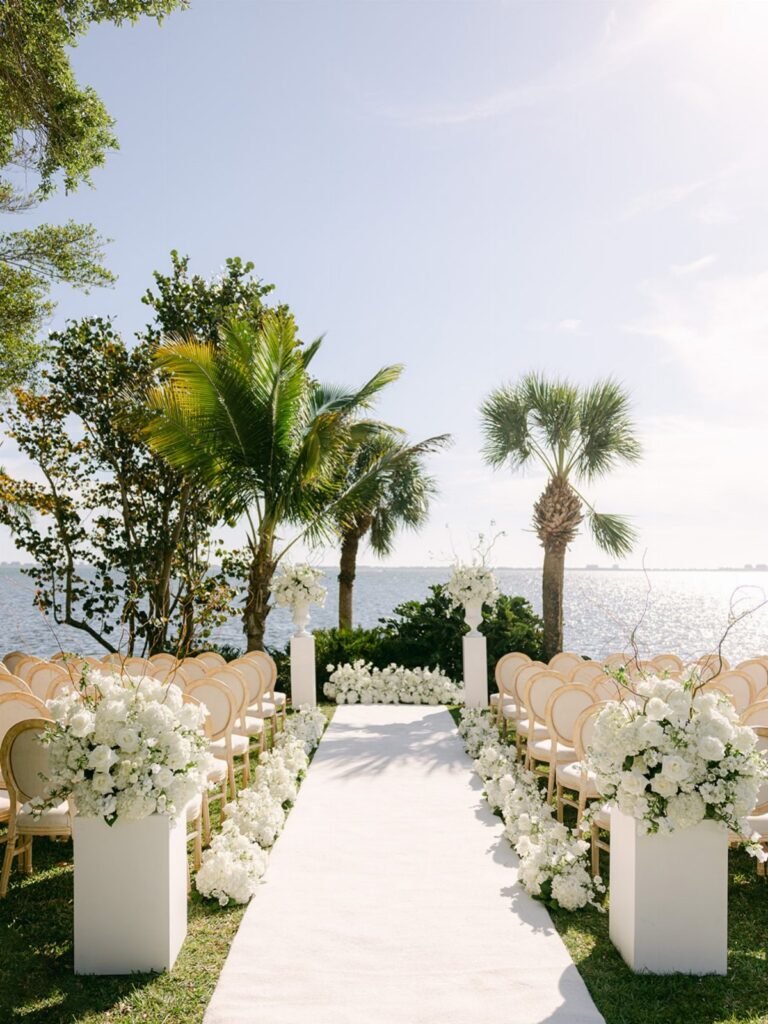
Waterfront wedding venues run from a wooden deck over a harbor to a full river estate with a white, multi-gabled building on the bank, and the deciding factor is whether you need the water as a backdrop or as the entire experience.
A yacht wedding caps your guest count tighter than any ballroom fire code, while a pondside garden keeps the willows but loses the tide charts entirely.
1. Lakefront Venues

A lakefront ceremony surrounds you with water on three sides, and you keep your shoes. The lawn rolls right to the shoreline, so guests seated in white chairs see the ceremony framed by open water and the hills beyond it.
Two renovated ceremony sites face the water directly, and the indoor spaces keep the view through beamed ceilings and fireplaces.
You will pay a site fee plus per-person costs, but guest lodging sits on the same property, which simplifies the shuttle math for out-of-town family.
This format suits couples who want the water view without the unpredictability of tide schedules or public beach permits.
Prime lakefront resorts cluster in the upper Midwest and northern New England, so Florida or California couples fly their guests in or choose a different water type.
2. Historic Waterfront Venues

Historic waterfront venues give you walls that existed before your grandparents were born and windows placed to catch harbor light.
The green patina on the arches, the skylight overhead, the stone underfoot; these details cost more to replicate than to inherit.
What you are actually renting is a building that solved its own climate and lighting problems a century ago. Check whether the kitchen can handle your guest count or whether you are required to use their caterer list.
Some civic buildings, like maritime museums or converted boathouses, fall in the mid-price band with published rate sheets. Others, like the Great Lakes Science Center, pair institutional history with a waterfront position and charge accordingly.
The real question is whether your wedding needs the grandeur or just the view. A historic ballroom demands formal attire, structured timelines, and furniture that respects the floors.
If you want barefoot dancing at midnight, rent the lawn next door instead.
3. Beachfront Ceremonies

Sand under the ceremony arch sounds romantic until you calculate the tide. Beachfront ceremonies require a window of low water, stable wind, and enough hard-packed sand to hold guest chairs without sinking.
A simple circular arch and lantern-lined aisle hold up better than heavy florals, which collapse in ocean gusts.
Some venues, like properties in Avalon, NJ, follow the sand ceremony with a ballroom reception where floor-to-ceiling windows keep the ocean in sight.
That two-part structure solves the practical problems: sand and salt for the ceremony, then climate control and proper stemware for dinner.
You will need a backup plan written into the contract, not just a verbal promise. Rain pushes you indoors; high tide pushes you up the dune.
Ask which scenario the venue has actually handled before, and whose responsibility the chairs and sound equipment become if the water moves faster than planned.
4. Yacht Weddings

A yacht wedding turns the venue into transportation, which changes every logistical assumption. Guests board at a fixed time; the ceremony starts when the captain clears the harbor, not when the mother of the bride arrives.
A yacht deck seats fewer guests than most land venues, even on a large vessel.
Yacht StarShip and similar operators handle the Coast Guard compliance, the route, and the catering tied to galley capacity.
You are buying a time slot on moving water, which means sunset timing depends on the date and the cruise schedule, not your photographer’s preference.
The cost structure layers a site fee onto per-person food and beverage minimums, and the guest count cap is firmer than any ballroom’s fire code.
What you gain is a full view that changes as you move, and a built-in exit strategy: the wedding ends when the boat returns to dock, which prevents the reception from drifting into overtime charges.
This format suits small parties who value novelty over dancing space.
5. Oceanfront Lawn Receptions

An oceanfront lawn lets you keep the grass underfoot and the horizon in sight. Round tables and string lights on level ground mean heels stay functional and rental furniture needs no special anchoring.
The Ocean House in Watch Hill, Rhode Island, sits on bluffs above the Atlantic with a sweeping lawn for ceremonies and a private beach for guest wandering.
The New England version of this idea layers in historic architecture and world-class dining; the California or Florida version trades the brick for palm trees and opens the bar earlier.
Wind is your real enemy on any coastal lawn. Weight the linens, secure the tent flaps, and ask the venue which direction the breeze typically blows during your ceremony hour.
A clambake rehearsal dinner, if the venue permits outside catering for pre-events, gives guests the coastal experience without risking the main reception’s timeline.
6. Waterfront Wooden Decks

A wooden deck over water gives you the harbor without the sand or the grass stains. Clear acrylic chairs disappear visually, which keeps the sightline open to the Ferris wheel and skyline beyond the floral arch.
Decks like this one work best when the structure is already built and permitted for events.
You are not constructing a dock; you are renting one, which means checking load capacity, insurance requirements, and whether the city allows amplified sound over open water.
Some venues, particularly in Ohio and the Great Lakes region, operate waterfront decks as part of larger properties with indoor backup spaces.
The material matters. Wood absorbs sound differently than lawn or stone, so a string quartet may carry farther than you want, or not far enough.
Test the acoustics during your walkthrough, not the ceremony. This format suits urban couples who want a water view tied to a city skyline rather than open ocean.
7. Pondside Garden Ceremonies

A pondside garden ceremony trades the drama of crashing waves for still water, overhanging willows, and the chance to hear your vows without wind interference.
A white aisle runs straight to a covered altar platform at the pond’s edge, with guest sections fanning out on the lawn, which keeps every seat close to the couple.
I would ask the venue about seasonal water levels before booking; a garden pond that photographs beautifully in May can shrink to mud flats by late August.
Spring Lake Heights in New Jersey builds around this risk with a water mill that trickles regardless of rainfall, plus resident swans that do not need your coordinator to cue them.
Their Lakeside Garden site includes the mill, a private dock, and enough flowers that you will not need to add much.
This format suits a small group best. The lawn sections would strain to hold more chairs without blocking the aisle or compressing the front rows into the pond’s margin.
In-house catering keeps the budget from ballooning, since there is no separate rental company hauling plates past garden beds.
Ask whether cocktail hour moves to an interior space; the Grand Lobby at Spring Lake Heights lets guests watch the kitchen work, which matters when your ceremony ends as the light is already fading.
8. Riverside Estates

Riverside estates give you the width of a river without the salt, the sand, or the permit headaches of public shoreline.
A white, multi-gabled building sits directly on the bank, with ceremony seating on the lawn between the guests and the water, so the river becomes the backdrop rather than the obstacle.
I would check current regulations yourself rather than trusting a venue’s summary.
Some Texas estates market themselves as lakeside, but their river-adjacent sister properties face the same question: who owns the water, and can your photographer step to the bank for the shot you want?
The building’s multiple gables create covered porches that work for cocktail hour if rain moves in, which matters more than most couples calculate; a river breeze that feels perfect in the afternoon turns cold by evening.
This format carries the cost of a full estate rental, not a bare picnic ground. You are paying for the building, the manicured lawn, and the water access together, so the per-guest math only works at 100 or above.
Below that, a smaller riverside restaurant with a private deck keeps the view and loses the pressure to fill a pergola that seats 200.
Tents on the grounds tell me the venue expects weather decisions.
Ask whether those are included or a line-item rental, and whether the white pergola is fixed or something they assemble per event; a fixed structure saves setup anxiety but limits where your officiant stands relative to the current.
Planning Considerations
Get the music cutoff in writing before you sign anything.
Parking can mean a ramp you must arrange well ahead, a per-vehicle fee, or a published shortage with ride-sharing recommended.
Budgeting for Venues
A rental fee and a per-person cost are not the same thing, and some venues publish one without the other.
The rental fee itself covers different things at different sites. One publishes a price without a time block length; another publishes a package without separating the fee.
Neither is a red flag, but you need both broken out to know what you are paying for.
Security requirements vary by city and by whether alcohol is served. Some venues require two officers, others a single off-duty officer whenever alcohol is present.
Those hours are real money on top of the quoted price.
Ask whether guest lodging is included, on the same property, or a separate reservation. When the venue controls rooms, shuttle math simplifies; when it does not, your guests become their own travel agents.
Guest Accommodations
Private beach venues and beach clubs trade the package for more creative control. You coordinate more vendors yourself, but you also choose each one.
The beachfront versus oceanfront distinction matters for sleeping arrangements.
Accessibility of Venues
Wooden decks over water, harbor docks, and blufftop lawns all present the same question: who can reach them. A dock has no gradual slope; a bluff has stairs.
Ask the venue to walk the route a guest using a cane or wheelchair would take, not the route you will take in heels.
Waterfront properties often spread across multiple levels connected by paths rather than paved routes. The lawn rolls to the shoreline, but the shoreline itself may not be firm enough for a walker.
Frequently Asked Questions
Where is the cheapest place to get married on the beach?
Maritime museums and converted boathouses often publish their rate sheets upfront, which puts them in a mid-price band that is easier to plan around than resort pricing.
For the lowest costs, I would look at public beaches where you bring your own setup, though you then face permit requirements and tide unpredictability that a venue contract would absorb.
Is $5000 a good budget for a wedding?
A modest budget means every choice becomes a budget-versus-dream trade-off, and the lower the number, the more creative you have to get about what water access actually looks like.
At that level, a lakefront civic building with a published rate sheet or a small yacht time slot stretches further than a historic ballroom or full estate rental, which only work financially at 100 guests or above.
What are some good places to get married on the water in Michigan?
Prime lakefront resorts in the upper Midwest include Michigan among their best locations.
What is the 30-5 rule for weddings?
The 30-5 rule suggests inviting 30% of your guest list to the wedding.
This rule does not come up in the context of water venues; capacity caps and what the space can legally hold matter more than invitation strategy when you are booking a deck or a yacht.