The shots that matter range from a quiet moment after the vows to the dip on the dance floor, and the list below covers the ones worth asking your photographer to plan for.
What you actually schedule, whether the photographer stays for the after-party or leaves after the cake, depends on whether you want the fresh makeup of the first kiss or the looseness that only comes once the clothes feel like costumes.
The 2 or 3 seconds a practiced lift actually holds, the single follow spot on a fogged floor, the meter reading for the bright background instead of the couple: these are the choices that fill the album.
1. The Vows

The vows frame themselves if you let them. Stand at the altar with your hands linked and your eyes on each other, not the officiant, and the photographer catches the rest.
Black and white prints of this moment hold up better over decades than color, something to ask your printer about when you build the album.
I would tell any couple writing their own vows to pause for breath between sentences; the camera finds your face in those still seconds.
2. The First Kiss

Your officiant’s wording matters. "You may kiss the bride" gives you a split second to turn toward each other before the guests react, and a photographer who starts shooting at that phrase, not after, gets the full arc.
The kiss itself can be brief; the arms around each other, the grin that breaks after, those carry the weight. Ask your photographer to stay on the couple past the kiss until the moment actually ends.
The officiant in frame behind you, slightly soft, grounds the moment in the ceremony rather than floating it.
3. Candid Close-Ups

Candid shots repay the photographer you hire to anticipate, not direct. Before the ceremony, during the cocktail hour, after the cake: these are the gaps where real interaction happens, and you want your person watching for them from the start.
Tell them explicitly that you want close-ups of you two being playful, not just the standard family lines.
The rice shower, the laugh after a misstep, the hand on a shoulder when no one asked for it: these need permission to exist, then they need someone looking.
4. First Dance

Fog on the floor and a single follow spot turn a first dance into something theatrical, though the move works as well in a barn with string lights if the couple holds each other properly.
The practiced dance and the honest stumble read the same on film when the eyes stay locked. I have watched couples choreograph every step and still the best frame came from the unplanned sway at the end.
Tell your DJ to keep the introduction short; too much buildup and the moment thins out.
5. The Lean and Kiss

A few feet of separation before the lean gives the photographer room to work, and an archway or column behind you turns the gap into geometry. The bride’s bouquet raised high adds vertical balance that a hands-at-the-waist kiss lacks.
Evening light flatters this pose more than midday sun; the shadows soften the angle of approach. For a couple with height difference, the lean evens the line of the bodies in a way a standing kiss does not.
6. The Forehead Rest

Forehead to forehead removes the performative pressure of the camera. A smile or a full view of your faces is optional; the gesture reads as tenderness without either.
A sunset behind you backlights the couple into silhouette if you choose, though full color keeps the embroidery and the lawn. I would suggest this pose for any couple who tenses in directed shots: there is nothing to get wrong.
One hand holding the bouquet low, at hip level, keeps the frame from closing in too tight.
7. The Cutting of the Cake

The cake cutting gives you a built-in pause in the reception where both of you are doing something with your hands and looking at each other, which means genuine expressions instead of held poses.
Your photographer needs to be positioned for the couple’s faces, not the cake. The tradition is the shared knife and the first slice; after that, you choose whether to feed each other neatly or go for the smash.
Either way, tell your photographer which you have planned so they are ready for the reaction.
I would only schedule this if you actually want to eat cake.
Couples who skip dessert or do a small display cake for photos and serve sheet cake in the kitchen still get the moment; couples who do no cake at all should not invent this one.
8. Couple Covered by the Veil

A long veil becomes a soft room with the two of you inside it, diffusing whatever light is falling and erasing the background.
A cathedral-length veil draped over both heads takes an extra pair of hands to arrange and a moment to settle.
Your photographer will need to shoot from outside the fabric, close enough that the couple fills the frame, or the veil reads as fog with shapes somewhere inside.
This needs time and stillness, so I would not build it into a rushed portrait slot.
It suits couples who have scheduled a generous first-look or golden-hour window, and who have a veil long enough to cover both of you without pulling tight.
9. The After, After Party

Late night, after the band has packed or the DJ has played the last song, the energy changes entirely.
The formal portraits are done, the guests have gone, and you are left in clothes that now feel like costumes from a party that already happened.
Your photographer can step into this scene or you can set a phone on the dresser; the looseness is the point, not the equipment.
This trades away the fresh makeup and the good light for something harder to fake.
I would ask whether your photographer is booked until the absolute end, or whether you are comfortable with the candids your guests will take once the professional has left.
10. The Lift and Laugh

A lift only works if the groom can actually lift the bride, in her dress, without either of you tipping backward or the dress ripping.
Practice this in the clothes you will wear, or something close to them, a week before.
The bride raises one arm for balance and keeps the other at the groom’s shoulder or neck; the groom sets his feet shoulder-width and lifts from the legs, not the back. Hold it for 2 or 3 seconds, not a count of 10.
I would skip this for a heavy ballgown or any dress with a fragile bodice. The shot worth keeping is the laughing faces and the raised arm; the one you do not want is the stumble that follows.
11. The Dip

The dip is a formal gesture made romantic by the trust involved: the bride leaning back, the groom holding the weight, both of you looking at each other instead of the ground.
It needs a level surface and a groom with the arm strength to lower and raise smoothly. A bridge balustrade and a city skyline give the pose a stage.
Beach grass or a meadow work the same way; a crowded dance floor does not, because the bride’s head will be below elbow height of passing guests and the groom cannot see his footing.
I would save this for the portrait session, not the first dance, unless you have rehearsed it with the actual dress and the actual shoes.
12. Shadow Play

A single strong light behind you, and you become silhouette or half-silhouette: the shape of a hand kiss, the line of a gown, with no face visible and every face readable.
You need the light source, the couple between it and the camera, and a surface to catch the shadow if you want the projected version rather than the direct silhouette.
Move too far from the screen and the shadow blurs; move too close and you block your own light. The photographer meters for the bright background, not the couple, which means you will be dark.
This trades away color, expression, and the details of your clothes for shape and gesture.
I would use it for one frame in a larger set, not the only portrait you have, and I would plan it for a moment when the natural light is right or when your venue has a spotlight you can borrow briefly.
Importance of Candid Shots
The posed family lines belong in every album, but the frames you reach for first are usually the ones you did not know were being taken.
A photographer who keeps their eyes on you through the getting-ready hours, the cocktail gaps, and the late dance floor has the chance to catch the hand on your shoulder that no one asked for, or the laugh after a misstep.
Ask your photographer to catch each of you alone: her turning from the mirror once the dress is fastened, him working a cufflink that will not sit right.
When the gallery comes back, the images you forgot were being taken often matter more than the ones you posed for.
Communicating with Photographers
A list of must-have shots, given to your photographer before the day, keeps the important frames from becoming accidents. I would put candids on that list, and the specific individual shots: bride after dressing, groom at the mirror.
The family lines will happen regardless; the unguarded moments need to be named.
Detail photos of rings, bouquet, watch: these can be assigned or left to the photographer’s eye. Either way, mention them.
Mixing Classic and Creative
The veil shots in your gallery work because they mix a traditional object with an unexpected use: draped over both of you, swept in front, or the photographer shooting from underneath it.
I would treat this as one frame among many, not the dominant portrait.
Standing face to face and being in the moment together is a classic pose that still leaves room to vary.
The photographer can shift angles, have one partner look at the camera while the other does not, or catch the sway that reads as dancing.
From this single setup come detail shots of rings, bouquet, watch: multiple images without multiple poses.
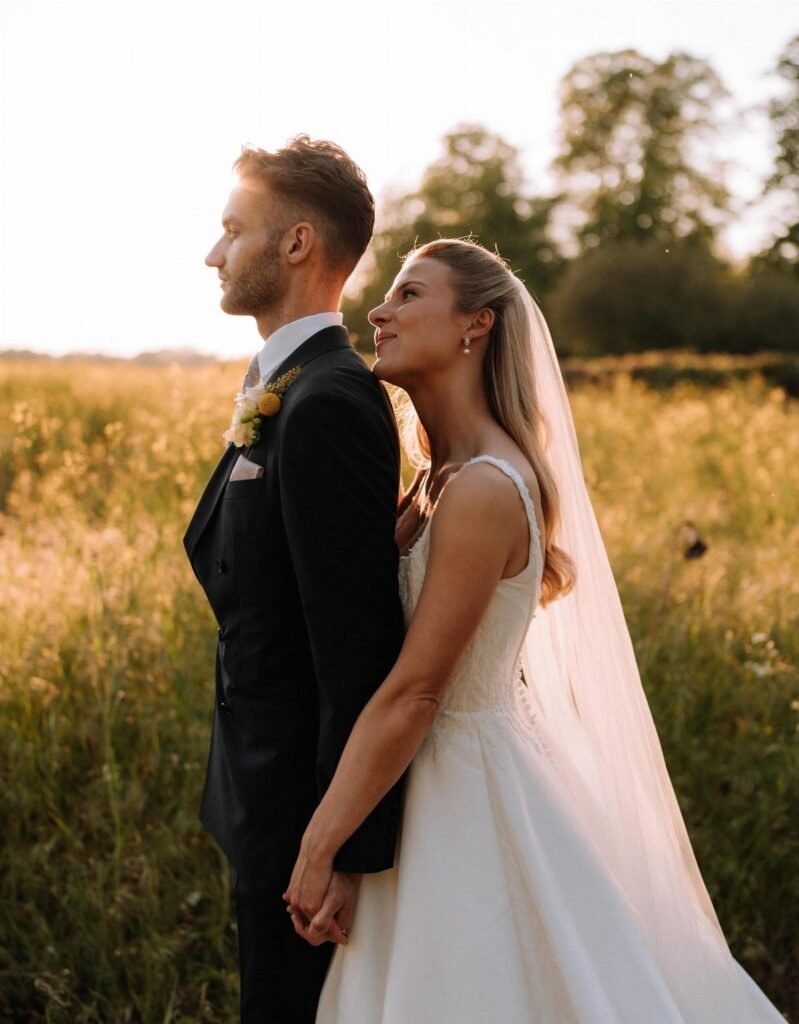
A hug from behind, the partner wrapping the other up, gives the same efficiency. Simple, timeless, and easy to extend into close-ups of hands, flowers, the timepiece on a wrist.
Frequently Asked Questions
What are the bride and groom photos called?
They are usually called wedding portraits or couple portraits, and the industry breaks them into categories: formal posed shots, candid moments caught between events, and creative or editorial frames that use light and setting more like fashion photography.
Formal and candid shots each have their place, and a few styles borrowed from editorial work, like shadow play and the veil shot, have become standard options.
What are classic bride and groom poses?
The ones that belong in every album are the vows, first kiss, first dance, and the basic standing pose with hands at hip and waist.
These work because they put you two facing each other, which the camera reads as intimacy even in a still frame. The forehead rest and the dip have become classics too, though they need more setup.
What are some creative photo ideas for bride and groom?
Shadow play with a single strong backlight, the couple covered by a cathedral-length veil, and the after-party shot once the guests have gone and the formal portraits are done each give a different mood.
The lift and laugh counts too, though only if the dress and the groom’s back can handle it.