
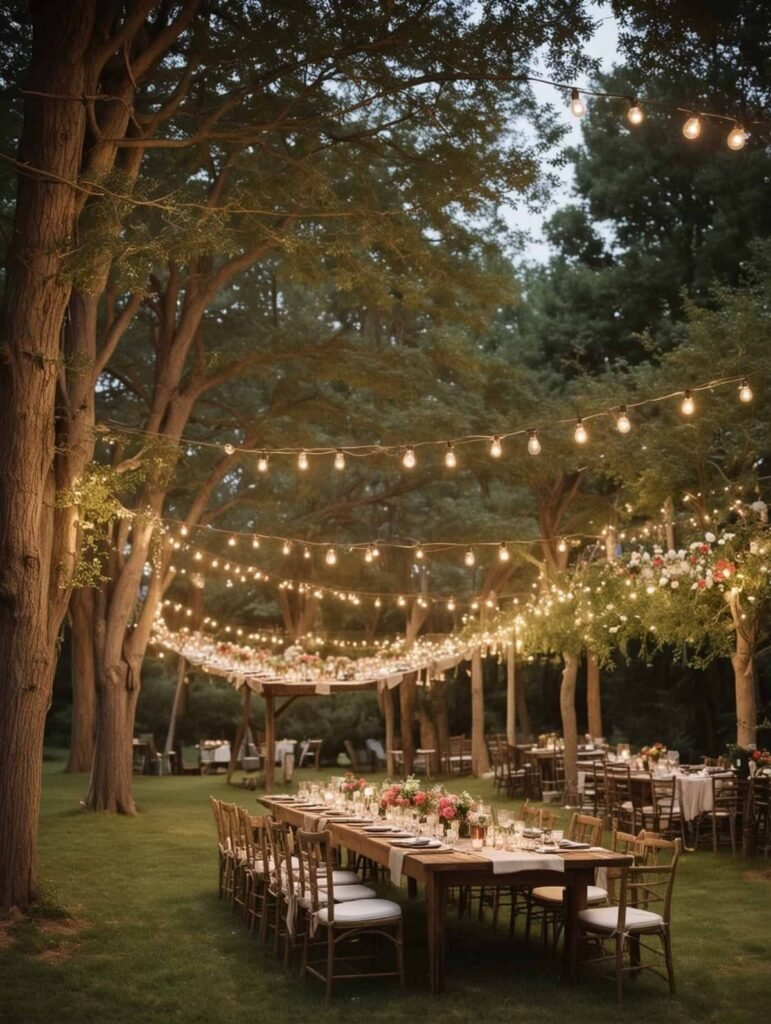
These 16 ideas run from a backyard ceremony to a sword ritual and a fantasy costumed wedding party, with most falling somewhere between a unity sand ceremony and a family puzzle.
What separates one idea from another is not your aesthetic but your tolerance for logistics: whether you want to manage a venue and guest seating or only the fit of a puzzle piece in a child’s hand.
The Japanese maple that turns crimson each fall, planted with soil from two childhood yards, asks years of care where the unity candle asks only a table out of the wind.
1. Backyard Wedding Ceremony Venue

A backyard wedding strips the day down to what you actually want: no package deal, no ballroom minimum, no caterer who insists on their own bar. You pick the yard, you pick the rules.
A rented house with a lawn, a parent’s garden, a community center with green space behind it; each shifts the budget differently and each puts the ceiling on your guest count before any vendor does.
I would check parking first, then power, then whether the neighbors will hear the music. Museums and nonprofit spaces work the same way, more formal but still yours to arrange.
You become your own venue manager for the day, or you hire one. I’d spend the savings on a coordinator instead of a tent.
2. Tree Planting

Planting a tree together asks you to think past the wedding day in a way that feels concrete, not sentimental.
A sapling in a pot, soil from two homes or two childhood yards, and an officiant who speaks briefly about roots and seasons while you both add your handful.
The pot travels with you; the ground comes later, when you have a yard that will last.
I have seen couples use a Japanese maple that turned crimson each fall, or a citrus tree that produced fruit by their third anniversary. Outdoor ceremonies already run long, so build in extra time for this.
Schedule it, or watch your cocktail hour shrink.
3. Candle Ceremony

Three candles on a small table: two lit by your mothers, your siblings, or the friends who introduced you, one lit by you together from those two flames.
The unity candle stays burning through the vows, three flames where there were two. It reads as traditional to older guests and still means something if you choose the people lighting the side candles with care.
I would place the table where every row can see it, not off to one side; the gesture is small and the flame is hard to spot from the back.
Wind makes this an indoor choice, or a very sheltered outdoor one.
4. Family Puzzle Ceremony

A wooden puzzle, one piece per person, assembled during the ceremony while guests watch. Each piece is sized for a child to hold, and the finished board hangs at home afterward.
I like this for blended families because the moment is genuinely collaborative: the kids are not standing still in matching outfits, they are doing something with their hands while adults help or miss the fit and laugh.
Practice once, or the pieces will not slide together and the officiant will be improvising through a long silence. A simpler version uses a pre-drilled board and pegs for younger children.
Plan for enough time, or edit the ceremony elsewhere.
5. Lounge Furniture Seating Arrangements

Sofas and armchairs in a semicircle replace the familiar aisle-and-rows setup, and the whole ceremony feels like a living room where the couple happens to be marrying.
Guests arrive, choose a seat, settle in; no one stands for the processional unless you want them to. Rentals, not purchases, make this practical; a rug underneath is what makes it feel finished rather than borrowed.
I would keep this small, or the outer chairs lose the intimacy that justifies the cost. Lounge groupings read beautifully in stills but can block sightlines for guests in the second row.
6. Candle Garden

Multiple small candles, each representing a year you have already shared or a person who shaped you, lit by the couple or by guests who carry their flame forward.
A garden version might run to many votives in sand or water, arranged on a low table you circle together.
I would assign each candle before the day, write the names or years on tags, and let guests read them as they light.
Wind is still your enemy, so this suits indoor ceremonies or evenings calm enough that a glass sleeve solves it. The glow photographs warm, and the timing is flexible if every guest lights one.
7. Handfasting

The couple’s hands stay joined while a cord, usually braided from cloth or ribbon, loops around both wrists in a loose figure-eight.
Someone speaks vows through the binding, and the knot stays tied long enough to feel deliberate but comes free afterward; the cord becomes the keepsake, not the restraint.
Colors matter in this ritual: one strand for each life being joined, or one color for prosperity, another for passion, a third for peace, chosen to match what the couple actually wants to call in.
Catholic weddings sometimes borrow the shape of this, wrapping hands in the priest’s cloth for a blessing, though the Celtic version keeps the speaking role with the couple themselves.
Outdoor settings suit it naturally, and the cord shows up best against skin or simple sleeves. I’d pick natural fibers that photograph softly and feel right in hand: cotton, linen, or silk rope rather than anything synthetic and shiny.
The person doing the binding should practice the wrap once or twice; fumbling through the loops while guests watch kills the mood.
This works best when at least one partner carries Celtic roots or when both want a ritual with physical weight but no flame to guard outdoors.
It trades the instant symbolism of rings for something that unfolds in time, which means it also trades brevity; ceremonies already running long should skip it or keep the speaking tight.
8. Unity Sand Ceremony

Two bottles of sand, two colors, one clear vessel to receive them, and the couple pours together or in turns until the layers blend where they meet.
The result stays on a shelf afterward, a solid object carrying the day, unlike candle smoke or wine consumed.
Sand ceremonies began as a beach substitute when wind made unity candles impossible, though they have outgrown that origin; now they suit any setting where a couple wants something to keep.
The vessel matters more than couples first assume. A narrow cylinder gives dramatic layers but shows less blending; a wide bowl mixes faster and reads as more unified.
I’d choose the shape for the marriage being described: distinct personalities that overlap, or two lives already thoroughly combined. For families blending children, each person adds a separate color, and the container carries more weight, literally and otherwise.
This asks little of guests beyond watching, which is either a relief or a missed chance at participation, depending on the couple.
It also demands a table, a flat surface, and some protection from breeze; sand scattered on grass does not sweep up cleanly.
The ceremony itself runs just long enough to feel intentional; any longer and the pouring starts to feel performed rather than lived.
9. Mix-and-Match Attire

Women in dresses each chosen by their wearer, standing together without clashing only because someone set a loose frame: a color family, a length, a level of formality, or none at all beyond "please look festive."
The host’s job shifts from dictating to curating.
Send a mood board, or a single fabric swatch, or three adjectives; give too little guidance and someone arrives in sequins while another wears linen, give too much and the point is lost.
I have seen "pick anything in the blue-green range" work cleanly, and "wear what makes you feel good" work when the group shares taste already. The latter fails more often than hosts expect.
Cost drops, usually, since no one buys a dress they will never wear again; stress shifts too, from bridesmaids resenting a chosen gown to bridesmaids anxious about choosing wrong. That anxiety is real and worth naming.
This suits groups with strong individual style, or friends from different phases of life unlikely to match naturally, or couples who would rather their people look like themselves than like a set.
10. Nontraditional Wedding Attire

A yellow skirt answers a question most couples never fully ask: who decided white was neutral, and when did that decision expire?
For some, breaking from it means a colored gown; for others, separates, or a suit in a hue that does not appear in standard groomswear, or fabric that moves like celebration rather than ceremony.
The choice depends on what the day is actually for.
A courthouse signing with a small party of witnesses invites risk that a large church service might not; family expectations are real constraints unless the couple is prepared to absorb the friction.
I’d check three things before committing: what the venue requires (some houses of faith still mandate), what photographs will read as decades from now, and whether both partners want to depart from convention or only one.
Comfort matters more than tradition admits. A bride in boots and a groom in a kilt both gain hours of ease that translate to presence; a couple distracted by corsetry or rental shoes misses their own party.
Lace with yellow, blue with field grass, both choices that let the wearers move and breathe. That is not incidental.
It is the whole argument.
11. DIY Food Stations

Guests assemble their own pani puri at this station, reading a small sign for guidance, reaching for crisp shells and spiced potato and the green water that makes the dish complete.
The setup asks people to stand, to choose, to wait their turn and talk while waiting; it turns eating into something that happens between guests rather than to them.
A food station lives or dies by its flow. One bottleneck and the line becomes the memory.
I’d place two identical setups for any group large enough to form a line, and position them where people naturally gather rather than in a corner that must be sought out.
An instruction sign is not decorative; without it, someone fills a shell wrong and the experience sours.
Cost shifts depending on what is being assembled.
Pani puri, tacos, sundae bars, and build-your-own pasta all land differently; the common thread is labor moved from kitchen to guest, which can mean savings or can mean more spent on quality ingredients to compensate.
This suits casual receptions, daytime events, any crowd that would rather mingle than be seated and served. It trades elegance for energy, a trade I would take every time for the right couple.
12. Intimate Elopement Ceremony

The couple on the ridge chose the people present, or chose no one at all beyond themselves and whoever stood witness.
That selection, that tight circle, is what separates elopement from small wedding; the guest list is not reduced but interrogated, each name passing a test of necessity.
The test is personal and often painful. Raini Rowell’s question works: do I want this person to hear these words, to watch this ceremony?
Not "will they be offended to be excluded," not "do they expect an invitation," not "will we regret the photos without them."
The words spoken matter more than the people hearing them only if the couple actually believes that; some want the crowd, the community, the accountability of promises made in public. Elopement is not morally lighter, just differently weighted.
This suits pairs with complicated families, with limited budgets, with a private vocabulary they do not wish to translate.
It trades the celebration for the moment itself, which means it also trades the stories told afterward by guests who were there; the memory becomes narrower and deeper.
Mountains, courthouses, city halls, living rooms: the setting matters less than the intention behind the compression.
13. Pets Walk Down the Aisle

A pet carrying the rings or trotting ahead of you turns the procession into something only your guests could witness at your wedding.
A bowtie, a small vehicle, or a custom carrier adds up fast, and you will need a handler who is not you.
Your pet needs a rehearsal, a bathroom break right before, and someone to whisk them away once the vows start.
This suits couples whose animal is already central to their daily life, not those borrowing a relative’s pet for the photo.
14. Sword Ceremony Ritual

Holding a ceremonial sword together during the vows layers an old military and aristocratic formality onto a modern promise.
The ribbon-draped blade looks borrowed from a historical reenactment or a family collection; antique swords turn up at estate sales and military auctions, while a new decorative one keeps the cost low.
You pass it between you, grip the hilt together, or have it presented by an officiant who has rehearsed the weight. The moment is brief and reads as either serious or playful depending on your faces.
I would only add this if at least one of you already collects blades or studies a period where the ritual belongs; otherwise it risks looking like costume jewelry with no story behind it.
15. Paper Cube Guest Seating

Crinkled paper over cube stools turns practical seating into something that photographs like sculpture and costs less than rental chairs.
Terracotta and white cubes arranged in rows facing an orange platform make a warm, grounded aisle; kraft paper, packing paper, or hand-dyed sheets cover standard ottomans or wooden blocks.
Tear and crumple the paper rather than wrapping tight, which hides uneven edges and speeds the work. Bring a few helpers and set aside an afternoon; paper and tape add up to a small per-cube cost.
This works for outdoor ceremonies on flat grass where ground moisture is not an issue; skip it if rain threatens or your guests include older relatives who need back support.
16. Fantasy Costumed Wedding Party

Dressing your wedding party as specific characters from a game, novel, or historical era commits every photo to your shared obsession.
The Zelda, Link, and medieval gown are recognizable enough that guests who know the source feel included and guests who do not still see a coherent color story.
Commissioned cosplay runs high per outfit; thrifted base pieces with added trim and accessories cut that sharply.
Give your party plenty of lead time to gather or commission pieces, and assign one person to check that greens match and that no one shows up in a clashing interpretation.
This is for couples whose friends already costume together at conventions, not for surprising a traditional wedding party with an assignment they will resent.
Choosing the Right Venue
A museum or gallery hands you the atmosphere already built; your job is to keep your ceremony from competing with it.
Natural light should fall on the couple, with floral arrangements kept lower than the art so the eye travels past the vows instead of stopping short.
Community centers and garden spaces cost less and ask more of you in chairs, sound, and parking logistics. A nonprofit venue often restricts which caterers you can hire, which is worth checking before you fall in love with the courtyard.
Backyards shift every cost to your own planning: tent rental, portable restrooms, neighbor relations. The savings only materialize if you resist upgrading every element to match what a ballroom would have provided.
Engaging Guests
A ring-warming ceremony passes the bands through every row, each guest holding them for a moment before the exchange.
Build extra time into the schedule for any interactive element that involves every guest, or cut it if the crowd is large enough that the last rows feel rushed.
A small cloth bag keeps the rings from fumbling hands; someone assigned to track timing prevents the last rows from feeling hurried. Readings and blessings from guests work best when chosen for brevity; several short voices outlast one long one.
Circle seating, with guests in a ring around the couple, removes the aisle entirely and changes who watches whom. It suits small weddings and asks for a strong officiant who can hold focus without the familiar architecture of a processional.
Breaking Traditional Norms
Skipping the aisle walk means rethinking when guests see the couple for the first time and where the emotional peak lands.
Both partners can already be in the space, or enter from opposite sides to meet in the middle, or the ceremony can begin with everyone mingling until a bell or song gathers them.
The absence of a gown does not mean the absence of drama; a red dress or a jumpsuit carries its own statement, though family friction is real and worth weighing against the satisfaction.
Matching denim jackets over formal wear, as one approach, read as costume in some photographs and genuine in others; the difference is in the wearer’s comfort, which the camera catches.
The number nine is considered an auspicious number in Japanese culture, making this tradition a particularly meaningful part of the wedding celebration. At this Vogue wedding in Japan, the newlyweds broke into a 36-liter sake barrel at their reception ahead of the ritual.
— Vogue