A Game of Thrones wedding is almost always a political weapon dressed in ritual, and the few built on love end in catastrophe.
Robb Stark’s secret nighttime marriage to Talisa Maegyr cost him his kingdom, his wife, and his life at the Red Wedding.
Of the eight ceremonies that shape the series, only one produces a legitimate heir to the Iron Throne, and it happens entirely in secret, with no guests at all.
Robb Stark and Talisa Maegyr
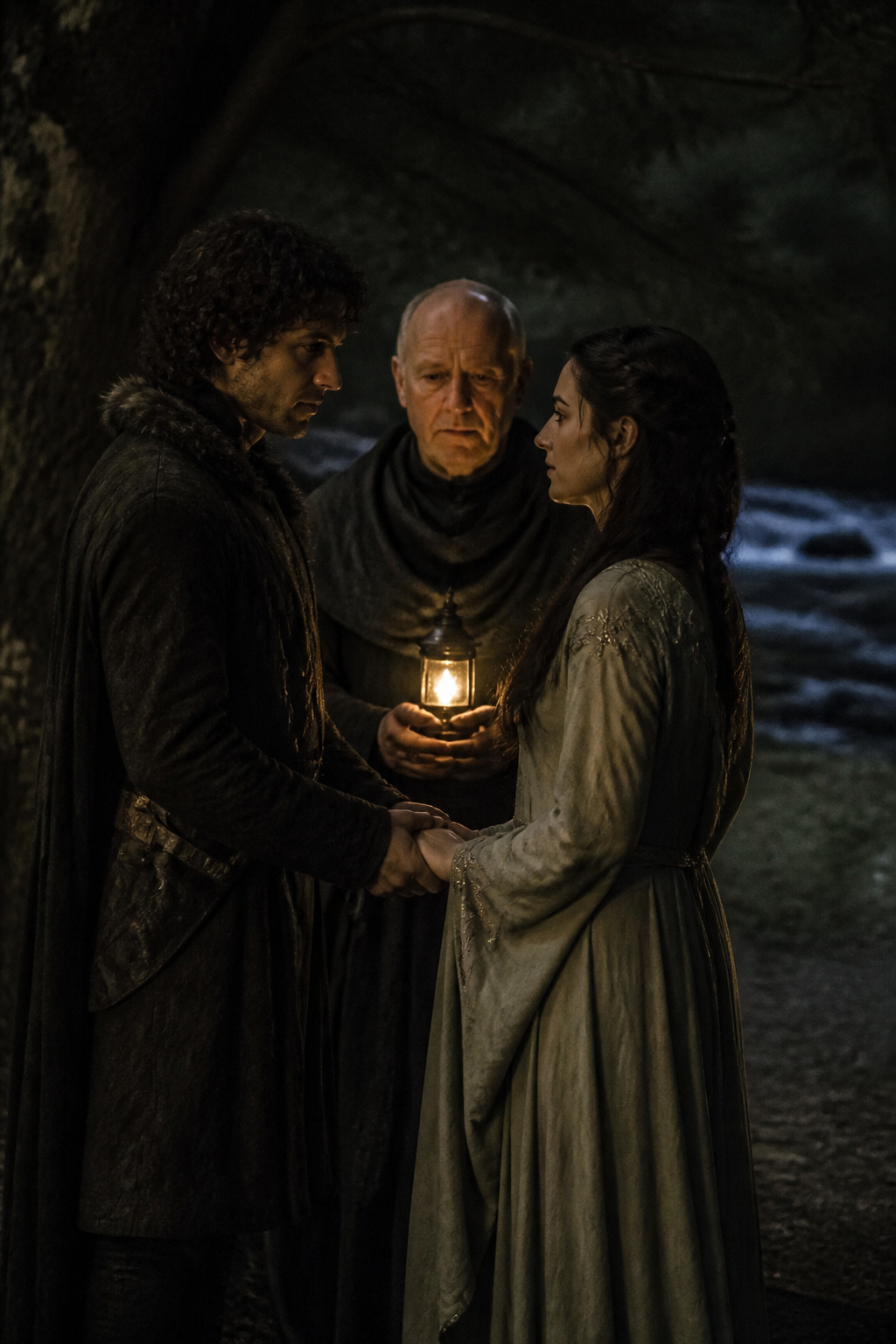
Robb Stark’s secret marriage to Talisa Maegyr in season 2, episode 10 "Valar Morghulis" stands as one of the few love-based weddings in the entire series, and that rarity is exactly what made it so costly.
He married a foreign battlefield healer in a nighttime ceremony with no guests, exchanging vows before a Septon alone. The simplicity was deliberate, meant to hide the breach from Walder Frey until Robb could manage the fallout.
He never got the chance. Catelyn Stark had negotiated his betrothal to a Frey daughter as the price for crossing the Twins during the War of the Five Kings.
By choosing Talisa, Robb voided that contract entirely. The political damage was immediate and fatal: Walder Frey’s vengeance and Roose Bolton’s treachery converged at the Red Wedding, which decimated the Stark host and ended the Northern rebellion.
The marriage lasted less than a full season. Talisa died at the massacre, stabbed repeatedly in the womb while Robb watched, before he too was killed.
Their wedding was the rare Westeros union built on genuine mutual feeling, and in that world, the punishment for that choice was extinction.
Edmure Tully and Roslin Frey
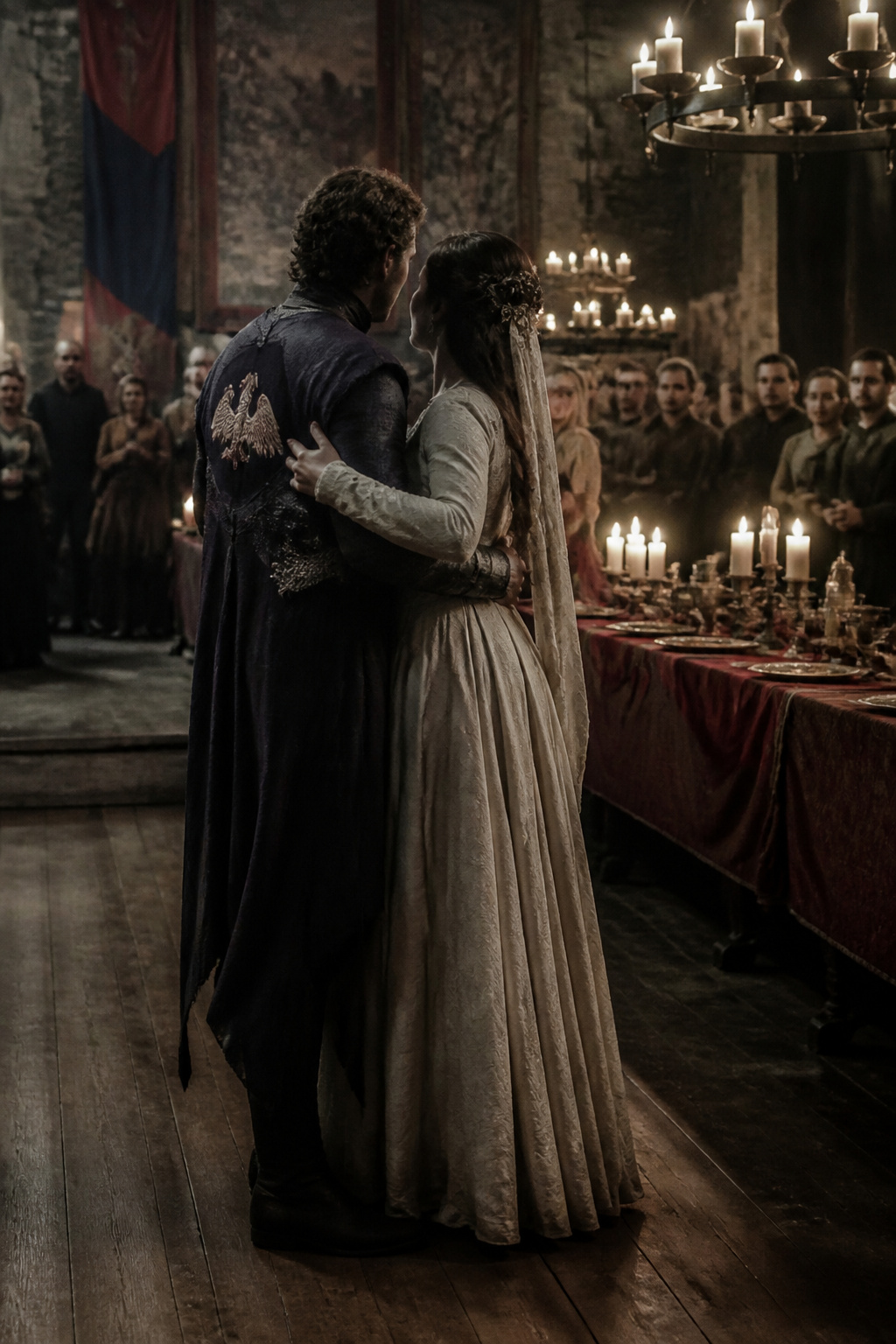
The wedding of Edmure Tully and Roslin Frey in Season 3, Episode 9, "The Rains of Castamere," is the ceremony that became the Red Wedding itself.
Walder Frey orchestrated the match as political theater, offering his daughter to the heir of House Tully at Riverrun to lure the northern leadership under his roof with promises of protection and renewed alliance.
The trap had been set after Robb Stark broke his own marriage pact with House Frey. Walder secretly sided with Tywin Lannister in the War of the Five Kings, and the ceremony gave him cover.
After the vows were exchanged and the couple was carried off to their bed chambers, the signal went out. Roose Bolton turned on his king, and the slaughter began in the sealed hall.
Robb, Catelyn, Talisa and her unborn child were killed along with the Stark bannermen. Brynden Tully, the Blackfish, managed to escape.
Edmure himself was thrown into a cell and held prisoner until much later in the series. The marriage lasted only minutes; the massacre ended Robb’s war and handed the North to Lannister control through Roose Bolton’s betrayal.
Joffrey Baratheon and Margaery Tyrell

The Purple Wedding takes its name from the color of the wine that killed Joffrey Baratheon, not from House Tyrell’s sigil. Olenna Tyrell and Petyr Baelish planned the assassination together.
During the feast in Season 4, Episode 2, "The Lion and the Rose," Olenna offered condolences to Sansa Stark and slipped an amethyst crystal from Sansa’s necklace into Joffrey’s glass.
That crystal was the Strangler, and the king died gasping at his own wedding.
Margaery Tyrell gained everything from his death and lost nothing she wanted. The marriage had freed her from Renly’s shadow and made her queen, but Joffrey’s cruelty made him impossible to control.
With Joffrey gone, she moved to Tommen, younger and pliable, in what the same alliance needed all along. Cersei blamed Tyrion for the poisoning, and that misjudgment cost her the trial by combat and her father’s life.
The grandeur of the feast, the pigeon pie, the humiliation of Tyrion, all of it ended in a color most guests never saw coming.
The poison was in the wine, not the pie, a distinction that mattered for Tyrion’s survival and Littlefinger’s escape.
Sansa Stark and Tyrion Lannister

The forced marriage in Season 3, Episode 8, "Second Sons," strips away every romantic pretense and leaves only power on display.
Tywin Lannister arranges the match to secure the North through Sansa Stark’s claim, and Joffrey Baratheon takes visible pleasure in twisting the knife.
He escorts Sansa down the aisle in place of her dead father, then snatches away the stool Tyrion needs to cloak his bride, forcing Sansa to kneel in front of the court.
That cruelty makes Tyrion’s choice the more striking. He refuses to consummate the marriage against her will, a restraint none of her other husbands or betrothed would show.
Sansa later tells him he was the best of them, and the line lands because the bar was so low and because Tyrion understood her humiliation was already complete.
The marriage never actually gives the Lannisters any political advantage. Littlefinger’s schemes draw Sansa away before Tywin gets his northern heir, and the alliance dissolves without ceremony or consummation.
What remains is the small decency Tyrion offered in a room full of mockery, and the memory Sansa carries of it years later.
Sansa Stark and Ramsay Bolton

Sansa Stark’s return to Winterfell in season 5 should have been a homecoming. Instead, Petyr Baelish brokered her marriage to Ramsay Bolton, the legitimized bastard whose father Roose now held the title Warden of the North.
The wedding took place in the Godswood during "Unbowed, Unbent, Unbroken," with the aesthetic trappings of a proper Northern ceremony that made the aftermath even more brutal.
Ramsay sexually assaulted Sansa on their wedding night and forced Theon Greyjoy to watch.
The horror was deliberate: a Stark bride in her own family’s castle, violated by the son of the man who’d betrayed her brother at the Red Wedding.
Political marriage in Westeros was never kind to women, but this alliance stripped away even the pretense of protection. Roose wanted Sansa’s name to legitimize Bolton rule; Ramsay wanted an heir to secure it.
She was currency twice over.
The escape came through Theon, whose own breaking made him finally act. Sansa fled, survived, and eventually retook Winterfell with Jon Snow’s army.
Ramsay met his end fed to his own hounds. The marriage accomplished nothing for House Bolton except to demonstrate how completely the North remembered, and how little fear could buy loyalty that honor did not.
Daenerys Targaryen and Khal Drogo

The first wedding shown in the series takes place entirely outdoors beneath open sky, with guests feasting, drinking, and fighting to the death throughout a ceremony that spans the full day.
Illyrio Mopatis remarks that a Dothraki wedding without at least three deaths is considered a dull affair, and the episode delivers on that standard.
This is marriage as transaction: Viserys trades his sister for the army he needs to retake the Iron Throne, and the bride’s consent never enters the negotiation.
What follows the ceremony is harder to watch. The consummation on their wedding night is plainly sexual assault, with the power imbalance of captor and captive written across every frame.
The show later walks this relationship backward into something resembling love, or at least mutual respect, but that arc does not erase where it began.
The gifts hold their own narrative weight. Daenerys receives three stone eggs from Illyrio at this ceremony, objects she will eventually hatch into dragons only after Drogo’s death and the collapse of everything this wedding was meant to secure.
Against Westerosi custom, where ceremonies unfold in sept or godswood with ritual language and symbolic cloaks, the Dothraki version strips marriage to its barest elements: violence as entertainment, the bride as property transferred, consummation as conquest.
The contrast is deliberately stark. Where Westerosi weddings bind families through staged pageantry, the Dothraki version makes the brutality explicit.
Rhaegar Targaryen and Lyanna Stark

Rhaegar Targaryen’s marriage to Lyanna Stark is the single most consequential wedding in the entire series, and it happened entirely in secret.
The ceremony took place in Dorne after Rhaegar had his existing marriage to Elia Martell annulled by a High Septon, a detail Samwell Tarly later discovered in a diary at the Citadel.
What everyone believed was a kidnapping was actually a consensual union, and Jon Snow was born legitimate, named Aegon Targaryen, and entitled to the Iron Throne ahead of Daenerys.
The political fallout was catastrophic. Robert Baratheon launched his rebellion based on the false belief that Lyanna had been taken by force, and in the war that followed, Ned Stark’s father and brother were burned alive by the Mad King.
Elia Martell and her children were murdered by Ser Gregor Clegane, and Ned returned to Winterfell with an infant he claimed as his bastard, protecting his nephew at the cost of his own honor and his wife’s trust.
The marriage’s secrecy cost nearly every participant their life or their happiness, and it reshaped the succession for three decades until Bran Stark’s visions finally exposed the truth.
Tommen Baratheon and Margaery Tyrell

Margaery Tyrell’s third royal wedding landed her the one husband she could actually mold: a boy king barely into his teens.
Tommen Baratheon inherited the crown after Joffrey’s death at his own wedding feast, and the Tyrells moved fast to keep their grip on the throne. The ceremony itself, held in season 5’s "High Sparrow," stayed almost unsettlingly quiet.
No poison, no crossbows, just a simple exchange of vows in the Sept while Cersei Lannister watched from the sidelines with the only sour face in the room.
The marriage bought House Lannister something it desperately needed: the Tyrells’ gold and their grain. Tywin Lannister backed the match before his death because the richest house in Westeros could bankroll a kingdom drowning in war debt.
For the Tyrells, the reward was the crown itself, and Margaery set to work turning Tommen against his mother with the patience of someone who had done this twice before.
The age gap between them made the whole arrangement queasy to watch. Tommen was a child playing at ruling; Margaery was a woman playing him.
When she suggested sending Cersei back to Casterly Rock, the Queen Mother chose a different exit strategy.
Cersei’s alliance with the High Sparrow, her walk of shame, her eventual trial, it all led to one morning in the Great Sept of Baelor. Wildfire consumed Margaery, Loras, Mace Tyrell, and the Sparrow’s entire congregation.
Tommen watched the green flames from the Red Keep window, then stepped out of it.
Political Marriages in Westeros
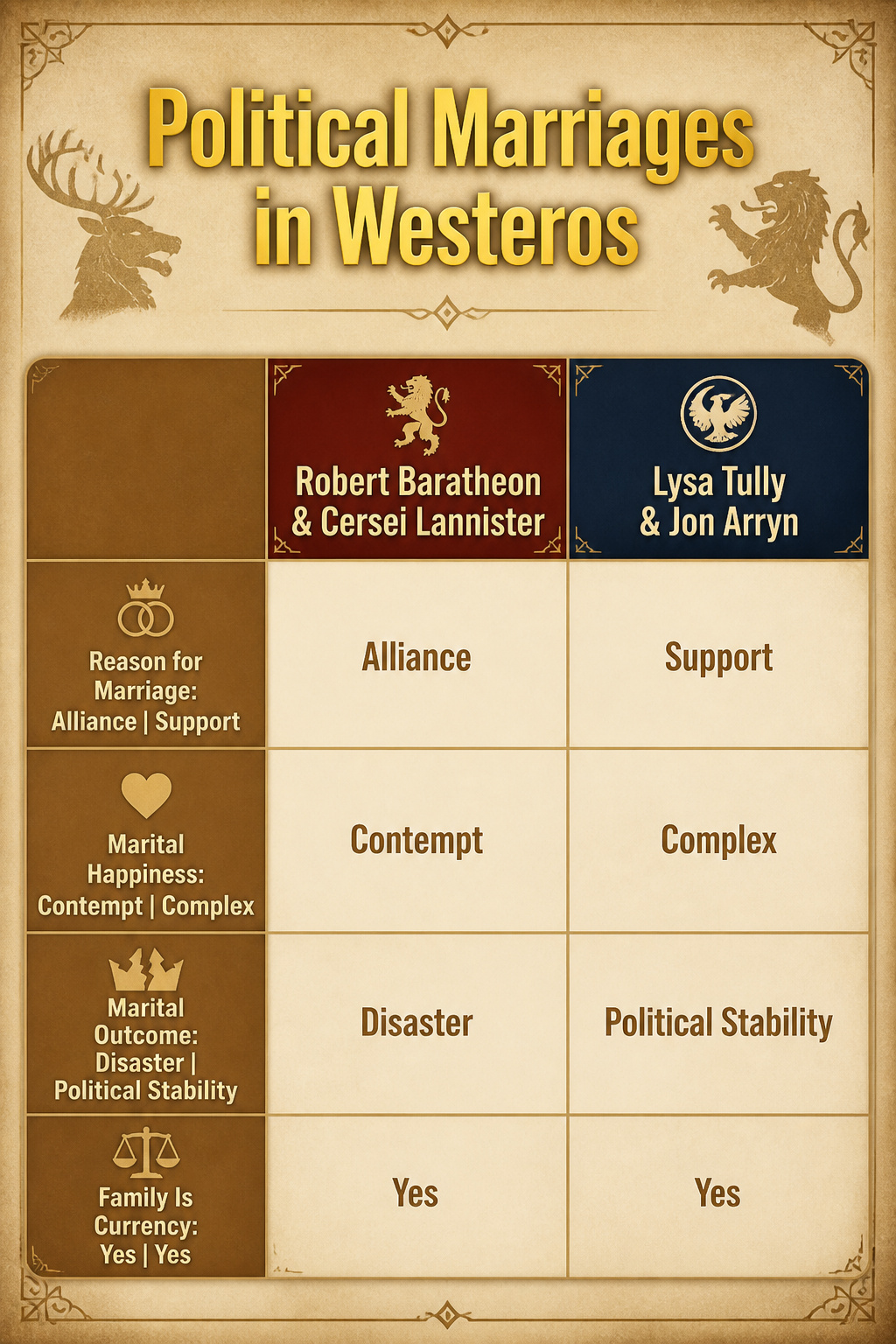
Arranged marriages bind the great houses of Westeros together the way treaties bind kingdoms, and love is the exception that proves the rule.
George R.R. Martin has stressed that Westeros mirrors the real-life Middle Ages in this respect: nobility marry to secure alliances, not happiness.
Robert Baratheon and Cersei Lannister united their houses to end a rebellion, yet their union curdled into mutual contempt. Lysa Tully wed Jon Arryn, a man old enough to be her father, because her house needed the Eyrie’s support.
Catelyn Stark later urged her son Robb to accept the same bargain, arguing that her own arranged marriage to Ned had grown into something genuine over years of effort. Most couples never get that far.
"The royals in Thrones know that marriages between members of the Great and/or Noble Houses are a surefire way to shore up succession and strengthen claims. Simply put, they enter into marriages for political, social, and economic gains."
— Gamerant
That single sentence explains why women function as currency in these negotiations. Margaery Tyrell married three successive kings because her house’s loyalty was valuable enough to purchase repeatedly.
When Robb Stark broke his betrothal to a Frey daughter to marry Talisa Maegyr for love, the move cost him his kingdom and his life.
Tywin Lannister alone among major lords married for love, wedding his cousin Joanna with no political gain attached, yet he later forced his own children into the very arrangements he had escaped.
The pattern holds across every ceremony: personal feeling is a luxury the nobility cannot afford, and those who indulge it pay dearly.
Wedding Ceremonies and Rituals
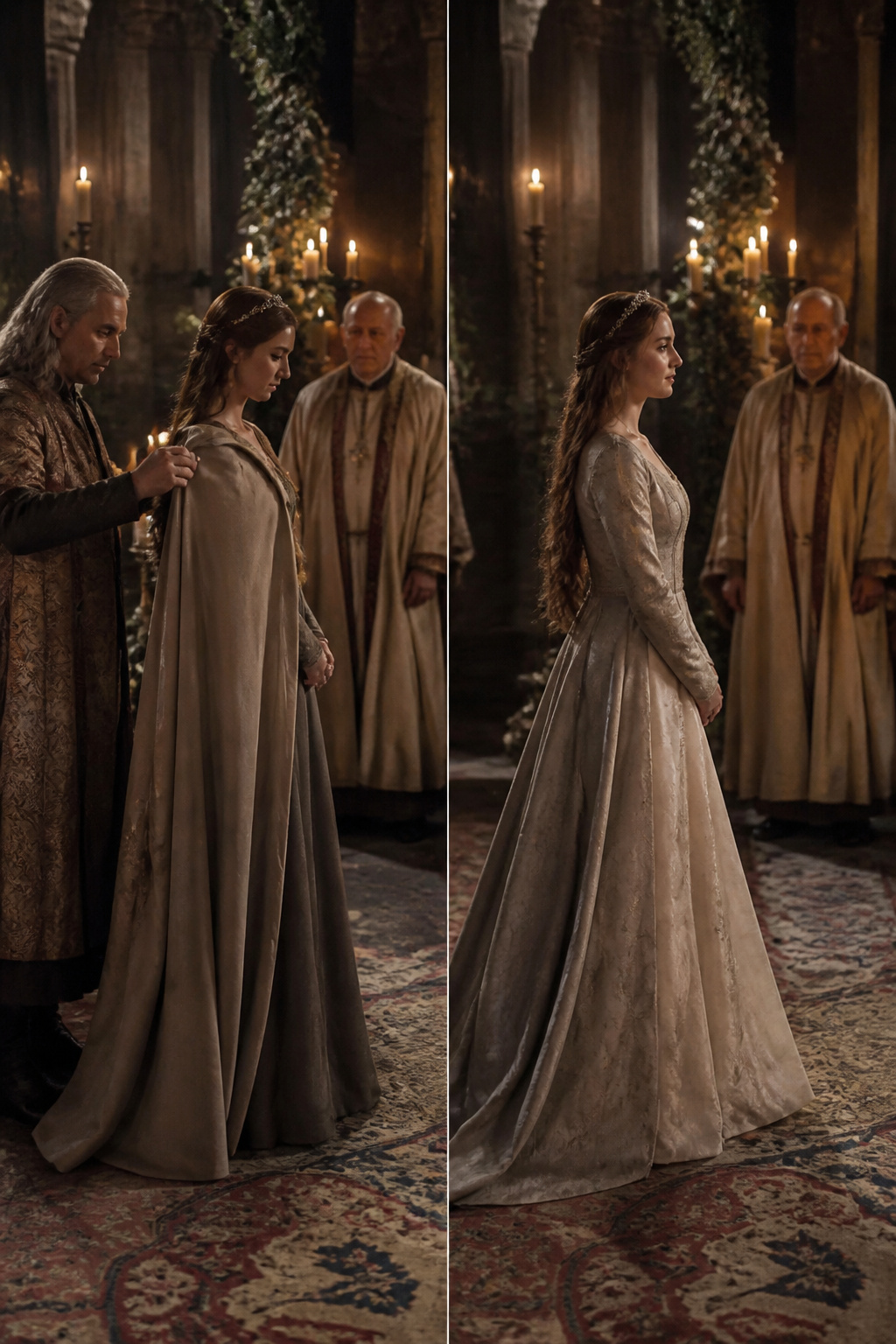
The Faith of the Seven wraps its weddings in ritual that looks almost gentle on the surface.
A septon leads prayers and song inside a sept, the bride arrives in a maiden’s cloak bearing her house colors, and her father removes it so her husband can replace it with his own.
That swap is the whole contract made visible: protection passes from one man to another, and the bride’s consent is folded into the gesture rather than spoken.
The vows couples share, "I am his and he is mine, from this day until the end of my days," sound mutual, but the structure around them is not.
Northern weddings under the old gods strip this down to something starker and, in its way, more honest. No priest speaks; the couple kneels before a heart tree in silent prayer, then rises for the same cloaking exchange.
The north keeps the bones of the ritual without the music to soften them. Some northmen even read weather as omen: snow during the ceremony means a cold marriage ahead.
The Dothraki make no pretense of gentleness at all. A wedding without at least three deaths is considered a dull affair, and the violence is not accident but expectation.
Blood marks celebration; strength is the only currency, and a khal’s wedding proves his power by the body count. Where Westerosi ceremonies disguise transfer of ownership as protection, the Dothraki display conquest openly.
Secret ceremonies, like those wed by blood and fire, stand outside both systems. A woman may officiate, and the rites reject every public structure the Faith demands.
They serve couples who need legitimacy without witnesses, not blessing but binding all the same.
Thematic Elements for Real Weddings
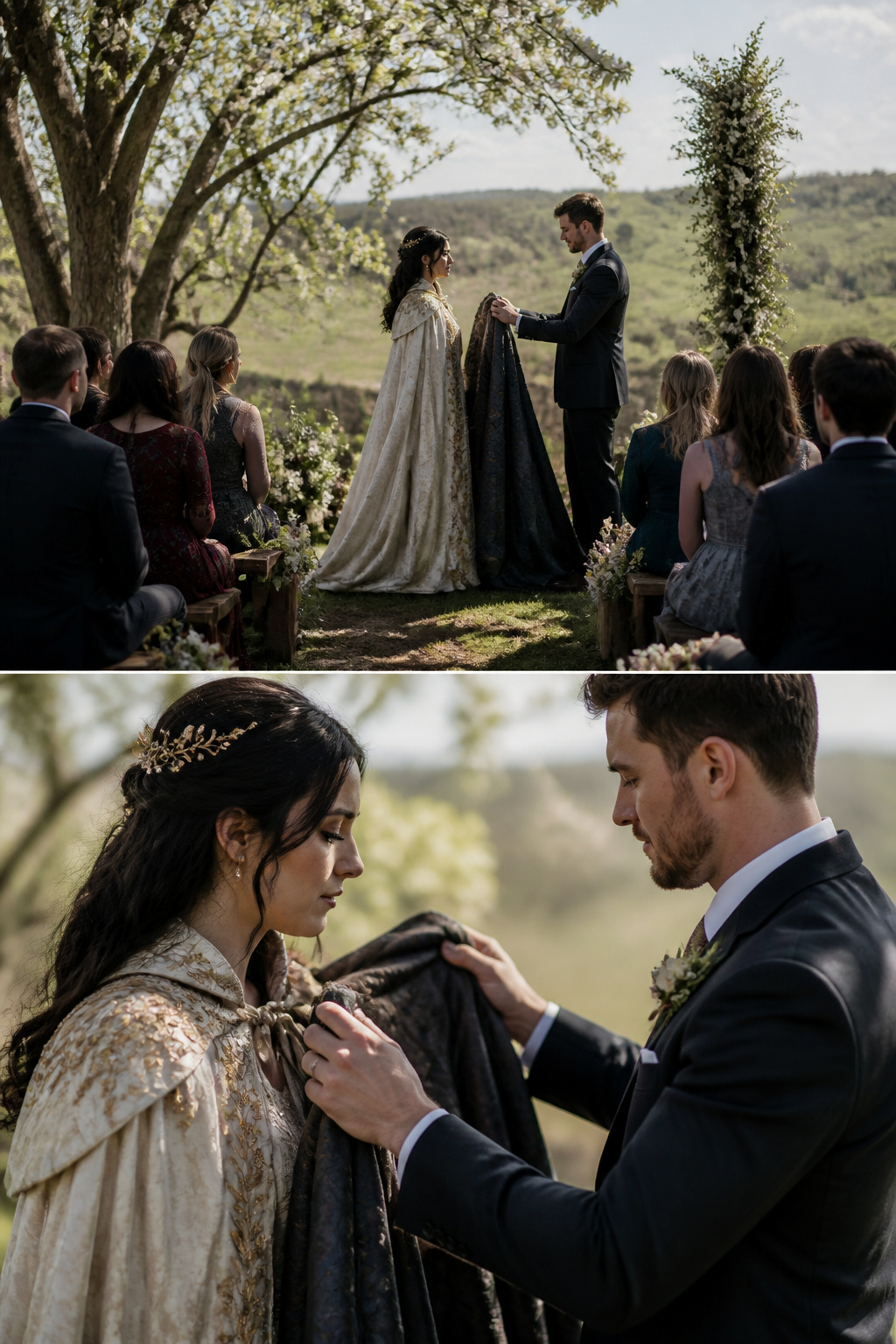
The cloaking ceremony translates better to real weddings than you might expect. A bride starts in a cloak bearing her family colors, and the groom removes it to place his own cloak across her shoulders, signifying protection.
Modern couples often adapt this into a mutual exchange: both partners cloak each other, or they design patchwork cloaks combining heirloom fabrics from both families.
A self-designed sigil on a custom cloak runs far less than most floral arches and photographs with unusual weight.
Vow styles from the show tend to work best when stripped back. Robb and Talisa’s ceremony in the light of the Seven recited personal promises without the surrounding spectacle, and that simplicity is what most guests can actually sit through.
The alternative, a full recreation of a Faith of the Seven service, loses people who do not know the reference.
Feast aesthetics borrow more easily than feast logistics. The wedding pie filled with living songbirds, doves and nightingales among them, makes a striking image; releasing actual birds indoors is a mess and a liability.
A pie with feathered decorations, or a cake with bird silhouettes, gives the visual cue without the chaos.
Music choices face the same fork: instrumental covers of the show’s score set a mood, while lyrics in Dothraki or High Valyrian become a puzzle for guests.
What fails in practice is the bedding ceremony, the post-feast ritual transition to the marriage being consummated. Modern guests have boundaries, and the show itself treated this with uneven consent.
Leave it out entirely. The tournament tradition also scales poorly: a melee at the Golden Wedding of 49 AC entertained forty thousand guests, but a rental hall rarely holds the space or the insurance coverage.
Cultural Significance and Family Expectations

Westerosi weddings bind houses, obligate armies, transfer property, and reshape maps. The couple themselves are often the least important figures in the room.
Sansa Stark moves through three engagements and two marriages as currency: first promised to Joffrey to secure Stark loyalty, then wed to Tyrion Lannister to block Tyrell ambitions, finally married to Ramsay Bolton to reclaim Winterfell for her family.
Each ceremony strips her further from choice while advancing someone else’s strategy.
Margaery Tyrell plays the same system with more apparent success, marrying Renly, Joffrey, and Tommen in succession to plant Tyrell influence on the Iron Throne.
Her weddings are outwardly beautiful and politically precise, yet each groom dies, leaving her position as temporary as Sansa’s. The performance of happiness matters more than the feeling.
Modern couples face milder versions of this pressure: the guest list becomes territory for parental claims, the venue choice signals status, the date accommodates someone else’s cruise schedule. The difference is the exit door.
Sansa and Margaery cannot decline a match that secures grain shipments or cavalry allegiance; a couple today can reject the family loan that comes with a required church or a dictated dress code.
Recognizing where the pressure parallels Westeros and where it stops short lets you borrow the drama without living the trap.
Frequently Asked Questions
What are the most important weddings in Game of Thrones?
The eight most consequential weddings are Robb Stark and Talisa Maegyr, Edmure Tully and Roslin Frey (the Red Wedding), Joffrey Baratheon and Margaery Tyrell (the Purple Wedding), Sansa Stark and Tyrion Lannister, Sansa Stark and Ramsay Bolton, Daenerys Targaryen and Khal Drogo, Rhaegar Targaryen and Lyanna Stark, and Tommen Baratheon and Margaery Tyrell.
Each reshapes the political map, with three ending in massacre and only one born from genuine mutual love.
How do Game of Thrones weddings differ from real-life weddings?
Westerosi marriages are political contracts that transfer property and alliance, with the bride’s consent folded into ritual rather than spoken. Modern weddings center the couple’s choice, while Westerosi ceremonies center house strategy.
Real couples also skip the bedding ceremony, the post-feast consummation ritual, and the expectation of at least three deaths at the celebration.
What inspired couples to have Game of Thrones-themed weddings?
Fans borrow the show’s aesthetics, vows, and rituals while dropping the violence and betrayal. Popular elements include golden goblets, medieval-style decorations, castle venues, house sigils, deep red and purple florals, and Iron Throne photo backdrops.
The cloaking ceremony translates especially well, with couples often mutualizing the tradition so both partners cloak each other.
Which episode is the wedding in Game of Thrones?
The series features weddings across multiple episodes, not one.
Major ceremonies appear in Season 1 Episode 1 (Daenerys and Drogo), Season 2 Episode 10 (Robb and Talisa), Season 3 Episode 8 (Sansa and Tyrion), Season 3 Episode 9 (the Red Wedding), Season 4 Episode 2 (the Purple Wedding), Season 5 Episode 3 (Tommen and Margaery), and Season 5 Episode 6 (Sansa and Ramsay).
What happened during the Red Wedding?
Walder Frey lured Robb Stark and his bannermen to Edmure Tully’s wedding to Roslin Frey, then sealed the hall and massacred them.
Roose Bolton stabbed Robb through the heart after Catelyn Stark’s throat was cut, and Talisa Maegyr was stabbed repeatedly in the womb. The betrayal ended the Northern rebellion and handed the North to Lannister control.
Who marries who in Game of Thrones?
Robb Stark wed Talisa Maegyr; Edmure Tully wed Roslin Frey; Joffrey Baratheon, then Tommen Baratheon, both wed Margaery Tyrell; Sansa Stark wed Tyrion Lannister and later Ramsay Bolton; Daenerys Targaryen wed Khal Drogo; and Rhaegar Targaryen secretly wed Lyanna Stark after annulling his marriage to Elia Martell.
How many times did Daenerys marry?
Daenerys married once in the series, to Khal Drogo in the pilot episode. The arrangement was brokered by her brother Viserys in exchange for Drogo’s army.
She later formed political alliances and romantic attachments, but no additional marriages occurred before her death.