A two-tier wedding cake can run from smooth buttercream and fresh roses to vintage piped swags and gold initials, with the deciding factor being how much of your budget is spoken for before the cake enters the room.
The same buttercream base carries both smooth finishes and elaborate piping; what changes is the labor layered onto it.
A narrow wedge cut from a tall slice stretches a modest head count without drawing attention, something most bakers know how to do.
1. Smooth Buttercream Finishes
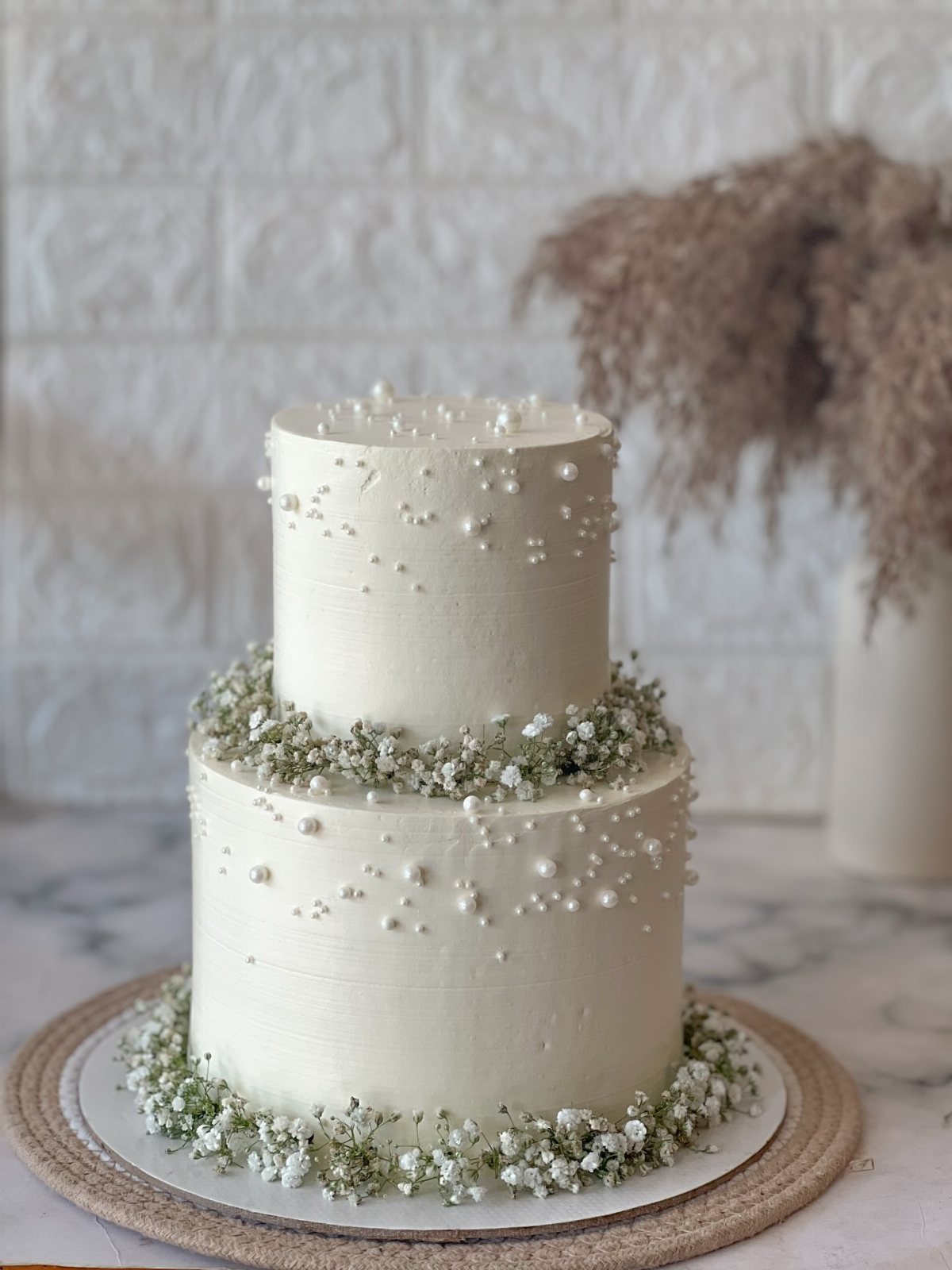
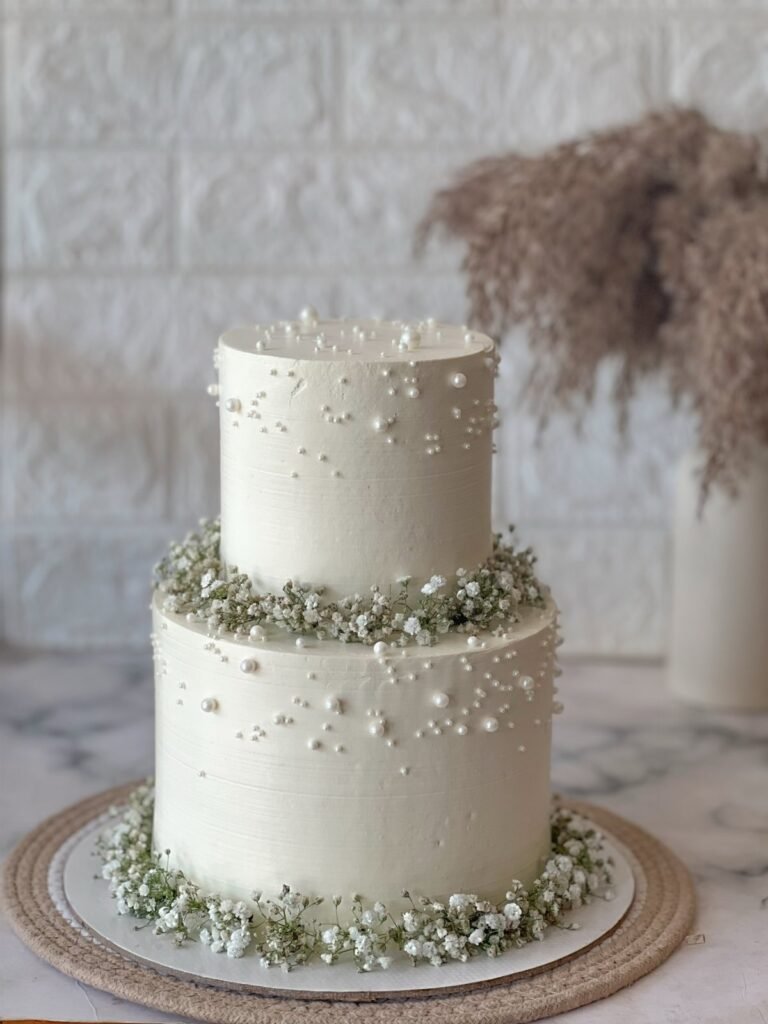
A smooth buttercream finish reads as intentional restraint rather than unfinished, which is exactly why it works for a two-tier cake that needs to hold its own without climbing higher.
Keep the surface clean and let scattered edible pearls and rings of baby’s breath do the visual work.
This is the choice for couples who want elegance without fondant’s stiffness or its labor cost. A polished buttercream base also accepts a thin ribbon or a small fondant bow if you want one dressed-up element.
Metallic leaf works here too, though I would keep it to a trace; the restraint is what makes this look work, so nothing should shout.
Budget-wise, buttercream costs less than fondant coverage and takes less time to smooth than you’d think. The baker’s hours drop, and your per-serving price drops with them.
2. Two-tier Wedding Cake
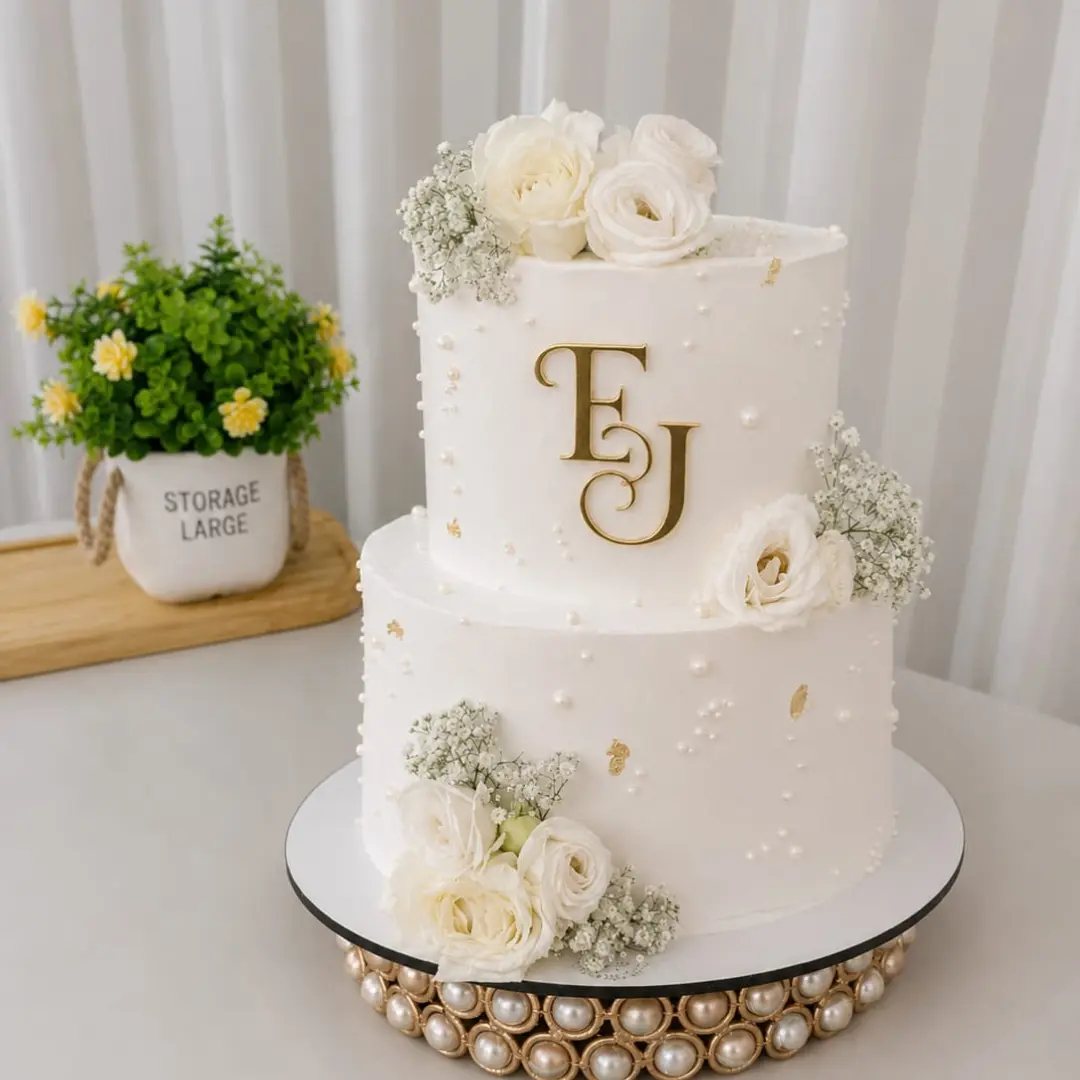
Most two-tier cakes pair a smaller top tier over a wider base tier, which feeds a modest group well.
That is the standard for a reason: it photographs well, it slices cleanly, and it does not leave you with half a tier of leftovers you paid for.
A two-tier cake makes sense when your guest count is modest and you do not want the visual weight of something taller.
The cake still registers as a wedding cake, not a birthday afterthought, but the baker spends fewer hours on structure and doweling. Those hours come off your bill.
If your count pushes higher, a wider base tier adds servings without adding a third tier. You can also set out sheet cake in the kitchen.
Guests get the same flavor; you get the same ceremonial cutting moment; the budget stays closer to modest.
3. Cake Serving Sizes
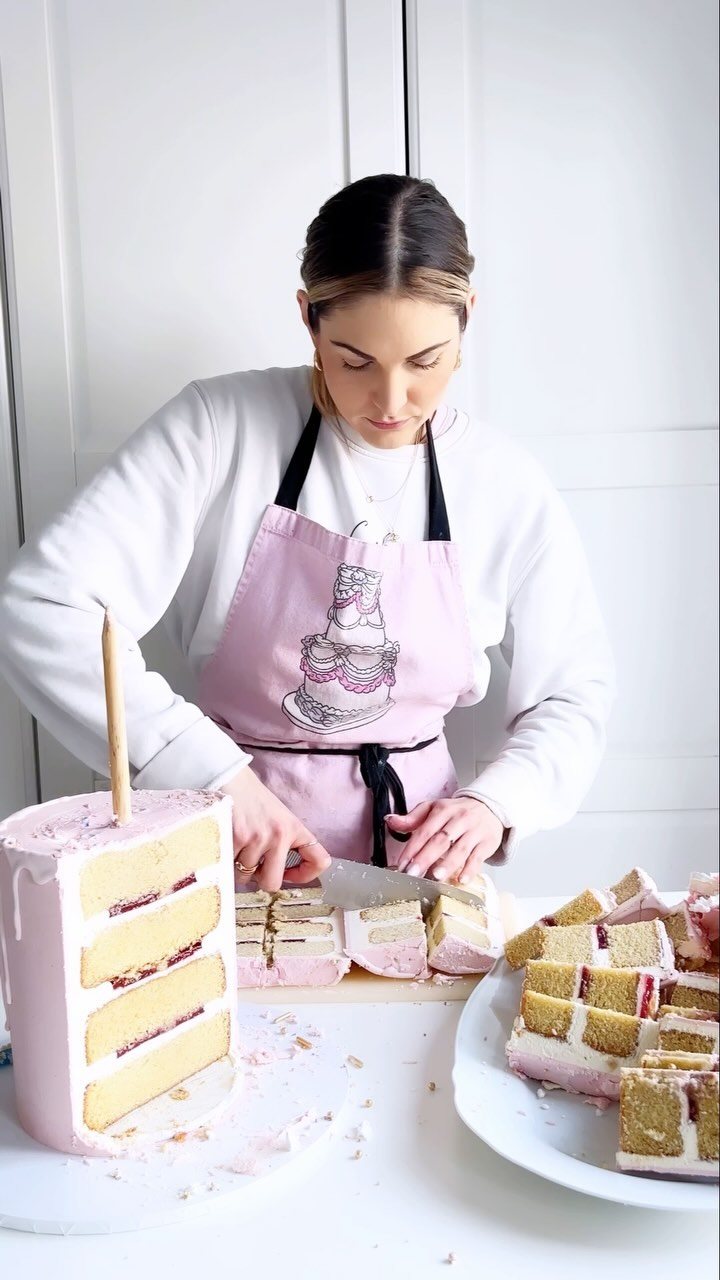
The slice size is where couples get surprised. A two-tier cake built from a smaller tier stacked on a wider base yields fewer portions if you cut generously, or stretches further if you cut thin.
The height works in your favor; each slice is tall enough that a narrow wedge still feels like a full serving.
I have seen bakers cut a tall slice in half to stretch the count further.
The technique matters: a sharp knife, a clean wipe between cuts, and cutting from the top tier down rather than trying to saw through both at once.
If your reception includes a full dessert table or late-night snacks, you can safely plan on the lower end of the range.
Guests who have already eaten cake from a buffet do not return for a second wedge of the main cake.
4. Floral Accents with Gold Initials

Food-safe flowers are non-negotiable. Your florist or baker needs to confirm the variety; some blooms carry pesticides or sap that should not contact frosting.
I would match the cake flowers to the bouquet for cohesion, though the cake needs fewer stems, so you can choose a pricier bloom there without blowing the floral budget.
Gold initials run from acrylic cutouts to metallic fondant to real leaf. Fondant letters are lighter and easier to anchor; metal or acrylic needs a dowel or a hidden pick.
Ask your baker which they have done before. A topper that tilts in the frosting is not the photo you want.
5. Vintage Piped Swags and Pearls

Piped swags read as old-fashioned in the best way, the kind of detail that signals someone chose craft over convenience.
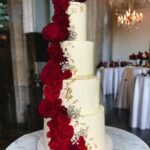
This style suits a reception with some traditional architecture: a historic hotel, a ballroom with crown molding, a garden tent with crystal chandeliers. The cake carries that formality without needing fondant’s porcelain smoothness.
Edible pearls, especially in gold, pick up warm light and add the one metallic note that keeps the palette from going flat white.
I would not pair this with a busy tablescape. The cake itself is already doing the ornate work; let the linens stay simple and the plates stay plain.
Piped buttercream does not travel as well as fondant, so your venue needs to be close enough that the baker finishes on-site or delivers with time to repair any smudge.
6. Fresh Roses with Greenery
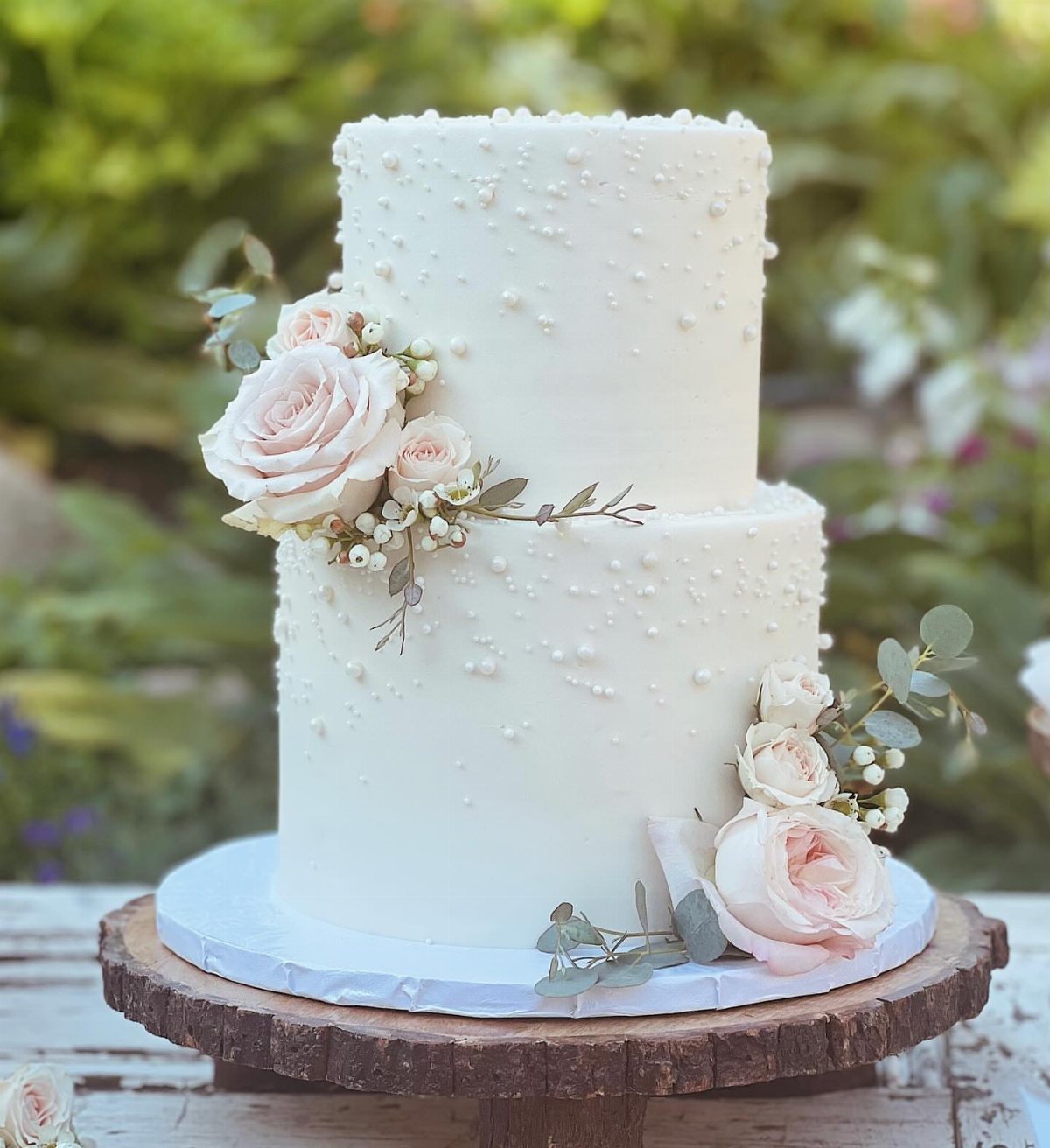
Eucalyptus and blush roses against white buttercream is a color combination that photographs reliably in any light. The stand is your pivot point.
Fresh greenery needs water picks or stems inserted into straws; bare stems touching frosting wilt and can flavor the buttercream. Your baker should handle this, but confirm the method.
I have seen cakes where the eucalyptus dried crisp by hour three of the reception, which is fine visually but brittle to the touch.
This look scales well. A small two-tier cake with minimal fresh greenery stays affordable in most markets.
Add more roses and the price climbs by the stem, not by the tier. For a tighter budget, I would keep the floral cake simple and put the flower money toward the bouquet and the arch.
7. Pink Baby’s Breath and Curls

Pink baby’s breath reads as airy and modern against dense white chocolate curls, a pairing that keeps a 2 tiered wedding cake from feeling too formal for a backyard or brunch reception.
Paper-thin white-chocolate ruffles need to be set while the chocolate is still soft; a bakery can execute them, or a confident home baker with a steady hand and an offset spatula.
I would ask for the baby’s breath in a slightly darker pink than blush, which photographs cleaner against white buttercream.
The gold script topper is where the personalization lives. Custom acrylic toppers run high depending on length of names; swap in a standard "Mr & Mrs" from a craft store and the whole look drops to a fraction of the cost.
That trade suits a couple who wants the gesture of a topper without the wait time of custom lettering.
This combination asks for a simple cake stand, white or clear. Ornate metal competes with the ruffles.
8. Delicate Pink Petals and Name Plaque
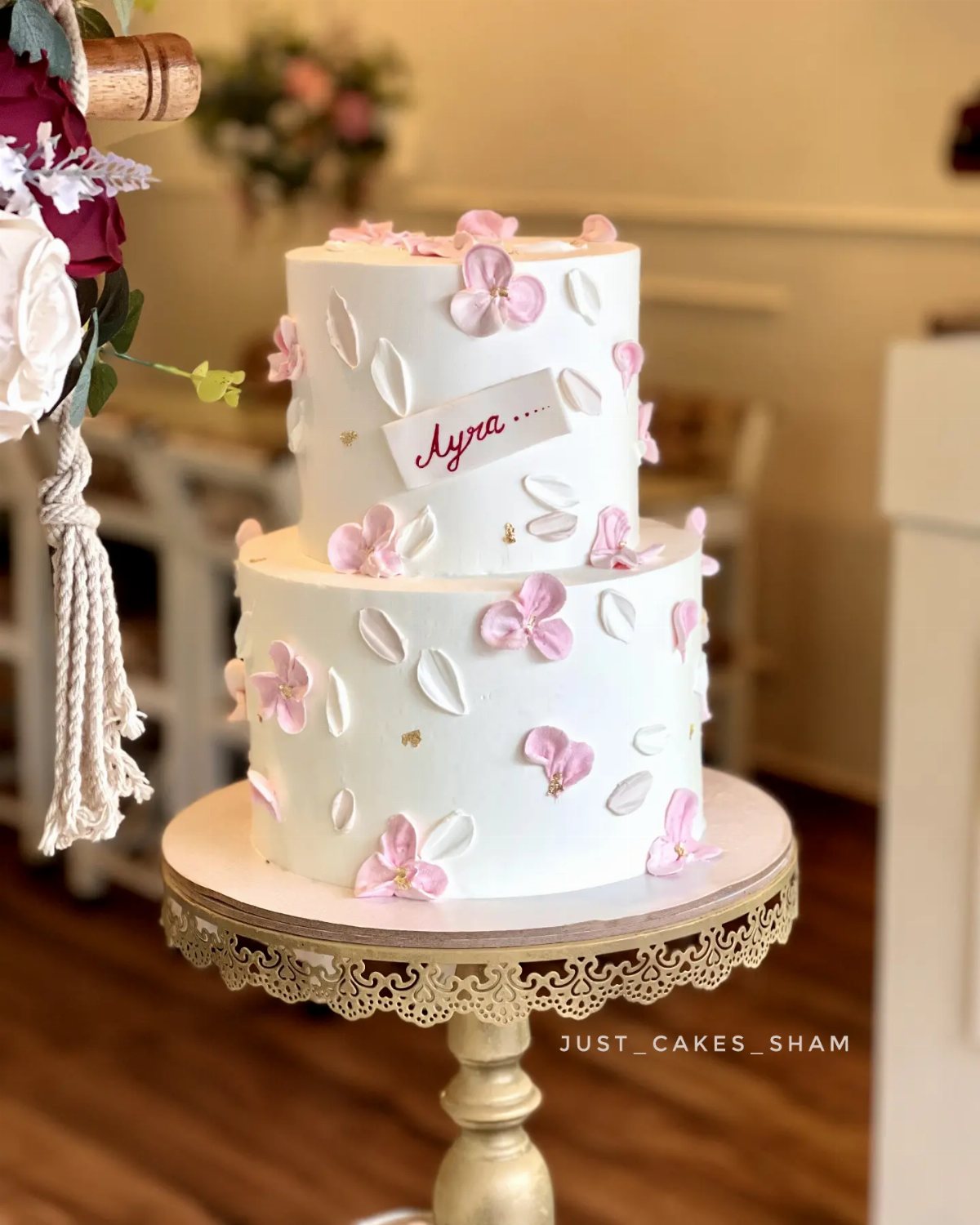
Texture carries this 2 tiered wedding cake: the pink petals are applied individually, overlapping like shingles, which catches light differently than smooth fondant or flat buttercream.
The effect is handmade without reading rustic, suited to a couple who wants color but not a cascade of blooms dripping down every tier.
The name plaque is the detail I would negotiate early. A flat rectangle topper needs to be planned before the bakery structures the top tier, since weight and placement affect internal supports.
A rectangular plaque also photographs more clearly in group shots than a curved banner that wraps the tier.
Rent one if the venue does not provide it; purchase runs high for metal with working scrollwork. Without that elevation, the cake risks looking stranded on a standard plate.
Budget Considerations
A standard two-tier build, 6 inches over 8 inches, feeds 40 to 50 people if you cut thin.
The informal reception is where this cake earns its keep.
A brunch wedding, a backyard gathering, an early afternoon party where cake is one of several desserts; all of these are cases where a four-tier showpiece would look out of scale with the rest of the day.
A semi-custom design keeps the look personal without the fondant labor that drives up cost. Choose your flavors and fillings, add one decorative element that ties to the rest of the reception, and stop there.
The restraint reads as intentional.
Customization Options
Splitting flavors by tier is an option some bakers offer and others do not. If yours does, consider how the two flavors read together.
A vanilla bean cake with lemon curd on the bottom and chocolate with salted caramel on top gives guests a choice, but the combination should taste like it belongs at the same party.
Macarons in graduated sizes, arranged at the base or clustered on top, add color without the water-pick logistics of fresh flowers.
A drip of dessert sauce down the edge works on buttercream; it does not work on fondant, which repels liquid. Fresh fruit needs to stay refrigerated until the last hour, so confirm your venue’s cooler space before you commit.
Sprinkles and small cookies suit a reception with a playful tone. These read as casual, which is fine if the rest of the day is casual too.
The rule I would apply: match the cake’s decoration to the formality of the table settings, not the other way around.
Delivery and Pickup
Delivery is not automatic. Some bakeries bring the cake to the venue; others require pickup during business hours, which for a Saturday wedding means Friday afternoon at the latest.
Ask the question directly; do not assume.
A two-tier cake fits in most standard car trunks if the tiers are boxed separately and assembled on-site. The base tier stays flat on the floor; the top tier rides beside it, level.
Bring a non-slip mat. Buttercream smudges do not repair themselves in a moving vehicle.
If the baker delivers, the fee is usually set by mileage, not by tier count. A two-tier cake does not automatically cost less to deliver than a three-tier; the driver still makes the round trip.
Factor this into your comparison of total prices, not just the cake quote alone.
Cake Stability
Dense cake recipes stack more forgivingly than airy ones. A pound cake or a butter cake with less leavening holds its shape under the weight of a second tier.
That said, a fluffy recipe can work if the layers are baked thick enough to compress slightly without collapsing.
Flat layers matter more than density. A domed top on either tier throws the whole stack off plumb.
Trim with a long serrated knife before you frost, or ask your baker whether they level. Some charge extra; some consider it standard.
Refrigeration firms buttercream and sets the cake’s structure. If your venue lacks a cooler, choose a fondant finish, which tolerates room temperature longer.
A buttercream cake in a warm tent for 3 hours before cutting is a risk I would not take.