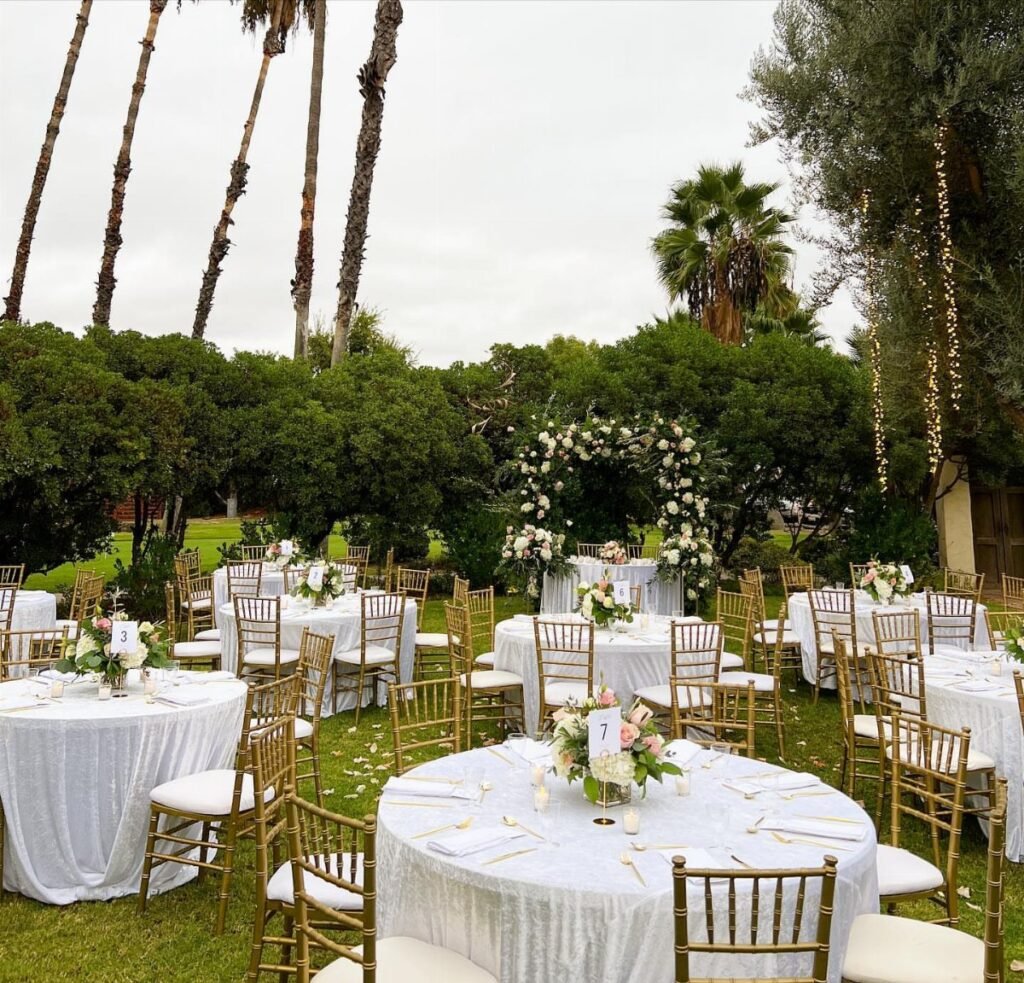
California wedding venues run from a civil ceremony under 300 feet of gilded dome to buyouts of entire luxury resorts, with guest counts and minimums shifting as sharply as the landscape itself.
The right choice depends on whether your budget is fighting the venue’s built-in costs or its location premium, since a Sonoma vineyard’s wine-country profile and a Palm Springs desert resort’s hotel minimums operate on entirely different economics.
1. The Best California Wedding Venues in Big Sur

Highway 1 does the work before guests even arrive. The drive through Big Sur frames what comes next: redwood groves, ocean mist, and ceremony spots where the view sets the schedule rather than the other way around.
Alila Ventana Big Sur builds its whole identity around the cliffs and redwoods. Multiple layouts let the wedding scale from intimate to full property, though guest counts trend lower here than almost anywhere else in the state.
I’d plan a late ceremony if you’re marrying midsummer, or move to September when the burn is cleaner. Carmel and Monterey anchor the north end with more hotels and a real airport, which matters for anyone flying in.
2. Ojai Valley Inn

Farm-to-table dining and thermal mineral springs sit on the same property, so guests have something to do between events.
The scale fits couples who want people to gather, loosen up, and move at their own speed.
I’d pick it for a group that would use the golf course, the spa, and the patios rather than one that wants to pack the schedule tight.
3. Beaulieu Garden

A garden that already looks finished before the florist arrives is the specific advantage here.
Stone fountains and reflecting pools organize the outdoor spaces with symmetry that doesn’t need much addition.
This is a venue for couples whose floral budget is modest or who would rather spend it on one dramatic moment than on filling empty space. The trade is location: you’re in Napa, with the cost profile that carries.
If the guest list is long and the wine country budget isn’t, look to Sonoma instead.
4. Luxury Hotels

The in-house structure is the point: everything stays contained, private, and consistent with a long-standing style.
This fits couples pulled toward classic Los Angeles glamour and the relief of a place that already knows exactly what it is. The trade is flexibility; the hotel is not a blank slate.
For a different coastal read, The Resort at Pelican Hill in Newport Beach runs Italian-inspired architecture against the Pacific, with a rotunda ceremony space and terraces that scale up or down.
5. Vineyards and Wineries

Napa carries the name and the highest minimums. Sonoma, more rural and looser on event rules, is where I’d begin if the budget sits under $100,000.
Vineyard venues are easier to book than Napa proper, and they are prevalent across California well beyond the famous names.
6. Beach and Waterfront Venues

840 miles of coastline means beach and waterfront venues are not all one thing. California offers ceremony space on sand, bluff settings above it, and lawns that read as country estate until the ocean appears at the edge.
Rosewood Miramar in Montecito runs an 8,000-square-foot Great Lawn for larger celebrations, with gardens that create smaller corners for groups that want to break apart. The coastal estate format works for guests who need to relax between scheduled events.
For a different angle, the 16-acre luxury resort in Menlo Park puts the Santa Cruz Mountains behind lawns that do not look like Silicon Valley.
Michelin-starred dining on property and a solid in-house event team count for a lot when guests are flying in from across the country and you need the logistics to stay upright.
7. Desert Venues

I would not book Palm Springs or Joshua Tree in July; the midday heat makes any outdoor setup dangerous for guests and staff alike.
The shoulder season, late March and October, still gives you those rose-gold sunsets without the premium of peak spring.
Joshua Tree leans more rustic, Palm Springs more polished, and both reward the couple who wants their guests to remember where they were. Check whether your venue has misters, generator power for after dark, and a solid indoor backup.
Sand gets into shoes, food, and car floors; warn guests or lean into it with the dress code.
Palm Springs hotels often require a minimum stay for any event booking. That changes the math for a wedding party spread across price points.
8. Intimate Venues

A deck this size, meant for a small group, lets you spend on one chandelier and strands of fairy lights instead of filling a ballroom.
I have seen couples overfill intimate spaces; the catering suffers, the bar line doubles, and the feeling curdles into cramped. The real value of a small venue is the conversation you can have with every guest.
That only holds if you actually cut the list. Elopement packages at these places often run midweek with a short window; book a full day only if you are adding a seated dinner.
Ask whether the deck is yours exclusively or shared with a restaurant; shared kills the privacy that justifies the premium.
9. San Francisco City Hall

San Francisco City Hall costs less than almost any private venue and draws couples from across the country for civil ceremonies.
The Beaux-Arts rotunda, with 300 feet of gilded dome, needs no décor budget at all; the marble and symmetry do the work. Marilyn Monroe and Joe DiMaggio married here, which matters to some couples and not at all to others.
I would use this for portraits even if the reception moves elsewhere. The building closes to the public for buyouts, so your photographer has run of the stairs without tourists in frame.
10. Sea Ranch Lodge

The Sea Ranch Lodge spreads across 53 acres of Sonoma coastline, and the design keeps pulling your eye back to the ocean and the light rather than to any centerpiece or draping.
That is the trade: you get restraint, clean lines, and a setting that changes hour by hour, but you do not get a blank canvas to theme heavily.
Ceremonies work on the bluffs, receptions in residential-style courtyards and patios, and the whole day moves between indoor and outdoor without ever leaving the property.
I would pick this for a couple whose guests are flying in from cities and need to decompress. The recently renovated spaces suit intimate dinners or full celebrations, though the lodge’s real strength is understatement.
Cell service is patchy along this stretch; print your timeline and shuttle details.
11. Mountain and Forest Venues

A glass pavilion in pine forest gives you the mountain setting without the weather risk of an open field.
Tahoe venues run higher in price and lower in availability for winter Saturdays; Yosemite permits cap guests and ban amplified sound in most groves.
The redwood belt from Santa Cruz to Humboldt offers 200-foot old growth no ballroom can buy, but the filtered green shade is unforgiving on timing.
State and county park land means permits, not venue contracts, with vehicle limits and no cell service; plan vendor arrivals like nobody can call anybody.
I would take the pavilion route for reliability and the redwood grove only if the couple values the specific place over comfort.
Choosing the Right Venue
Guest experience and travel logistics matter more than the photo set a venue posts online.
A space that photographs well at golden hour can still strand guests without cabs, or force a long walk between ceremony and cocktail hour in heels.
I would visit at the same time of day the wedding will run, not at the open house with every light on.
Watch where the sun falls, where guests cluster waiting, whether the restrooms are a hike from the dance floor. Privacy is harder to audit; ask which spaces are yours alone and whether a restaurant or second event runs simultaneously.
The flow of a full day or weekend only reveals itself when you map it minute by minute. A venue that sells itself on beauty can still leave you with dead hours, bottlenecked catering, or guests wandering without direction.
Wedding Venue Costs
California venues cost more than the national average, though how much more depends on where you look.
Guest count compounds in both directions. A smaller guest list in Big Sur or Joshua Tree can land you a more striking venue for less than a packed house somewhere ordinary.
Fewer guests, though, means each one costs more to host. I start with the total budget and work backward, not the other way around.
Seasonal Considerations
September and October are peak months across California, which means every vendor and hotel room is priced accordingly and booked early.
I would not assume good weather is guaranteed even then; coastal fog in San Francisco and Monterey can hang until midday, and inland valleys still hit 90 degrees in early fall.
Mountain and forest venues in Tahoe or the redwood belt carry winter snow closures and summer fire restrictions both, so the permit window matters as much as the date itself.
If guests are flying in, avoid holiday weekends when every airport and highway adds hours to the trip.
Logistics and Planning
A wedding planner earns their fee most on logistics that multiply: vendor arrivals across a property with no cell service, shuttle timing that cannot slip, or a buyout where every room block and meal period is contractually pinned.
For weddings above 120 guests, I would not attempt self-coordination in California; the state is too large, the permitting too varied by county, and the vendor market too segmented by region.
Planners who work a specific venue regularly know the hidden costs: which caterers carry proper insurance for state park land, whether the generator can handle both misters and the band, how the load-in door actually fits a rental truck.
For smaller weddings, a month-of coordinator may suffice if the venue has an in-house event team.
Ask directly who handles weather backup, parking, and guest questions on the day; a venue that passes all three to you needs more support than one that keeps them in-house.
Frequently Asked Questions
How much does the average wedding venue cost in California?
California venues typically run $34,500 to $51,700. Guest count moves the total more than location does; an intimate wedding in Big Sur or Joshua Tree lands you a better setting at a lower number than a full-size wedding somewhere lesser.
Is $10,000 a lot for a wedding venue?
In California it buys you a public space or an off-peak date at a modest private venue, not a Saturday in Napa or Montecito.
Inland counties and winter Fridays can pull premium spots down toward that mark, though catering and head count still stack onto the rental fee. For context, the typical California venue alone runs well above $30,000.