The ideas below run from a simple U-pin set at a beauty supply store to the cost of sourcing enough fresh roses for a full crown, and the deciding factor is not budget but where the eye needs to rest: on the dress, the hair itself, or the headpiece as the main event.
A ribbon tie at the back of a flower crown lets you loosen the fit as the day swells, which standard wire crowns cannot do.
1. Baby’s Breath

Baby’s breath works when you want the flowers to read as texture rather than statement.
I have seen it pinned into a half-up bubble ponytail where the tiny white clusters fill the gaps between sections like mortar, and I have seen a single stem tucked behind an ear for a courthouse wedding that needed almost nothing.
The stems are pliable enough to weave through a braid as you work, or your stylist can secure them with the same pins holding the style. They will last the day without water, which matters for outdoor summer ceremonies.
Pair them with roses or hydrangeas if your bouquet already goes that direction, or keep them alone for a look that reads as accidental, which I tend to prefer.
Best for: the bride whose dress already carries the weight.
2. Roses

A red rose against dark hair reads formal in a way that baby’s breath does not, and the fragrance is part of the event, not an afterthought.
A low bun holds together with one anchor flower, one supporting texture, and baby’s breath as filler; three large roses do the job here.
Color matching matters more here than with smaller flowers. A true red rose against an ivory dress is one statement; a dusty pink against champagne is another.
Your florist can source the shade, but bring a fabric swatch, not a phone photo, because screens lie about red.
I would skip the fragrance if the ceremony runs long in direct sun. Heat concentrates the smell, and not everyone in the front row wants to remember your wedding that way.
3. Jasmine

Jasmine strung into a gajra carries a specific weight: it signals a decision about tradition rather than a default.
Jasmine works as dense hanging strands wrapped through a long braid for the full version, or as a single circlet worked into a bun when the bride wants the reference without the full display at a mixed ceremony.
The flowers bruise easily. Arrange them the morning of, not the night before, and keep them cool until the last minute.
The scent is softer than rose, more green, and it fades rather than turning sharp.
For a jaali gajra, the weave is open and shows the hair beneath; for a wrapped garland, the coverage is total. The choice depends on whether the hairstyle or the flower is doing the work.
4. Chrysanthemums

Chrysanthemums carry a meaning that sounds like a greeting card until you need it: happiness, optimism, the long life you are promising.
Deep red chrysanthemums sit along a thick braid with deliberate placement, arranged one by one as punctuation rather than strung as a garland.
They are sturdier than they look. The petals hold through heat better than roses, and the color range runs from white through bronze to a red that borders on brown.
I would use them for a fall wedding where the palette already leans warm, or for any bride who wants the flowers to look chosen rather than expected.
The cheerful part is real. These are not apologetic flowers.
5. Braided Hair with Small Flowers

A thick braid with small flowers woven in reads as one movement, not a hairstyle plus decoration.
Pink and white blooms spaced far enough apart let the braid itself still show; too dense and the flowers look like a garland that slipped, too sparse and they look lost.
The stylist braided first, then inserted stems into the weave and secured each with a pin matched to the hair color.
If you are doing this yourself, practice on a friend; the angle of insertion changes when you cannot see the back of your own head.
This style trades away the security of a pinned-updo for movement. It will swing when you turn, which is the point, but check it in a mirror from behind before you commit.
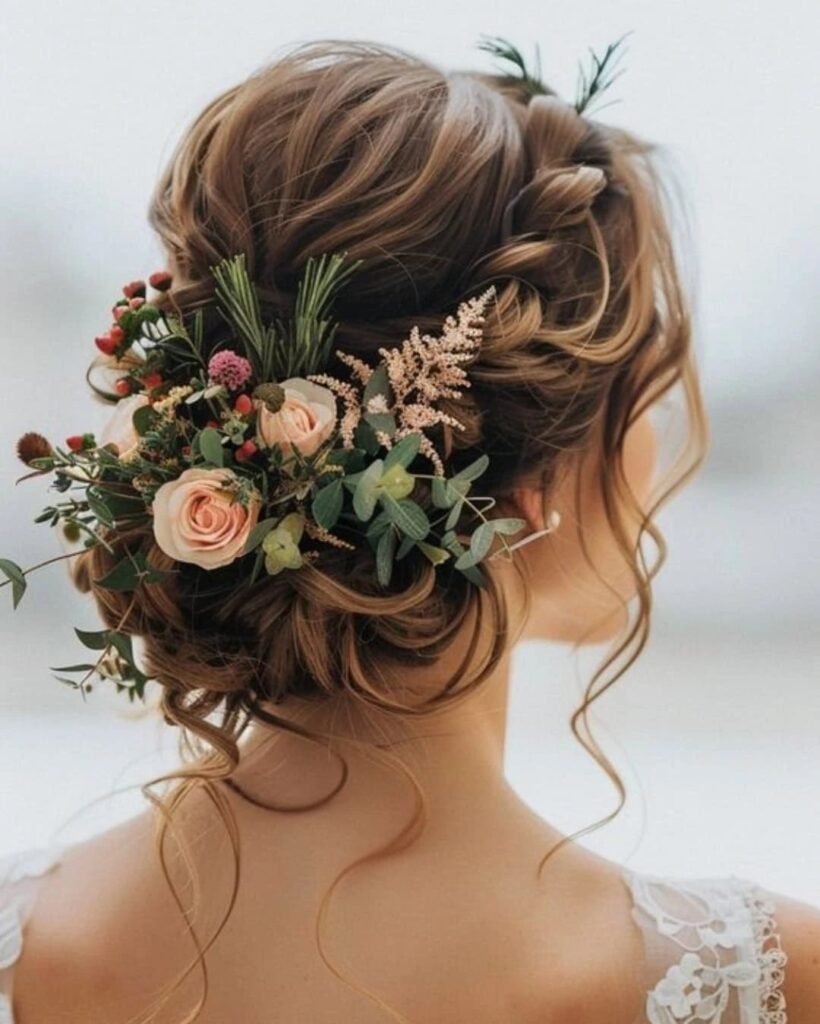
6. Low Bun with Mixed Blooms

A low bun at the nape keeps the flowers where a veil or a neckline would compete if they sat higher.
Small white blooms and leaves placed asymmetrically, more on one side than the other, keep a low bun from reading as a doughnut.
Green foliage matters as much as the flowers here. The leaves extend the shape and soften the edge where the bun meets the neck.
Without them, the white dots would float; with them, the whole thing becomes a single gesture.
This is the style I would choose for a boat neck or an open back, anything where the eye travels downward and needs a reason to stop.
It sits still, it photographs cleanly from behind, and it does not require the height some buns demand from your crown.
7. Center Part Floral Accents

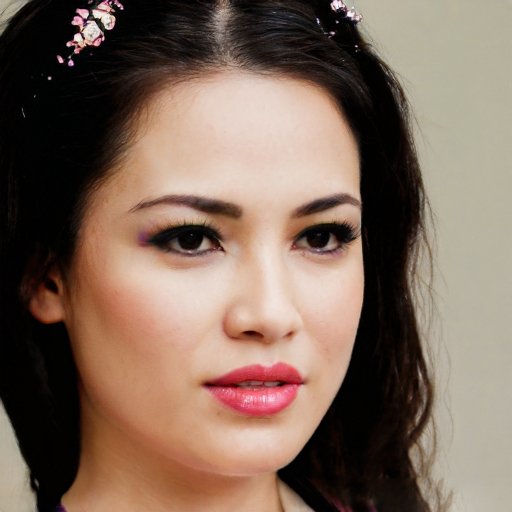
A middle part gives you natural symmetry, and soft pink and white blooms tucked along each side turn that symmetry into something ceremonial.
I like this for brides who want the feel of a flower crown without the full circle pressing against their forehead all evening.
The placement stays light if you keep the stems short and wire them to small pins rather than weaving full branches in.
Your florist can prepare these the morning of, or you can buy individual spray roses and baby’s breath and pin them yourself with U-pins from any beauty supply store.
This one reads as romantic rather than bohemian, so it pairs cleanly with simple earrings and a veil that sits below, not above, the flowers.
Check your hair trial: wavy texture holds pins better than blown-straight, and you will want to know how the weight feels by hour 4.
8. Colorful Flower Crown

Dried flowers let you build a crown in peach, orange, and blue that would cost triple from a florist and wilt by cake-cutting.
The color here is the point: this is for a bride whose palette runs warm and saturated, whose dress is plain enough to let the headpiece carry the visual weight.
A fabric headband in your hair color forms the base, and hot glue does the rest. A headband base holds dried blooms in place far better than a wire crown, which slips the moment you turn your head.
Starting the glue early and touching up loose stems the night before saves last-day panic.
Dried flowers carry a matte, slightly stiff texture that softens in afternoon light but flattens under flash. For a mostly outdoor wedding, that limitation barely registers.
9. Half-Up Waves with Delicate Flowers

Tiny white blossoms scattered through loose waves give you the softness of a full floral style without the structure of an updo.
This works best when your hair has natural wave or holds a curl set; straight hair lets the pins slide and the flowers look placed-on rather than grown-in.
I would ask your stylist to set the waves first, then pin the half-up section, then tuck the blooms last so nothing gets crushed under a comb.
Spray roses, individual jasmine buds, or even fresh lily of the valley if your budget stretches: the smaller the flower, the more delicate the effect.
The half-up frame keeps hair off your face for the ceremony but leaves length down for portraits.
One caution: dancing will loosen everything, so have your maid of honor carry a few spare pins and a small mirror for the reception.
10. Floral Hair Garland

A long garland of white jasmine woven through dark waves carries immediate South Asian wedding reference, though the style travels well to any formal event where you want continuous floral line rather than clustered accents.
The pink beaded jewelry paired here is optional; the garland alone is complete.
Fresh jasmine strands, called gajra, stay fragrant through the evening but bruise if handled too much.
Order them the morning of from an Indian grocery or flower market near you, or substitute artificial if fragrance is not your priority and you want to keep the piece.
Drape them once your hair is fully set; wrapping too early traps moisture and flattens curls.
With this much ornament in the hair, earrings become unnecessary; a bare earlobe keeps the look clean. The garland itself runs the length of the hair and provides enough visual rhythm.
11. Floral Crown with Ribbon Tie

A ribbon-tied crown gives you the lushness of white roses and baby’s breath with an adjustment most floral crowns lack: the satin bow at the back lets you tighten or loosen the fit across your temples as the day swelling changes, which it will.
A ribbon tie lets the crown sit high for the ceremony, then drop lower for dancing once the bow comes undone.
The ribbon also answers the question of what happens at the back. A standard crown ends in stems or wire; this one ends in a soft bow that photographs cleanly from every angle, including behind you at the altar.
Build this on a fabric-wrapped headband for security, or have your florist wire the blooms to a ribbon base if you prefer the genuine tie.
Either way, long hair worn down beneath it keeps the look from feeling too literal or too festival. I would reserve this for outdoor or garden settings where the scale of the crown matches the openness around you.
Choosing Hardy Flowers
Weight matters more than color when a bloom has to hold a pin from the ceremony through the last dance.
Dahlias and spray roses stay light enough that a cluster of 3 or 5 will not pull a half-up style loose by the reception.
Heavy stems like hydrangeas drag downward; if you want the pastel range they offer, use a single small floret wired flat against the head rather than a full globe on a stem.
Hardiness is the second check. A flower that bruises at the touch, like jasmine, needs morning-of timing and a cool car ride.
Sturdier petals, like those on chrysanthemums, will hold through heat that turns a rose mushy by cocktail hour.
Ask your florist which stems they have seen survive a July outdoor ceremony; their answer will narrow your list faster than any photo.
Styling Tips
Your stylist needs to know the flower plan before the hair trial, not after.
The placement of a low bun changes if 3 roses sit at the nape; a braid meant for woven-in buds needs tighter tension than one finished with a clip.
Mixing flower types works best when one carries the structure and the others fill. Roses or orchids give the eye a place to rest; baby’s breath or small pansies move around them without competing.
A wild assortment reads as boho only if the shapes vary enough, not if every stem is the same size fighting for attention.
Wire and U-pins from a beauty supply store let you test placement yourself the morning of, but a professional florist will gauge how much stem weight your style can take.
That conversation saves the discovery that your waves cannot hold 6 carnations once you step outside.
Seasonal Considerations
Spring and summer weddings favor the obvious choices: spray roses, baby’s breath, and delicate buds that match the garden around you.
The heat is the enemy even in May; flowers that need water every hour will not get it, so hardiness wins over the perfect shade.
Fall ceremonies lean into what lasts. Chrysanthemums in bronze or deep red hold their petals through temperature swings that would wilt a lily, and their color range speaks the same language as turning leaves.
A bride in ivory against an October backdrop needs that warmth somewhere; the hair is often the right place.
Winter forces the issue toward evergreens, berries, or dried material. Fresh jasmine or soft garden roses will not survive a December venue change from heated car to cold church to overheated reception.
Dried flowers, built on a fabric headband base and glued the week before, remove the gamble entirely.
Frequently Asked Questions
Can wedding guests wear flowers in their hair?
Guests can absolutely wear flowers in their hair, though the scale should stay below what the bride chooses.
A single bloom or small cluster reads as festive without competing; a full crown or garland risks looking like you missed the memo on whose day it is. For a daytime or outdoor wedding, a small accent fits the tone.
For a black-tie evening affair, metal or jeweled hairpieces usually match the formality better.
What flowers are good to put in my hair for a wedding?
Lightweight, hardy flowers hold up best: spray roses, baby’s breath, jasmine buds, and small chrysanthemums. Heavy blooms like full-size hydrangeas or dahlias pull at pins and wilt faster under body heat.
Stems that weave into braids or tuck behind ears without dragging the style down work best, and the ones worth choosing survive without water from morning prep through last dance.
What does putting a flower in your hair mean?
The meaning depends on the flower and context. The choice is less about universal symbolism than about what the particular flower communicates in that hairstyle, with that dress, on that day.