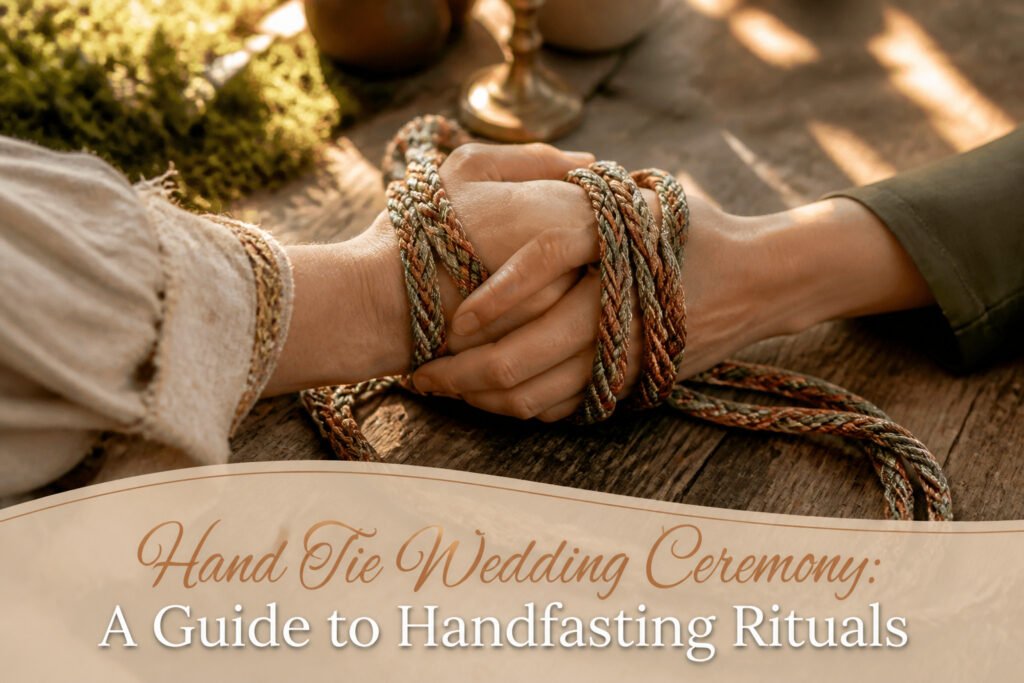
A hand tie wedding ceremony is a wedding ritual in which a couple’s clasped hands are wrapped and bound with a cord or ribbon to symbolize their union.
The binding has no legal force on its own; a marriage license and legal officiation are still required for the marriage to be recognized.
Most ceremonies use a cord at least a yard long, looped in a figure-eight pattern around the joined hands.
Setting Up
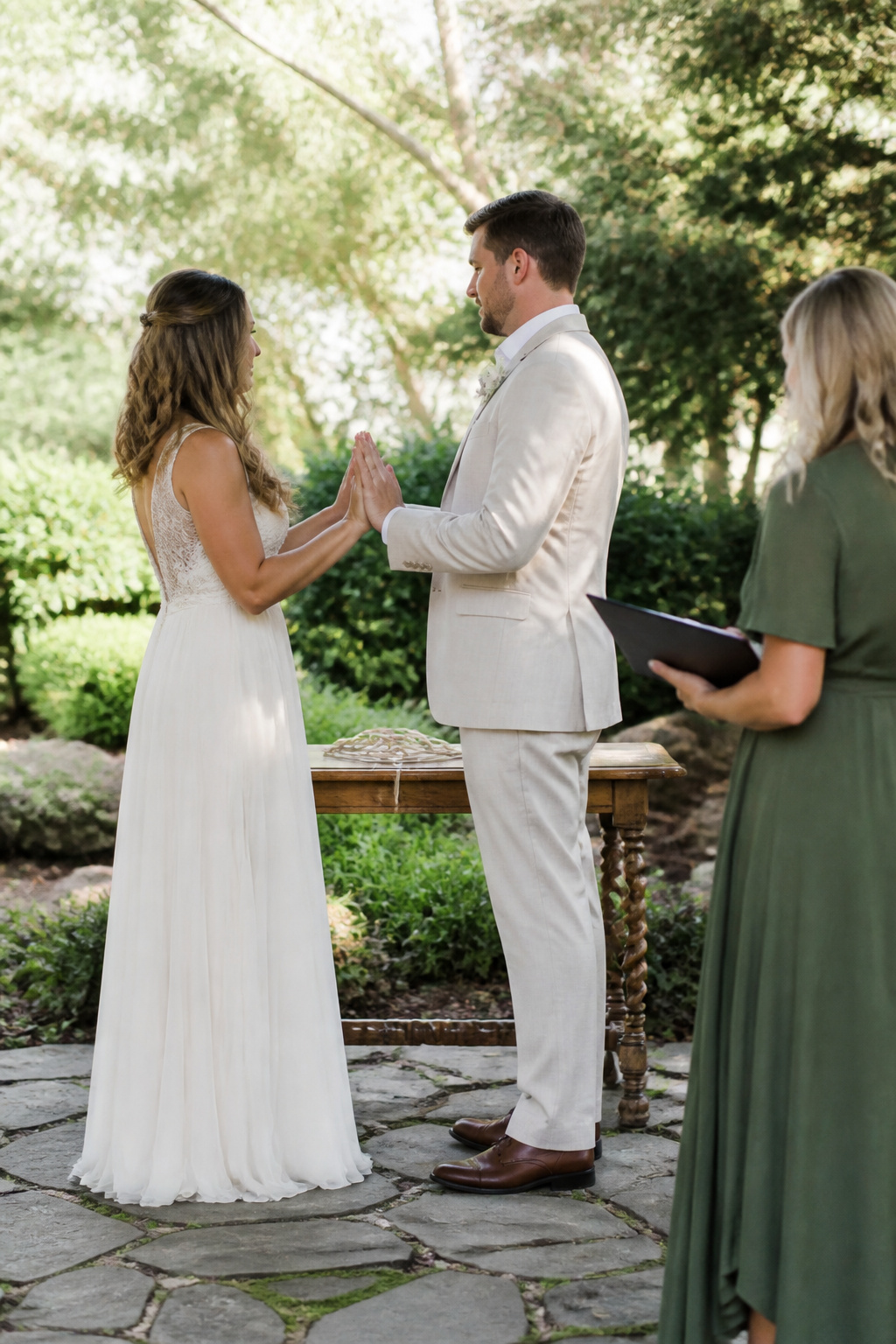
The couple stands facing each other, right hand to right hand and left hand to left hand, so their palms press together and fingers interlace naturally.
This crossed grip keeps both wrists at roughly the same height and leaves enough space between the forearms for the cord to pass through cleanly.
The officiant or a designated person should stand slightly to one side, the cord uncoiled and ready, so the wrapping can begin without fumbling or breaking the moment.
Weight settles evenly on both feet, shoulders soft, arms relaxed enough that the binding does not have to fight stiff muscles.
Some pairs prefer to look at each other; others drop their gaze to their hands to watch the cord take shape. Either works, but deciding beforehand saves a small hesitation that can throw off the rhythm of the ritual.
The stance matters less than the agreement to hold still: a sudden shift mid-wrap tangles the cord and turns symbolism into a brief comedy.
Binding the Hands
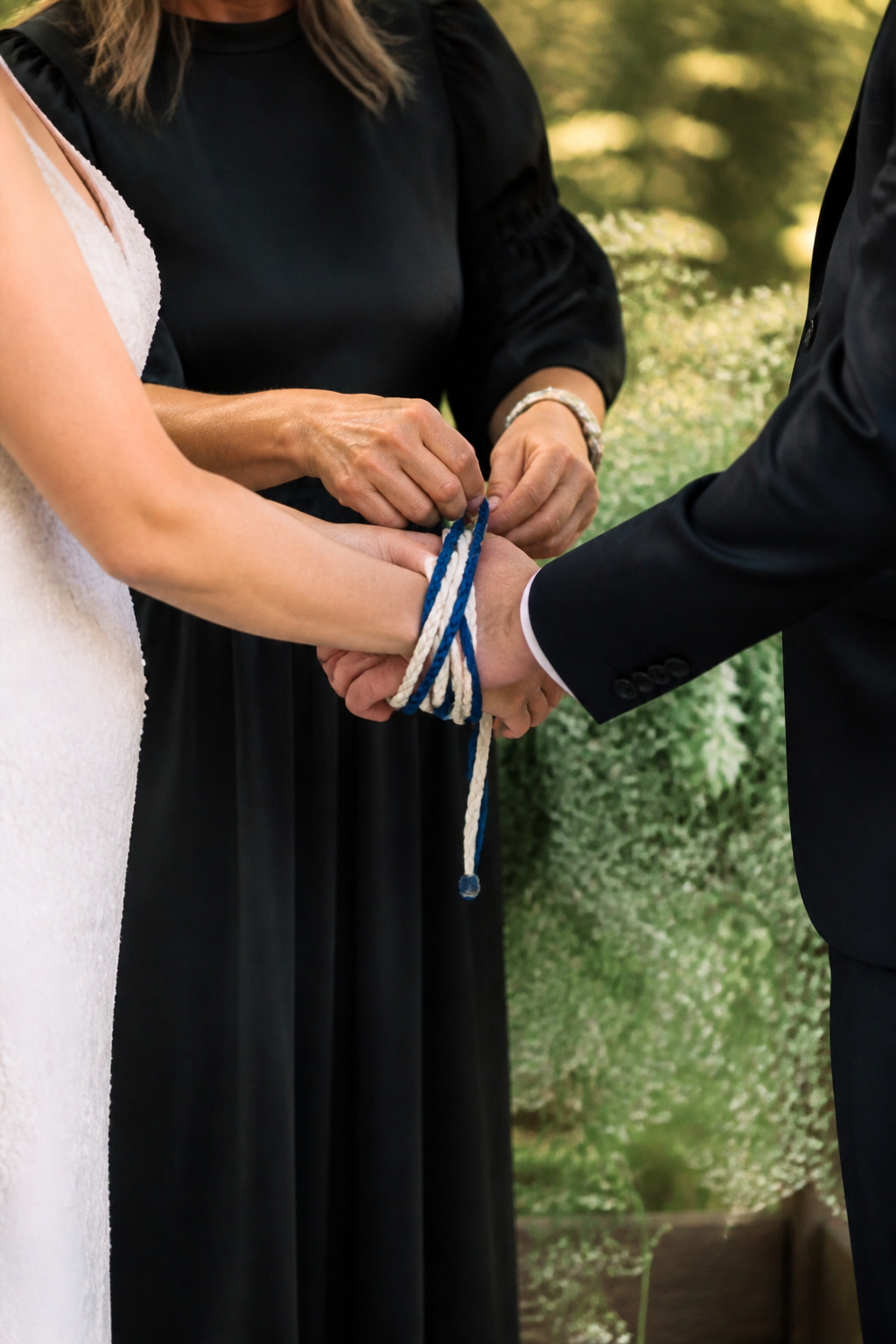
The couple stands facing each other, right hand to right hand and left hand to left, so their wrists and pulses touch. Someone chosen beforehand, usually the officiant or a close friend, takes the cord and begins the wrap.
The material needs to be over a yard long to allow for multiple passes without running short.
Most ceremonies use a single cord looped in a figure-eight pattern around the clasped hands, repeated three, six, or nine times. Each wrap crosses over and under in an infinity shape that sits flat against the skin.
Alternatively, you can drape a separate ribbon for each question or vow and tie them together at the end, though that takes more rehearsal to keep from tangling.
The final loop should be tied loosely enough that the couple can slip their hands out afterward while the knot itself stays intact. That takes practice.
I have watched a celebrant fumble with a too-short ribbon and have to start over mid-ceremony; the guests saw the panic before the couple did.
Rehearse the full sequence once, standing where guests can actually see, so you know exactly how much cord each wrap consumes and where to position yourself for the last tie.
Vows During the Binding
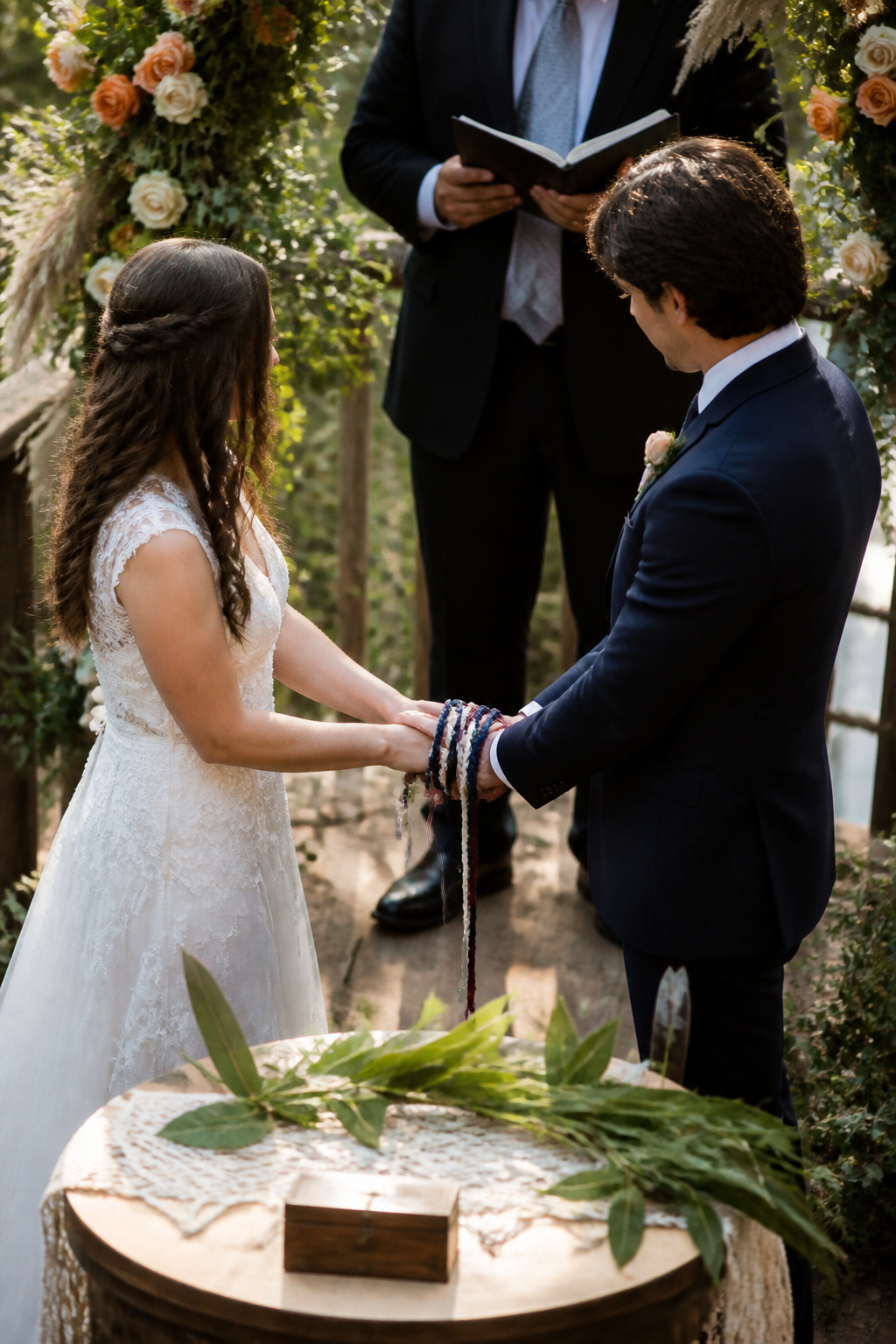
Most couples speak their vows while the cord is being wrapped, not before or after. The timing matters because the physical binding and the spoken promise become one act; your hands are literally tied as you make the commitment.
An officiant might lay a ribbon across your joined hands and invite you to speak a line for each one, or the tying might continue silently while you finish your full vows and the final knot gets set only after the last word.
Who speaks is flexible. The officiant can keep things moving with a short framing speech, then step back while the couple reads personal promises they wrote.
Some pairs prefer the officiant to carry the words entirely. Others skip spoken vows and let a song or a poem do the work during the wrapping.
Writing your own vows for this moment works best when the lines are short enough to speak between pulls of the cord.
One source suggests pairing each ribbon with a single binding promise: "With this ribbon, I bind my life to yours." That approach keeps the rhythm of the ritual intact.
If you want fuller personal vows, the knot can wait until you finish, though the crowd of hands and cord demands you keep it brief.
Unbinding or Keeping the Tie
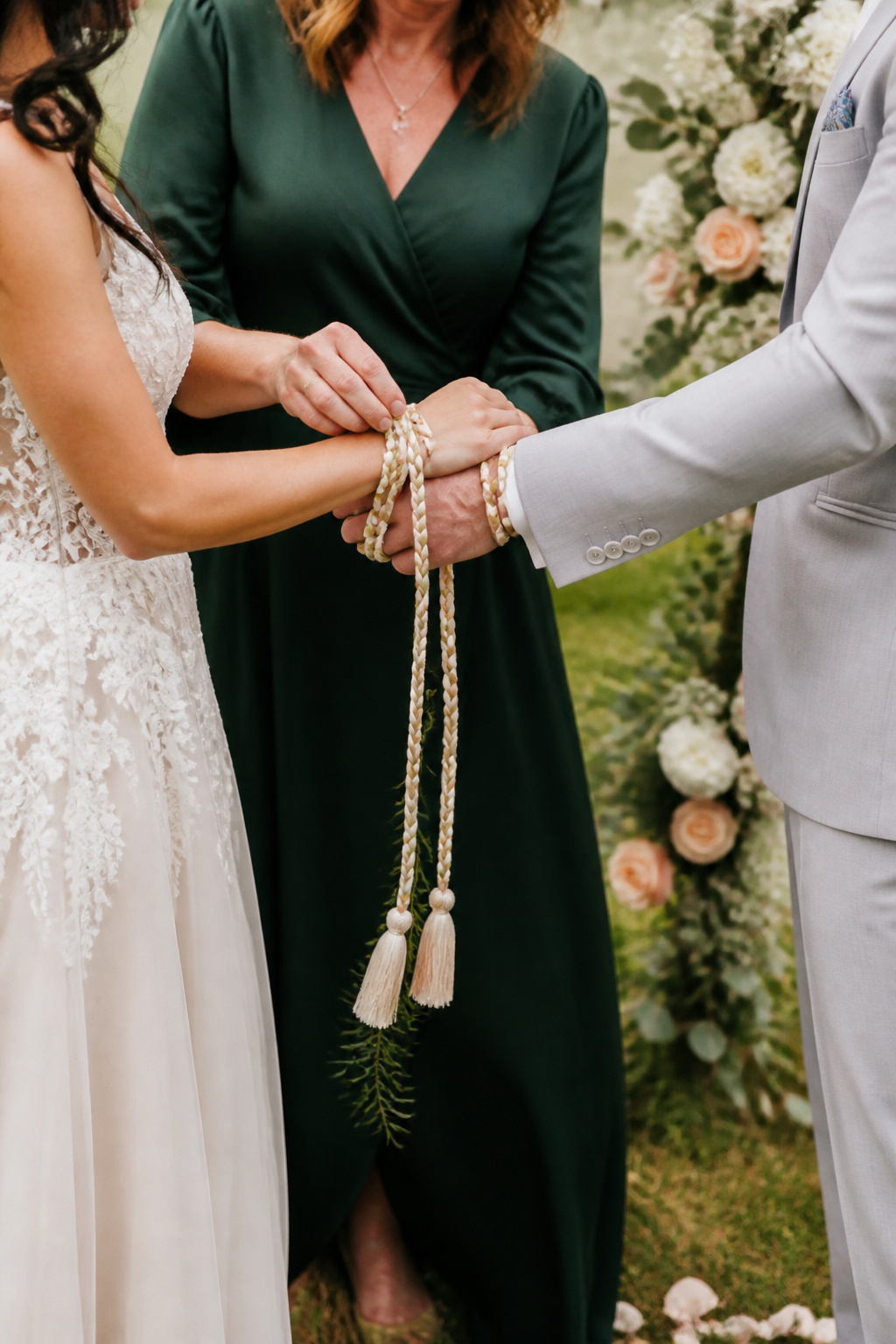
The moment the last knot is tied, someone has to decide what happens next. Leave the cord on your joined hands or slip it free before the ring exchange; either choice changes the flow of everything that follows.
Keeping the binding in place turns the ring exchange into a deliberate, two-person maneuver.
Whoever is placing the ring must thread it past the cord or work it over a bound wrist, which sounds awkward until you realize it is the point: the gesture becomes slow and watched, not automatic.
The cord stays on through the declaration of marriage and is only removed after you step back from the altar, ideally by the same person who tied it.
That person should know in advance they are not finished when the knot goes in.
Unbinding immediately after the vows frees your hands for the rest of the ceremony.
The officiant or the cord-keeper loosens the knot while a brief word is spoken about release being part of commitment, or about promises held lightly enough to grow. Rings then slide on the way they always have.
This path fits better if your ceremony stacks several traditions back-to-back and you worry about momentum sagging.
I have seen both go wrong from poor staging, never from the choice itself. A couple who kept their binding on had not rehearsed ring placement; the groom fumbled for twenty seconds that felt like two minutes.
Another pair unbound too quickly, and the cord-keeper had nowhere to set the loops, so she clutched them through the entire ring exchange like a forgotten prop.
Decide beforehand, tell your people, and place a small table or the officiant’s book where the cord can rest.
The Keepsake Cord
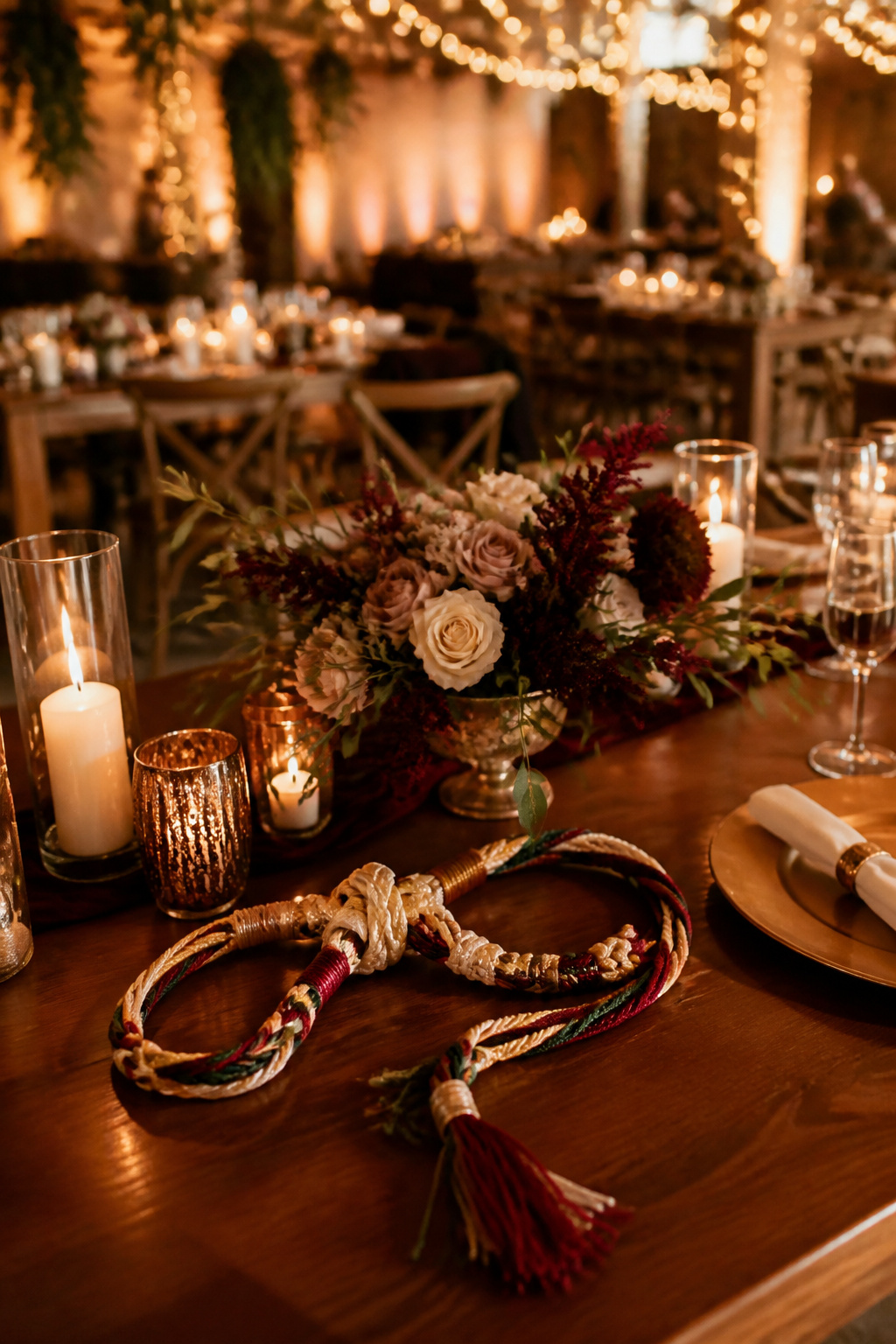
The cord from a hand tie wedding ceremony rarely gets tucked in a drawer if the couple thinks about it before the officiant asks for it back.
A yard-long ribbon, rope, or strip of family tartan is light enough to drape across the sweetheart table during the reception, where guests who missed the ritual can still see the evidence.
Afterward it graduates to wall status: framed flat, layered in a shadow box beside a print from the ceremony, or coiled in a glass-fronted box that keeps dust off the fibers.
Shadow boxes win for longevity because they protect the cord from light and handling while leaving the knots and wraps visible.
Some couples treat the material as a working object rather than a relic.
A cord made from meaningful fabric, say a grandmother’s veil ribbon, can be re-tied on anniversaries or laid across the marriage bed on New Year’s Eve, which turns the single-use ritual into something the couple continues to handle.
Decide the night before the wedding where the cord will live afterward, because a cord dropped in a bag on the venue floor tends to stay there.
Materials and Colors
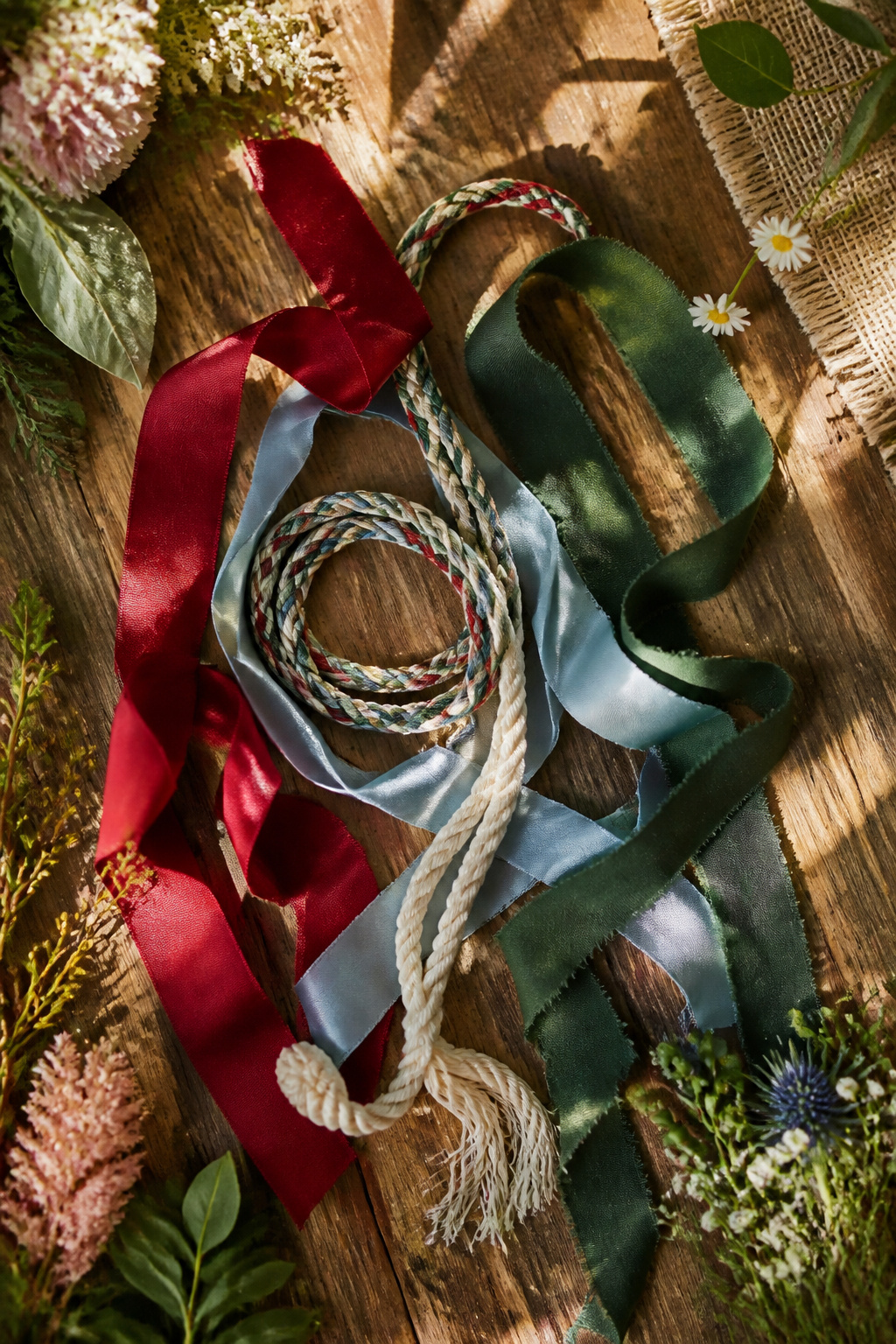
The material you choose for a hand tie wedding ceremony sets the tone more than most couples realize at first.
Ribbons, cords, or cloths all work, and the choice is less about tradition than about what the object already means to you.
- Braided rope is the most traditional option, and easiest to find in lengths that drape well around joined hands.
- Ribbons or cords let you assign a specific meaning to each color: red for passion, blue for loyalty, green for prosperity, and gold for unity. A single cord works if you want one symbol; multiple strands let you build a small braid of intentions as the officiant speaks.
- Family fabrics carry weight no store can replicate. A strip from a grandmother’s wedding veil, a father’s necktie, or a family tartan turns the binding into something that existed before your story started.
- Meter-long cords are the typical working length, enough to wrap and knot without awkward tugging.
Color meanings are a guide, not a rule.
Some couples pick hues that match the wedding palette; others choose shades that map to people they want named in the moment, like a cord for a child or a parent woven in.
The officiant can usually braid multiple ribbons as they speak, which keeps the ritual moving and gives you something solid to keep afterward.
Involving Family and Friends

The moment a hand tie wedding ceremony becomes communal is when someone other than the officiant steps forward to bind the couple’s hands.
Family members or friends can tie the knots themselves, which carries a weight no script can match: the physical act of blessing the marriage, not just witnessing it.
Children of the couple might tie a figure-eight knot with their own binding material, turning two people into one family unit in front of everyone gathered.
Give each participant a script beforehand so the gesture stays graceful under pressure. One person presenting the cords while another ties keeps the roles clean; two people tying simultaneously works if they have rehearsed the overlap.
The materials themselves can come from the guests: ribbons saved from the wedding invitations, a cord dyed in a family color, a strip of fabric from a grandmother’s dress. Whoever presents these speaks a few words, or none at all.
Silence is its own kind of participation.
The risk is clutter. More than three people at the couple’s side, and the geometry of hands and cords turns awkward.
Better to choose significance over numbers: the friend who introduced them, the sibling who steadied an early fight, the parent whose own marriage they hope to echo. Assign the role for the story it tells, not the obligation it satisfies.
Cultural Variations
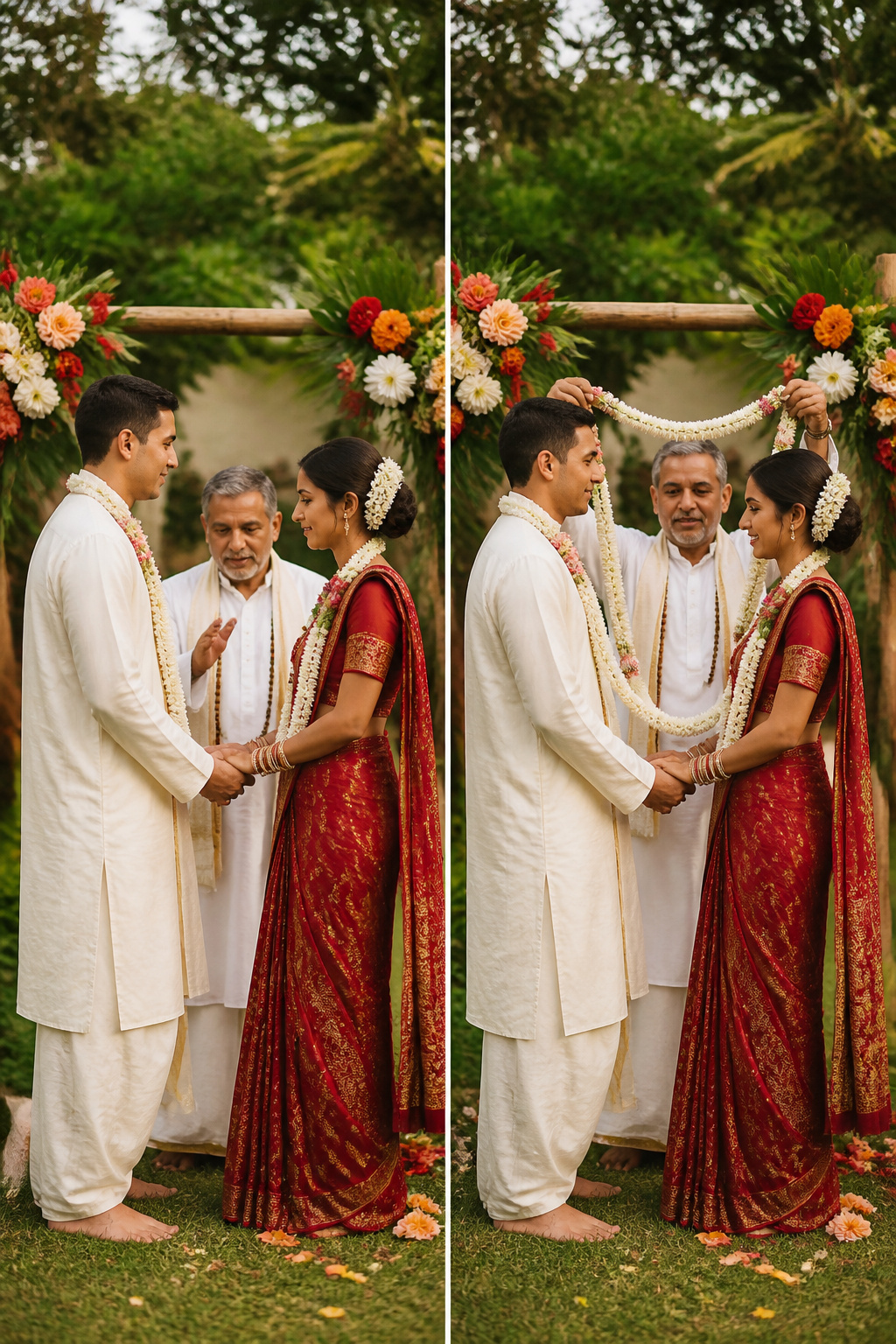
A hand tie wedding ceremony is not the only ritual that binds two people with a physical cord.
Hispanic wedding traditions include the lasso ceremony, where a floral rope or rosary looped in a figure eight is draped over the couple’s shoulders to symbolize their unity.
The granthibandhan in Hindu weddings ties a knot between the bride’s and groom’s clothing, anchoring them together as they take their vows around the sacred fire.
The mechanics differ: the lasso encircles both partners from above, while granthibandhan joins them side by side at the cloth.
Couples from blended backgrounds can borrow the gesture without misappropriating the full religious context. A Hispanic-Irish couple might weave a floral lasso into their handfasting rather than claiming either tradition wholesale.
Fusion works best when you name what you are doing and why.
If you reference granthibandhan, explain to guests that you are honoring the bride’s heritage through the act of binding, not performing a Hindu ceremony you have not been raised in.
What Handfasting Means

A handfasting ceremony binds a couple’s joined hands with a cord or ribbon, a physical act meant to symbolize the joining of two lives into one. The ritual has no legal force on its own.
A wedding that includes handfasting still requires a marriage license and an ordained officiant to be recognized under law, and the couple must still speak the declaration of intent and hear the legal pronouncement.
The phrase "tying the knot" likely grew from this exact gesture. Sources trace the custom back roughly 2,000 years to Norse and Scottish practice, where the Old Norse handfesta meant striking a bargain by joining hands.
In medieval and Tudor England, the ritual carried enough weight that it was sometimes treated as a legally binding commitment, a temporary marriage contract that could later be formalized or dissolved. That legal status has not survived.
Today a handfasting sits alongside other symbolic elements, a visual moment of commitment rather than the commitment itself.
Couples sometimes hold a handfasting alone, without any legal paperwork, as a personal or spiritual pledge. Others weave it into their licensed wedding ceremony as one layer among many.
The freedom to choose is the point.
Where Handfasting Comes From

The hand tie wedding ceremony reaches back roughly 2,000 years to Celtic and Pagan practice, where a druid bound the couple’s hands to mark a trial marriage lasting a year and a day.
Either partner could walk away during that year; if both stayed, the marriage became permanent at its end. This is where "tying the knot" actually comes from, not from the church aisle but from the literal cords.
The ritual survived in Scottish and Irish weddings, spread through Norse and Viking custom as a mark of loyalty, and carried into Wiccan and neopagan observance.
What began as engagement or probation shifted to the wedding itself once civil and religious registration took over the legal work.
Today most couples who include it treat the binding as the spiritual heart of the ceremony rather than a waiting period, a way to signal intention without replacing the license.
"Its roots are in ancient Celtic and Pagan traditions… a couple had their hands bound together by a druid so they were tied to each other for a year as a sort of trial marriage—essentially a modern engagement."
— Vogue
That year-and-a-day structure is long gone for almost everyone, but the visual remains: two hands, one cord, a public promise made with the body and not just the voice.
Modern Adaptations
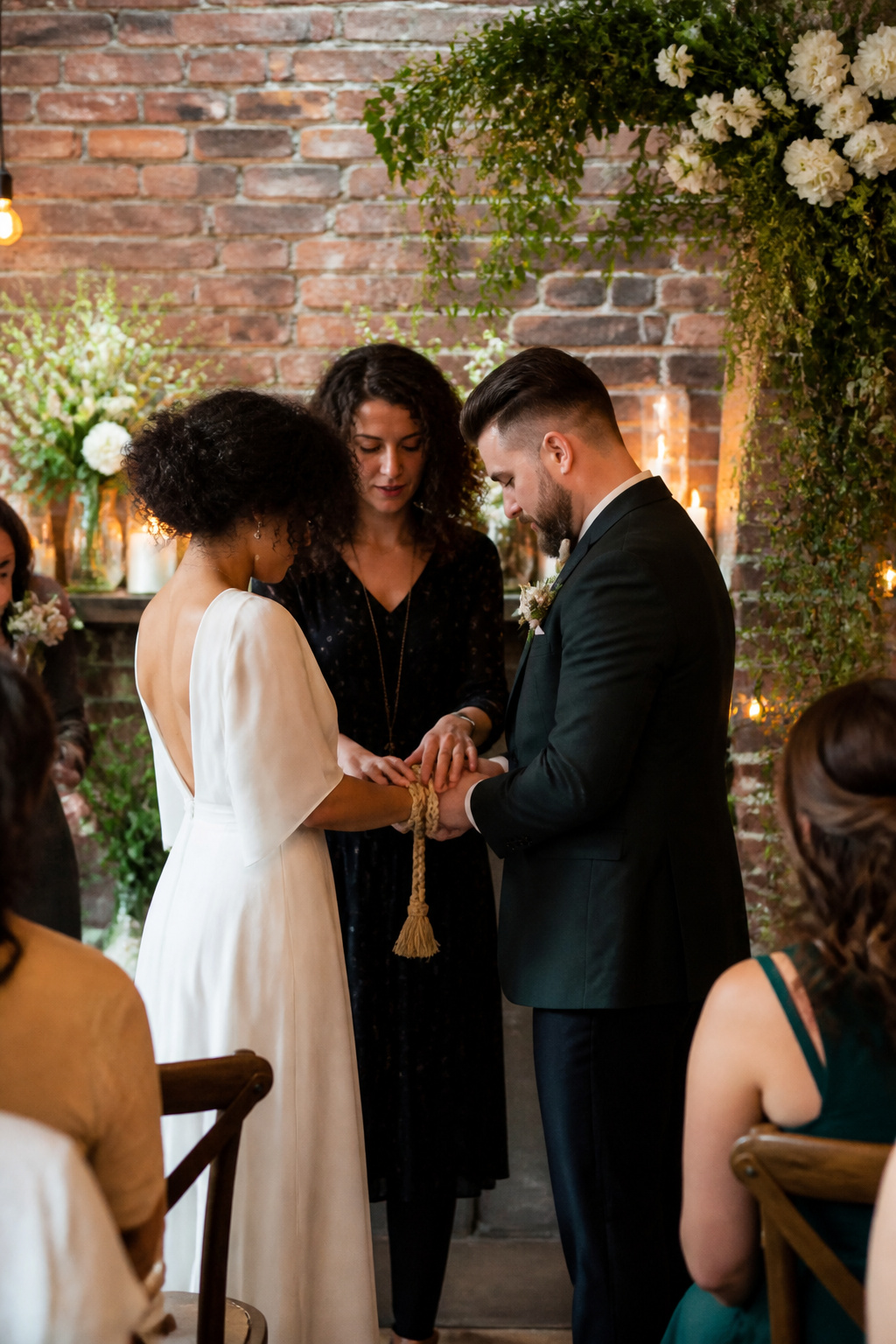
A hand tie wedding ceremony now shows up in weddings that would have looked nothing alike a generation ago.
I have seen it folded into Pagan celebrations, stripped down for secular city hall pairings, and used as the emotional center of a multicultural service where two families each bring their own words to the binding.
The cords themselves carry the personalization: a couple might braid in thread from a grandmother’s sari, or choose six colors that map to six shared years.
Children can tie a figure-eight knot with their own binding material, which shifts the ritual from a promise between two people to a visible knot that holds a whole family.
Timing is flexible, and the flexibility matters more than most couples expect. The handfasting can sit before the ring exchange, where it frames the vows that follow, or after it, where the binding becomes the seal rather than the preamble.
Some pairs build their spoken promises into the knot-tying itself; others keep the words and the gesture separate so each has its own weight.
A vow renewal years later can add a second binding without replacing the first, which is the kind of detail that makes the ritual feel like a continuing sentence rather than a single punctuation mark.
Frequently Asked Questions
Is a handfasting ceremony legally binding?
No. A hand tie wedding ceremony is purely symbolic and carries no legal force on its own.
You still need a marriage license and an ordained officiant who pronounces you married for the union to be recognized under United States law.
What do the ribbons or cords represent?
Each color or material holds its own meaning. Couples often assign red to passion, blue to loyalty, green to prosperity, and gold to unity, though you can choose family fabrics like a grandmother’s veil ribbon or a tartan instead.
Pick something that already matters to you instead of following a fixed rule.
Can we write our own handfasting vows?
Yes, and many couples do. Keep the lines short enough to speak between pulls of the cord so the rhythm of the ritual stays intact.
If you want longer personal vows, finish speaking before the final knot goes in, since bound hands and a crowd of cords make brevity practical.
Is handfasting a legal marriage in the US?
No. Handfasting does not create a legal marriage in any American state. It functions as a symbolic layer within or alongside a legally binding ceremony that includes the required declaration of intent and officiant pronouncement.
What do you say during a handfasting ceremony?
Most couples speak their vows while the cord wraps around their hands, turning the physical binding and spoken promise into one act.
An officiant might invite a short line per ribbon, or the tying continues silently while you finish full vows and the knot sets only after the last word.
Some pairs skip spoken words entirely and let music or a poem carry the moment.
Can Christians do a handfasting ceremony?
Yes. The ritual has no inherent religious affiliation and appears in secular, Pagan, multicultural, and Christian weddings alike.
A couple chooses the words and context that fit their own beliefs.
How long does a handfasting marriage last?
In ancient Celtic practice, a handfasting marked a trial marriage of a year and a day, after which the couple could separate or make it permanent.
That structure is long gone; today the binding serves as a symbolic moment within a wedding or vow renewal, not a temporary contract.